Mastering 9th Grade Kinematics
Displacement and Distance
Position, Distance, and Displacement
Before we can talk about motion, we need to know where something is. In physics, an object's position is its location relative to a reference point, or origin. Think of a straight road stretching east and west. If we call your house the origin (position 0), the shop 3 kilometres east is at position +3 km, and the park 2 kilometres west is at position -2 km. Position isn't just a number; it includes a direction.
Now, let's get moving. Imagine you walk from your house to the shop, then turn around and walk to the park. How far did you walk in total? You walked 3 km to the shop, and then 5 km to get to the park (3 km back to your house, plus 2 more km to the park). The total ground you covered is 8 km. This is the distance.
Distance
noun
The total path length covered by a moving object. It is a scalar quantity, meaning it only has magnitude (a numerical value) and no direction.
But where did you end up relative to where you started? You started at your house (position 0) and finished at the park (position -2 km). Your change in position is 2 km to the west. This is your displacement.
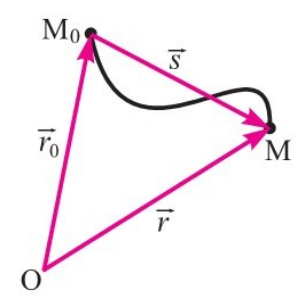
Displacement is the shortest straight-line path from the starting point to the ending point, including the direction.
Displacement
noun
The change in an object's position. It is a vector quantity, meaning it has both magnitude and a direction.
A Practical Example
Let's make this more concrete. A delivery van starts at its depot (position 0). It drives 10 km east to make a delivery, then turns around and drives 15 km west to make a second delivery. What is the total distance travelled and what is the final displacement?
The total distance is simple. It's the sum of the individual paths: 10 km + 15 km = 25 km.
For displacement, we need to consider the start and end points. The van starts at 0. It travels 10 km east, so its position is +10 km. Then it travels 15 km west. From +10 km, moving 15 km west puts it at -5 km. Its final position is 5 km west of the depot.
Distance travelled: 25 km. Final displacement: -5 km (or 5 km west).
Notice how different they are. The distance is always a positive number that accumulates, while displacement can be positive, negative, or even zero, and it only cares about the start and end points.
Using this formula for our van example: Initial position () = 0 km. Final position () = -5 km. Displacement () = -5 km - 0 km = -5 km.
Why This Matters
This distinction isn't just academic. Understanding the difference between distance and displacement is fundamental in physics. Concepts you'll encounter soon, like velocity and acceleration, are based on displacement, not distance. An object can move a great distance, but if its displacement is zero (like running a lap on a track), its average velocity is also zero. This is a key idea for accurately describing and predicting motion.
We need to make a distinction between the distance an object has traveled and its displacement, which is defined as the change in position of the object.
By grasping the roles of position, distance, and displacement, you've built a solid foundation for exploring the richer world of kinematics.
What is the key difference between distance and displacement?
A cyclist rides 5 km north, then turns around and rides 8 km south. What is the total distance travelled and their final displacement?