Mastering 6th Grade Mathematics
Factors and Multiples
The Building Blocks of Numbers
Every whole number greater than 1 is either prime or composite. A prime number has exactly two factors: 1 and itself. Think of 7. It can only be divided cleanly by 1 and 7. Nothing else works.
A composite number has more than two factors. Take 12. Its factors are 1, 2, 3, 4, 6, and 12. These are the numbers that can be multiplied together in pairs to make 12 (like or ). The number 1 is a special case, being neither prime nor composite.
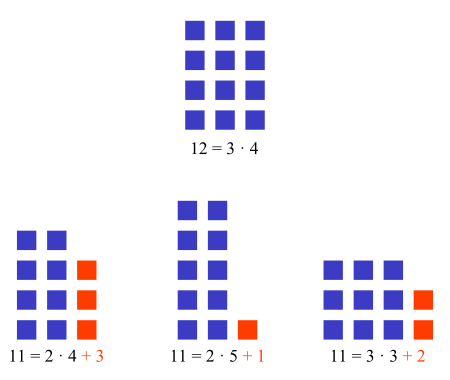
Understanding factors helps us explore the relationships between numbers. For instance, some numbers have a special property where the sum of their proper divisors (all factors except the number itself) equals the number. These are called perfect numbers, like 6, whose proper divisors (1, 2, and 3) add up to 6.
Divisibility Shortcuts
Instead of using division to find all the factors of a large number, we can use quick tests called divisibility rules. They're a fast way to check if one number can be divided by another without leaving a remainder.
| Divisible by... | The Test |
|---|---|
| 2 | The last digit is even (0, 2, 4, 6, 8). |
| 3 | The sum of the digits is divisible by 3. |
| 4 | The last two digits form a number divisible by 4. |
| 5 | The last digit is 0 or 5. |
| 6 | The number is divisible by both 2 and 3. |
| 8 | The last three digits form a number divisible by 8. |
| 9 | The sum of the digits is divisible by 9. |
| 10 | The number ends in 0. |
| 11 | The difference between the sum of the odd-placed digits and the sum of the even-placed digits is 0 or divisible by 11. |
Let's test the number 540. It ends in 0, so it's divisible by 2, 5, and 10. The sum of its digits is $5+4+0=9$, so it's divisible by 3 and 9. Since it's divisible by 2 and 3, it's also divisible by 6. The last two digits, 40, are divisible by 4. That’s a lot of information without a single calculation.
Breaking Numbers Down
Every composite number can be broken down into a unique product of prime numbers. This is its prime factorisation. The Fundamental Theorem of Arithmetic states that this prime 'fingerprint' is unique for every number, no matter how you find it. The most common way to do this is with a factor tree.
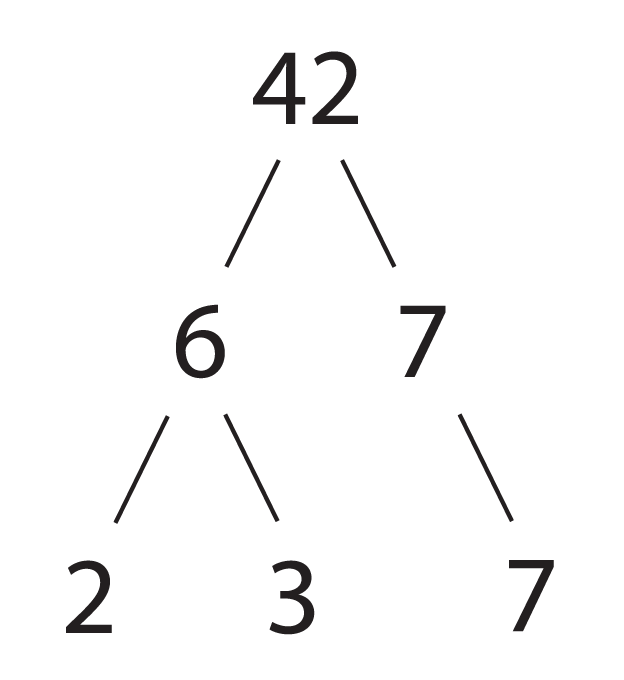
To factorise 42, you might start by splitting it into . Since 7 is prime, that branch is done. The number 6 is composite, so you split it again into . Both 2 and 3 are prime, so you stop. The prime factors are the numbers at the ends of the branches: 2, 3, and 7. So, the prime factorisation of 42 is .
Finding Common Ground
Prime factorisation is incredibly useful for finding the Highest Common Factor (HCF) and the Least Common Multiple (LCM) of two or more numbers. The HCF (also called the Greatest Common Factor or GCF) is the largest number that divides into all of the numbers in a set. The LCM is the smallest number that is a multiple of all numbers in the set.
Let's find the HCF and LCM of 12 and 18.
First, find their prime factorisations:
To find the HCF, you multiply the lowest power of each prime factor that is common to both numbers. Both have a 2 and a 3. The lowest power of 2 is and the lowest power of 3 is . So, the HCF is .
To find the LCM, you multiply the highest power of every prime factor present in either number. The highest power of 2 is and the highest power of 3 is . So, the LCM is .
This method works for any pair of numbers. While prime factorisation is reliable, for very large numbers, mathematicians often use a more efficient method called the to find the HCF without factoring.
Putting It to Work
These concepts are not just abstract. They solve real-world problems.
HCF Problem: You have 24 chocolate bars and 36 packets of crisps. You want to create identical snack bags for a party, with no items left over. What is the largest number of snack bags you can make?
This is an HCF problem because you're dividing items into the largest possible identical groups. We need the HCF of 24 and 36. The HCF is . You can make 12 identical snack bags.
LCM Problem: A red bus leaves a depot every 20 minutes, and a blue bus leaves every 25 minutes. If they both leave at 9:00 AM, when will they next leave the depot at the same time?
This is an LCM problem because you are looking for the next time their schedules align. We need the LCM of 20 and 25. The LCM is . They will next leave together after 100 minutes, which is 1 hour and 40 minutes. So, they will depart at the same time at 10:40 AM.
Let's review these core concepts.
Now, test your understanding.
Which of these statements correctly describes the number 1?
What is the correct prime factorisation of 36?
Understanding how numbers are built from primes is a fundamental skill. It forms the basis for working with fractions, solving algebraic equations, and even securing data online.