Mastering 5th Grade Math Concepts
Fractions and Decimals
Handling Different Denominators
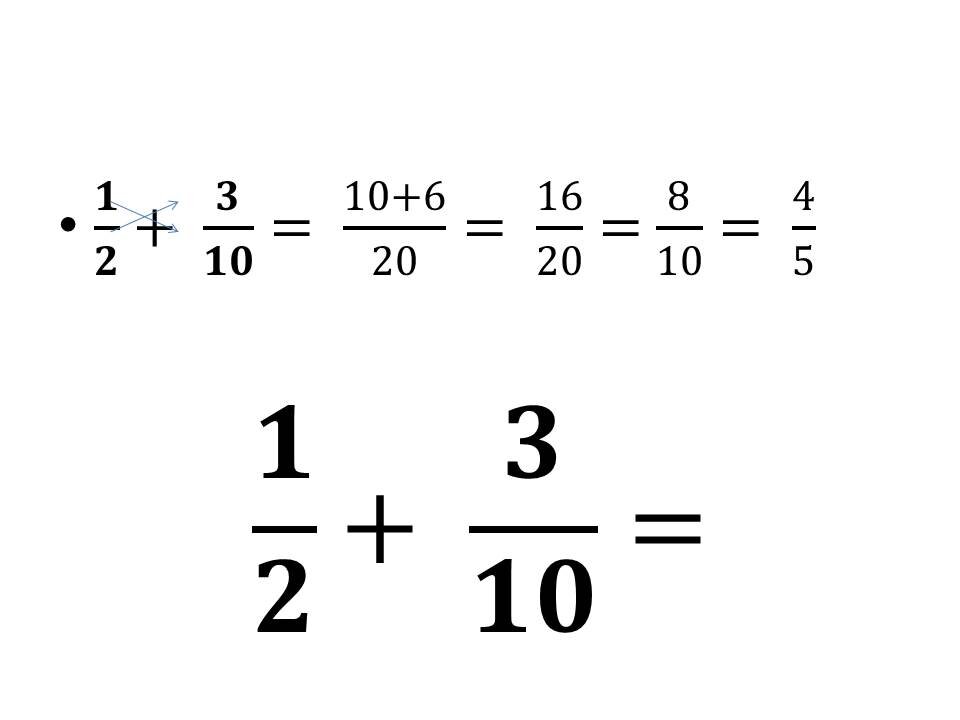
Adding or subtracting fractions with different denominators is like trying to add apples and oranges. Before you can combine them, you need to find a common unit. For fractions, this means finding a common denominator.
The easiest way to do this is to find the least common denominator (LCD), which is the smallest number that both denominators can divide into evenly. The LCD is simply the least common multiple (LCM) of the denominators.
Imagine you have half of a pizza and a friend has a third of another pizza. To figure out how much pizza you have together, you can't just add the tops and bottoms. You need to slice both pizzas into equal-sized pieces—in this case, sixths.
Let's try adding and . The denominators are 4 and 8. The smallest number that both 4 and 8 divide into is 8. So, our LCD is 8.
The fraction already has the right denominator. We just need to convert . To turn 4 into 8, we multiply by 2. To keep the fraction's value the same, we must also multiply the numerator by 2.
Now that both fractions have the same denominator, we can add their numerators.
Subtraction works the same way. For , the LCD is 15. We convert both fractions, then subtract the numerators.
Multiplying and Dividing Fractions
Multiplying fractions is more straightforward—no common denominators needed. You simply multiply the numerators together and the denominators together.
Dividing fractions involves one extra step. You flip the second fraction upside down—this is called finding its reciprocal—and then multiply.
Working with Decimals
Decimals are essentially fractions with denominators of 10, 100, 1000, and so on. The number 0.789 is read as "seven hundred eighty-nine thousandths," which is the same as .
When comparing decimals, like 0.65 and 0.7, start from the left. In the tenths place, 7 is greater than 6, so 0.7 is greater than 0.65. You can also think of them as 0.70 and 0.65 to make the comparison clearer.
| Place Value | Tenths | Hundredths | Thousandths |
|---|---|---|---|
| Decimal | 0.1 | 0.01 | 0.001 |
| Fraction |
Adding and subtracting decimals is all about lining up the decimal points. This ensures you're adding tenths to tenths and hundredths to hundredths.
  12.34
+  5.6
-------
  17.94
For multiplication, multiply the numbers as if they were whole numbers, and then count the total number of decimal places in the original numbers. Your answer will have that many decimal places.
To multiply , first calculate . Since has one decimal place and has two, the answer must have a total of three decimal places. So, the result is 0.036.
When dividing decimals, if the divisor (the number you're dividing by) is a decimal, move its decimal point to the right until it's a whole number. Then, move the decimal point in the dividend (the number being divided) the same number of places to the right. Now, you can divide as usual.
Bridging Fractions and Decimals
Since fractions and decimals are just two ways of showing parts of a whole, you can convert between them.
To turn a fraction into a decimal, divide the numerator by the denominator. For example, becomes .
To turn a decimal into a fraction, use its name. The decimal 0.8 is "eight tenths," which you can write as . Then, simplify the fraction if possible. In this case, simplifies to .
Here's a word problem to see these skills in action. You're baking cookies and the recipe calls for cups of flour. You only have a measuring cup that holds of a cup. How many scoops will you need?
First, convert the decimal to a fraction. is "one and one-half," or . Now, you need to find out how many cups are in cups. This is a division problem.
Time to test your knowledge on these concepts.
What is the first step when adding or subtracting fractions with different denominators, like and ?
Solve the following:
Mastering these operations is a key step in becoming comfortable with more advanced math.