Mastering 12th Grade Modern Physics
Dual Nature of Light
Light's Double Life
For centuries, we thought of light as a wave. It ripples, spreads out, and interferes with itself, just like waves in a pond. This wave model perfectly explained phenomena like diffraction and interference. But at the turn of the 20th century, a new experiment revealed a completely different side to light's personality.
The mystery began with a simple observation: when you shine light on a metal surface, it can knock electrons loose. This process is called the photoelectric effect. To study it, scientists set up an experiment with a metal plate (the emitter) and another plate (the collector) inside a vacuum tube.
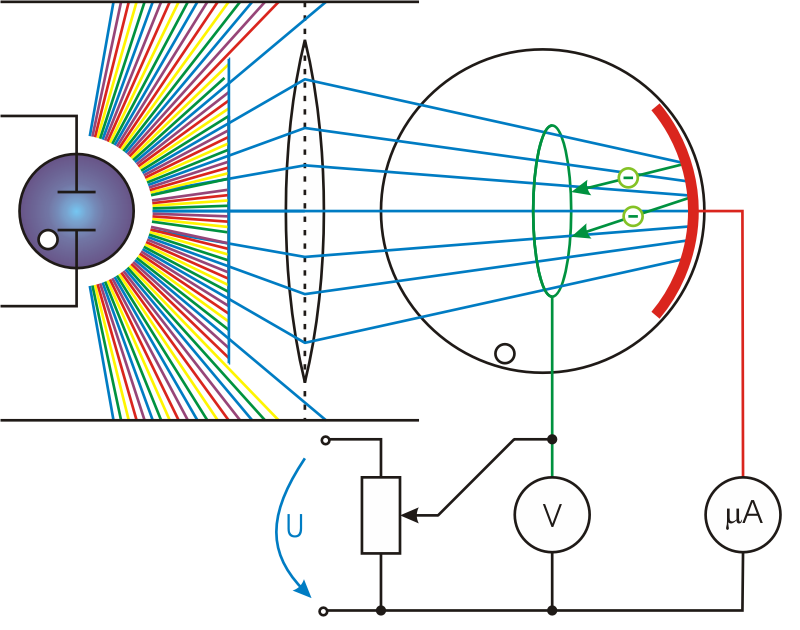
When light hits the emitter plate, it ejects electrons, which then travel to the collector plate, creating a measurable electric current. By changing the intensity and colour (frequency) of the light, physicists hoped to confirm the wave theory. Instead, they found a series of results that were completely baffling.
The Wave Theory Fails
Classical wave theory made some clear predictions about what should happen. A brighter light (higher intensity) is a more energetic wave, so it should eject electrons with more kinetic energy. Also, a dim light should take some time to build up enough energy to kick an electron out. The experiments showed the exact opposite.
| Observation | Wave Theory Prediction | Experimental Result |
|---|---|---|
| Intensity | Higher intensity means higher electron kinetic energy. | Higher intensity means more electrons, but their energy is unchanged. |
| Frequency | Frequency of light should not affect electron kinetic energy. | Below a certain threshold frequency, no electrons are emitted at all. |
| Time Lag | A dim light should have a time delay before electrons are emitted. | Electrons are emitted instantaneously, even with very dim light. |
These contradictions were a major crisis for physics. The wave model, which worked so well for so long, simply could not explain the photoelectric effect. Something was fundamentally wrong with our understanding of light.
Einstein's Quantum Leap
In 1905, Albert Einstein proposed a radical solution. He suggested that light isn't a continuous wave, but is instead composed of discrete packets of energy he called "light quanta," which we now call photons. Each photon carries a specific amount of energy that depends only on its frequency.
Photon
noun
A discrete particle, or quantum, of electromagnetic radiation. A photon has zero rest mass and carries a fixed amount of energy.
Einstein's idea was that the photoelectric effect is a one-to-one interaction: one photon hits the metal and transfers all its energy to one electron. If the photon has enough energy to overcome the forces holding the electron to the metal, the electron is ejected. The minimum energy required to free an electron is called the work function (), and it's a property of the specific metal.
This simple equation brilliantly explained all the experimental mysteries.
- Threshold Frequency: An electron is only ejected if the photon's energy is greater than the work function (). If not, nothing happens, no matter how bright the light is. This explains why there's a minimum, or threshold, frequency.
- Instant Emission: The energy transfer is instantaneous. If the photon has enough energy, the electron is knocked out immediately. There's no waiting for energy to build up.
- Energy vs. Frequency: The kinetic energy of the electron depends directly on the photon's frequency (). A higher frequency means a more energetic photon and a faster electron.
- Intensity vs. Current: A brighter light simply means more photons are hitting the metal per second. This ejects more electrons, resulting in a higher current, but the maximum energy of any single electron remains the same.
Stopping the Electrons
We can measure the maximum kinetic energy of the photoelectrons by applying a reverse voltage, called the stopping potential (). This voltage creates an electric field that pushes the electrons back. When the voltage is just high enough to stop even the fastest electrons from reaching the collector, the current drops to zero.
By combining this with Einstein's equation, we get a direct link between the stopping potential and the frequency of the light: . This predicts a straight-line graph if you plot stopping potential versus frequency, a result that has been confirmed by countless experiments.
The photoelectric effect proved that light, which we knew behaved as a wave, also acts like a particle. Each photon has no rest mass, always travels at the speed of light, and carries not just energy, but also momentum.
This dual nature, where something can exhibit both wave-like and particle-like properties, is a central concept in quantum mechanics. It doesn't just apply to light; it applies to all matter, including electrons, protons, and even you. The associated wavelength, known as the , is just too small to notice for large objects.
The classical wave theory of light failed to explain the photoelectric effect. Which of the following experimental observations was a major contradiction to the theory?
To explain the photoelectric effect, Albert Einstein proposed a revolutionary idea in 1905. What was the core of his proposal?
The photoelectric effect was a crucial turning point. It challenged a century of classical physics and opened the door to the strange and wonderful world of quantum mechanics, forcing us to accept the strange reality that light leads a double life.