Master Your Sleep for Peak Performance
Understanding Sleep Basics
The Architecture of Sleep
Sleep isn't just an on/off switch. It's an active, highly structured state that your brain cycles through every night. Think of it less like powering down a computer and more like running a series of essential maintenance programs. This nightly process is broadly divided into two main types: NREM (Non-Rapid Eye Movement) sleep and REM (Rapid Eye Movement) sleep.
NREM sleep is the deep, restorative part of the night. It's when your body repairs tissues, builds bone and muscle, and strengthens the immune system. REM sleep, on the other hand, is when your brain is highly active. This is the stage most associated with vivid dreaming, memory consolidation, and emotional processing.
Journey Through the Night
Throughout the night, you travel through these sleep stages in a predictable pattern called a sleep cycle. Each cycle lasts about 90 to 110 minutes and repeats several times.
NREM sleep itself has three distinct stages:
| Stage | Description |
|---|---|
| N1 | This is the lightest stage, a brief transition from wakefulness to sleep. Your breathing and heart rate slow down, and your muscles begin to relax. It's easy to be woken up during N1 sleep. |
| N2 | You spend about half your total sleep time in this stage. Your body temperature drops, and brain waves show specific bursts of activity called sleep spindles and K-complexes. This stage is important for memory consolidation. |
| N3 | This is deep sleep, also known as slow-wave sleep. It's very difficult to wake someone from N3 sleep. This is the most physically restorative stage, critical for growth and repair. |
After progressing through N1, N2, and N3, you'll briefly return to N2 before entering your first REM period. The first REM stage of the night is usually short, perhaps only 10 minutes. As the night goes on, however, the cycles change. You'll spend less time in deep N3 sleep and more time in REM sleep, with some REM periods lasting up to an hour near the morning.
Your Internal Clock
So what tells your body it's time to begin this nightly journey? The primary driver is your circadian rhythm, a natural, internal process that regulates the sleep-wake cycle and repeats roughly every 24 hours.
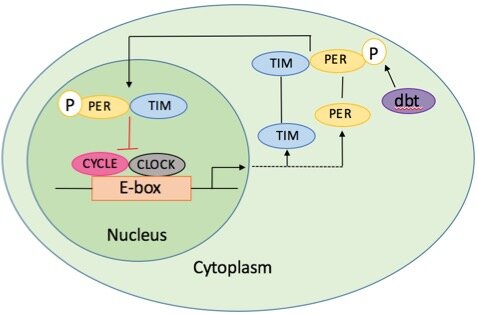
Think of it as a master clock in your brain. This clock, a tiny region in the hypothalamus called the Suprachiasmatic Nucleus (SCN), coordinates all the biological clocks throughout your body. The SCN is highly sensitive to light. When light enters your eyes, signals are sent to the SCN, which then interprets this as a sign to be awake and alert. As light fades in the evening, the SCN signals the pineal gland to start producing melatonin, the hormone that makes you feel sleepy.
The Biology of Sleepiness
While the circadian rhythm tells you when to sleep, another process determines how much you need to sleep. This is called sleep pressure, or sleep-wake homeostasis.
From the moment you wake up, a chemical called adenosine begins to build up in your brain. Adenosine is a byproduct of energy consumption in your cells. The longer you're awake, the more adenosine accumulates, and the higher your sleep pressure becomes. This mounting pressure is what creates the feeling of drowsiness.
Caffeine works by blocking adenosine receptors in your brain, which is why it makes you feel more alert. It doesn't get rid of the adenosine, though—it just prevents you from feeling its effects for a while.
During sleep, your brain clears away this adenosine. When you wake up, adenosine levels are at their lowest, and you feel refreshed. The two systems—the circadian clock and sleep pressure—work together. Your desire to sleep is strongest when sleep pressure is high and your internal clock is signaling for rest, typically late in the evening.
Now, let's test your understanding of these core sleep concepts.
What is the primary function associated with REM (Rapid Eye Movement) sleep?
Which chemical builds up in your brain the longer you are awake, creating a feeling of 'sleep pressure'?
Understanding this underlying biology is the first step to appreciating just how vital sleep is for your mind and body.