Master Your Schedule
Understanding Circadian Rhythms
Your Body's Internal Clock
Have you ever wondered why you start to feel sleepy around the same time each night, or why you naturally wake up in the morning, sometimes even before your alarm? The answer lies in your body's internal timekeeping system, known as your circadian rhythm.
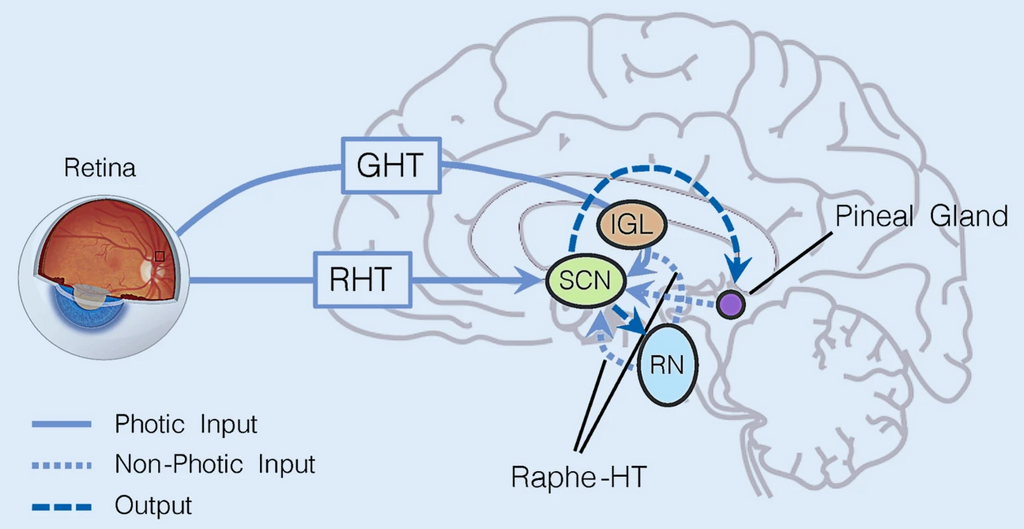
Your circadian rhythm is your body’s internal clock—a complex system synchronized primarily by light exposure, regulating nearly every biological function on a 24-hour cycle.
Think of it as a master clock in your brain that coordinates dozens of smaller clocks throughout your body. This system doesn't just manage your sleep-wake cycle. It also influences your body temperature, hormone release, appetite, and even your mood. These rhythms are generated internally, but they don't run in a vacuum. They are constantly being fine-tuned by cues from the world around you.
How Rhythms Drive Sleep
Two main forces work together to regulate when you sleep and when you wake up: sleep pressure and your circadian rhythm.
Sleep pressure, also called sleep homeostasis, is simple. The longer you're awake, the more your body wants to sleep. This feeling of sleepiness builds steadily throughout the day.
Your circadian rhythm, however, works on a different schedule. It sends out signals to keep you alert and awake during the day, counteracting that rising sleep pressure. As evening approaches, your circadian alerting signal begins to fade. This allows the sleep pressure to take over, making you feel tired and ready for bed.
This is also why you might feel a slump in the early afternoon. It’s a natural dip in your circadian alerting signal, not necessarily a sign that you didn't sleep well.
Cues from the Outside World
While your internal clock runs on its own, it needs to stay synchronized with the 24-hour day. It does this using external cues from the environment. Scientists call these cues zeitgebers, a German word meaning "time-givers."
zeitgeber
noun
An external or environmental cue that entrains or synchronizes an organism's biological rhythms to the Earth's 24-hour light/dark cycle.
By far, the most powerful zeitgeber for humans is light. When light enters your eyes, it sends a signal directly to the master clock in your brain, telling it that it's daytime. This reinforces alertness and keeps your internal clock on track.
Other zeitgebers include meal times, social activity, and exercise. A consistent daily schedule helps anchor your circadian rhythm, making all your body's internal processes run more smoothly.
When the Clock Goes Haywire
What happens when your lifestyle is out of sync with your internal clock? You might have experienced this as jet lag after a long flight, or after pulling an all-nighter to study. This mismatch between your internal rhythm and the external world is called circadian disruption.
Occasional disruption isn't a major issue. Your body is resilient and can usually reset itself within a few days. However, chronic disruption can have more serious consequences. When your circadian rhythm is consistently thrown off, it can lead to problems like insomnia, daytime sleepiness, and difficulty concentrating.
Over the long term, a misaligned clock can affect more than just your sleep. Because these rhythms regulate so many bodily functions, chronic disruption is linked to a higher risk of various health issues. Keeping your circadian rhythm stable is a key part of maintaining your overall well-being and cognitive performance.

Now that you understand the what and why of your body's internal clock, let's test your knowledge.
What is the primary role of the circadian rhythm?
How do sleep pressure and the circadian rhythm work together to make you feel tired at night?
Understanding your circadian rhythm is the first step toward aligning your daily schedule with your body's natural tendencies. This foundation helps you build more effective and sustainable habits.