Master Your Habits and Build Your Empire
Neurology of Habit Loops
The Brain's Autopilot
Your brain is fundamentally lazy. Not in a bad way, but in an efficient one. It constantly seeks to convert routines into automatic habits to free up mental energy for more complex tasks. The main player in this process is the basal ganglia, a cluster of structures deep within the brain responsible for, among other things, motor control, procedural learning, and habit formation.
When you first learn a new skill, like driving a car, your prefrontal cortex is heavily involved. You consciously think about every action: checking mirrors, pressing the pedal, turning the wheel. It's exhausting. But as you repeat the action, the basal ganglia takes over. It encodes the sequence of actions into a chunk of behaviour. Soon, you can drive home from work while thinking about dinner, with your basal ganglia running the driving script automatically.
This automation process is the foundation of every habit you have, good or bad. It's a neurological shortcut that, once understood, can be deliberately engineered.
The Habit Loop
Every habit follows a simple, three-step neurological pattern known as the habit loop. Understanding this structure is the first step to changing your behaviour. The loop consists of a cue, a routine, and a reward.
A habit is formed when a behavior is:
Triggered by a cue
Followed by a routine
Rewarded with a feeling or outcome
Let's break it down:
-
Cue: This is the trigger that tells your brain to go into automatic mode and which habit to use. Cues can be a location, a time of day, an emotional state, the presence of certain people, or a preceding action.
-
Routine: This is the physical, mental, or emotional behaviour itself. It's the action you take when the cue is present. This is the part of the habit we typically focus on changing.
-
Reward: This is what helps your brain figure out if this particular loop is worth remembering for the future. The reward satisfies the craving that the cue initiated and solidifies the neural pathway.
For example, your phone buzzing (cue) triggers you to check social media (routine), which gives you a brief hit of social connection and novelty (reward). Over time, this loop becomes so ingrained that the cue alone is enough to trigger a powerful craving for the reward.
Dopamine and the Craving Brain
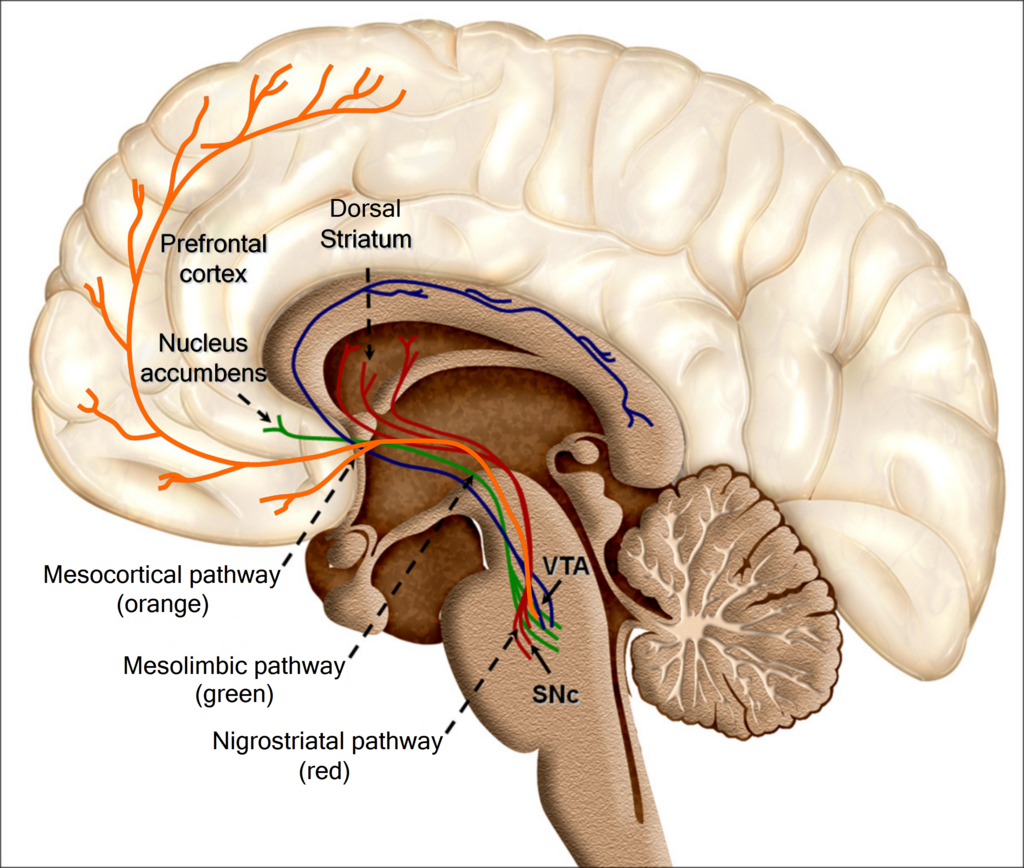
The reward is where dopamine enters the picture. Dopamine is a neurotransmitter often associated with pleasure, but its role in habits is more about motivation and anticipation. When you first experience a rewarding outcome, your brain releases dopamine. This signals that something important just happened and the preceding actions should be remembered.
Crucially, after the habit loop is established, dopamine is released in anticipation of the reward, not just upon receiving it. The cue itself triggers a dopamine spike, creating a craving that motivates the routine. This craving is the neurological engine that powers the habit loop.
This is why it's so hard to ignore the buzz of your phone. The buzz (cue) has been associated with the potential reward of a new message or notification so many times that it now triggers a dopamine-fueled craving. You aren't just reacting; your brain is actively pushing you to complete the loop.
To change a habit, you can't just ignore the cue. You must address the craving it produces. The most effective method is to keep the same cue and the same reward but insert a new, more constructive routine. If the cue is feeling stressed at work and the reward is a sense of distraction, you could replace the routine of scrolling through news feeds with a five-minute walk. The new routine satisfies the craving for a mental break, reinforcing a better habit.
Keystone Habits and Stacking
Some habits have a disproportionate impact. These are called keystone habits, and they create a cascade effect, spilling over into other areas of your life and sparking widespread change. Making your bed in the morning, for example, is a small act of discipline that correlates with better productivity and a greater sense of well-being throughout the day.
Exercise is another classic keystone habit. People who start exercising regularly often find themselves eating better, sleeping more soundly, and feeling less stressed, without consciously trying to improve those other areas. These habits work by changing your self-image and creating small wins that build momentum.
Identifying and focusing on a single keystone habit can be more effective than trying to change multiple behaviours at once.
A powerful technique for installing new habits is habit stacking. Instead of relying on a vague time or location as a cue, you link your new desired habit to an existing one. The completion of the old habit becomes the cue for the new one.
The formula is simple: "After I [CURRENT HABIT], I will [NEW HABIT]."
For example:
- "After I pour my morning coffee, I will meditate for one minute."
- "After I take off my work shoes, I will immediately change into my gym clothes."
- "After I finish dinner, I will immediately put my plate in the dishwasher."
This method leverages the automaticity of an existing neural pathway to build a new one. It removes the guesswork and decision-making, making it much easier for the new behaviour to become automatic.
Ready to test your understanding of how your brain automates behaviour? Let's see what you've learned.
What is the primary role of the basal ganglia in habit formation?
Identify the correct sequence of the three-step neurological pattern known as the habit loop.
By understanding the mechanics of the habit loop, the role of dopamine, and strategic approaches like keystone habits and habit stacking, you gain direct control over the scripts running your life.