Master Chess Like a Prodigy
Chess Fundamentals
The Pieces and How They Move
Every game of chess starts the same way. The board is an 8x8 grid of alternating light and dark squares. Each player gets an army of 16 pieces: one king, one queen, two rooks, two bishops, two knights, and eight pawns. One player has the light-colored pieces (White) and the other has the dark-colored pieces (Black). White always moves first.
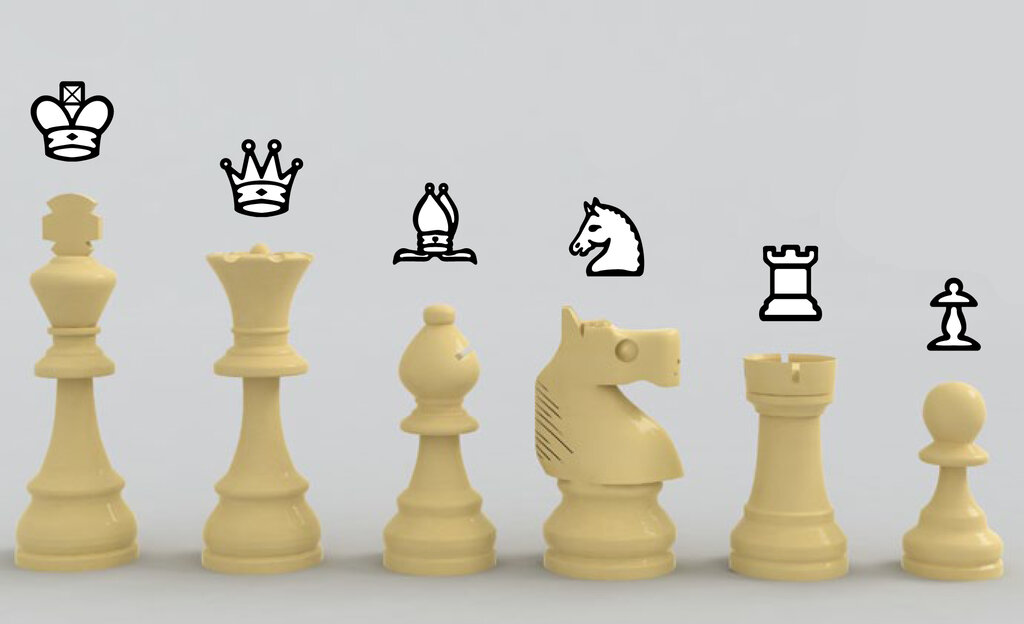
Each piece moves in a unique way. Learning these movements is the first step to playing chess. A piece can capture an opponent's piece by moving onto the square it occupies. The captured piece is then removed from the board for the rest of the game.
| Piece | Movement |
|---|---|
| King | Moves one square in any direction. The most important piece, but also one of the weakest. |
| Queen | Moves any number of squares horizontally, vertically, or diagonally. The most powerful piece. |
| Rook | Moves any number of squares horizontally or vertically. |
| Bishop | Moves any number of squares diagonally. Each player has one bishop on a light square and one on a dark square. |
| Knight | Moves in an 'L' shape: two squares in one direction (horizontal or vertical), then one square perpendicular. It's the only piece that can jump over other pieces. |
| Pawn | Moves forward one square. On its first move, it has the option to move two squares forward. It captures diagonally one square forward. Pawns cannot move backward. |
The Goal of the Game
The object of chess isn't to capture all of your opponent's pieces, though that often helps. The true goal is to trap the opponent's king so that it's under attack and cannot escape. This is called checkmate.
Check
noun
A situation where a king is under direct attack by one or more of the opponent's pieces. The attacked player must move out of check on their next turn.
When a king is in check, it must get out of attack immediately. There are three ways to do this:
- Move the king to a square that is not under attack.
- Block the check by placing another piece between the king and the attacking piece.
- Capture the piece that is attacking the king.
If none of these are possible, the king is in checkmate, and the game is over.
Checkmate
noun
A position in which a player's king is in check and there is no legal move to escape the check. The player who is checkmated loses the game.
Sometimes a game can end in a draw. One way this happens is through stalemate.
Stalemate
noun
A situation where the player whose turn it is to move has no legal moves, but their king is not in check. The game ends in a draw.
In a stalemate, no one wins and no one loses. The king isn't under attack, but any move it could make would put it under attack, and there are no other pieces that can move.
Fundamental Strategy
Moving the pieces correctly is just the start. To play well, you need to understand some basic strategic principles. These ideas guide your moves and help you build a strong position.
The principles of controlling the center, developing pieces, and ensuring king safety provide a strong foundation that applies across various opening scenarios.
Controlling the Center
The center of the board, especially the squares d4, e4, d5, and e5, is the most important territory. Pieces in the center control more squares and have more mobility. By controlling the center, you can restrict your opponent's pieces and create attacking opportunities.
Piece Development
At the start of the game, most of your powerful pieces are stuck on the back rank. Development is the process of moving these pieces off their starting squares into active positions where they can influence the game. In the opening, you should aim to develop your knights and bishops, usually towards the center.
A good rule of thumb for the opening is: move each of your knights and bishops only once, control the center with a pawn or two, and get your king to safety.
King Safety
Your king is your most vulnerable piece. While it's important to develop your army and control the center, you must never neglect your king's safety. An exposed king can become an easy target for an attack. The best way to secure your king early in the game is by castling.
Castling is a special move where you move your king two squares towards a rook, and then move that rook to the square the king just crossed. It's the only move where you can move two pieces at once! You can only castle if neither the king nor the rook has moved yet, there are no pieces between them, and the king is not in check or moving through a square that is under attack.
Now that you know the basics, let's test your knowledge.
What is the primary objective of a game of chess?
True or False: The player with the black pieces always makes the first move.
These fundamentals are the building blocks of good chess. Mastering them will give you a solid base to build upon as you continue to learn the game.