Martial Arts Systems and Tactical Applications
Striking Ranges and Mechanics
The Science of the Strike
A powerful strike isn’t just about arm strength. It's a chain reaction that starts from the ground. This process, called , is how fighters transfer energy through their entire body to a single point of impact. Imagine cracking a whip. The energy flows from the handle, accelerating down the length until it culminates in a sharp crack at the tip. A punch or kick works the same way: it begins with a push from the feet, rotates through the hips and torso, and finally travels down the limb to the target.
Striking techniques, such as punches and kicks, rely on principles of leverage, momentum, and transfer of kinetic energy.
Your stance dictates how efficiently this energy transfer happens. A fighter constantly manages the trade-off between stability and mobility. A wider, more grounded stance provides a solid base for powerful strikes but can make you slower. A narrower, lighter stance allows for quick footwork and evasion but sacrifices some of the potential to generate force from the ground up. There is no single 'best' stance; it's always a tactical choice based on the situation.
Managing Distance
Every fight is a battle for control over the space between opponents, often called the 'critical distance'. From the outside, you are relatively safe but cannot effectively attack. Closing that distance opens up offensive opportunities, but also exposes you to danger. Striking arts have developed different tools for managing this space.
Muay Thai practitioners often use a long guard and a push kick called the teep to control range. The extended lead hand acts as a feeler and a barrier, while the teep functions like a jab, keeping opponents at bay. This allows the fighter to dictate when an exchange happens, either by maintaining distance or by closing in for devastating close-range attacks.
Boxing, by contrast, relies heavily on head movement and footwork. A boxer will use slips, rolls, and lateral movement to create angles and control distance. Instead of a stiff barrier, they use dynamic evasion to make the opponent miss and then counter-attack, closing the distance on their own terms.
Close-Quarters Combat
When the distance is closed, the rules of engagement change dramatically. This is where Muay Thai's nickname, "The Art of Eight Limbs," becomes terrifyingly relevant. While a boxer has two fists, a Muay Thai fighter adds elbows and knees to their arsenal. They excel in the a form of stand-up grappling where they control the opponent's head and posture to deliver brutal knee strikes and short, slicing elbows.
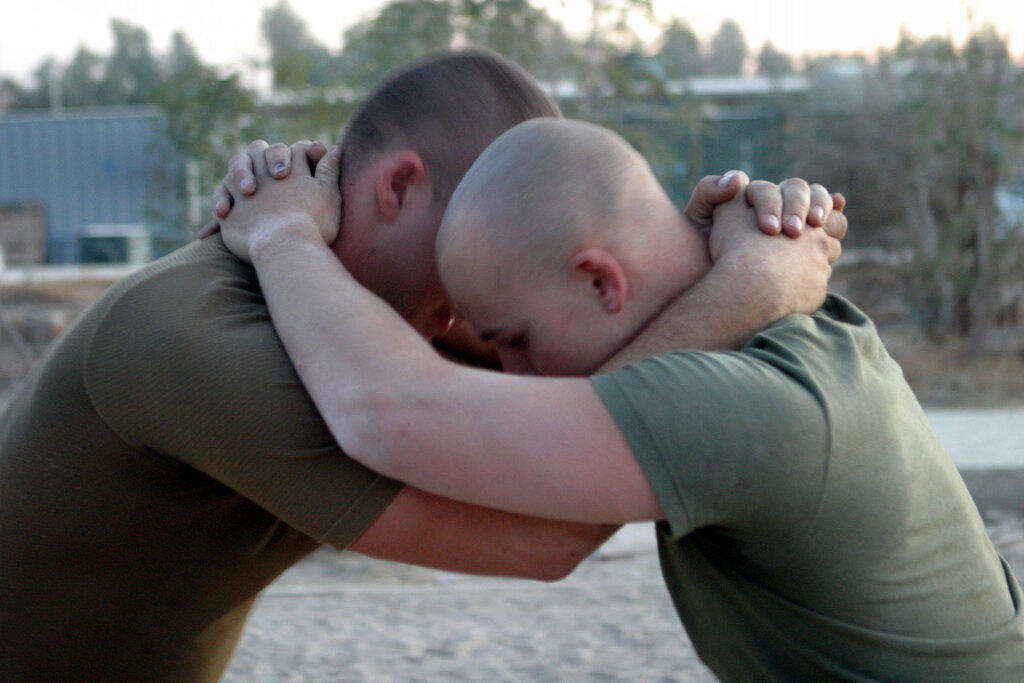
A boxer's inside game is entirely different. Without the option to grab or use knees, they rely on tight defensive guards, head movement, and short, powerful punches. They'll use hooks and uppercuts in tight spaces, often while slipping under the opponent's punches. It's a game of inches, where subtle shifts in weight and position create openings for fight-ending blows.
Stances and Strikes
These different tactical approaches are reflected in the typical stances of each art. Muay Thai often employs a more square, upright stance. This position makes it easier to fire off powerful kicks with either leg and to 'check' incoming leg kicks by raising a shin to block. The trade-off is that it presents a larger target and can be less mobile than a bladed boxing stance.
A traditional boxing stance is more sideways, or bladed. This presents a smaller target to the opponent and facilitates linear movement and powerful jabs and crosses from the rear hand. However, it makes throwing kicks from the rear leg more difficult and leaves the lead leg vulnerable to kicks, a key reason why it had to be adapted for sports like MMA.
The presence of gloves also alters striking mechanics. A boxer can block punches with their large, padded gloves, a technique that would be dangerous and ineffective with bare fists. The smaller gloves used in MMA represent a middle ground, offering some protection while still allowing for grappling and a more diverse striking environment.
What is the term for the process of transferring energy from the ground, through the body, to a single point of impact in a strike?
A fighter who primarily uses slips, rolls, and lateral movement to control distance and create counter-attacking opportunities is most likely a practitioner of which art?
Understanding these mechanical and tactical differences is key to appreciating the science behind striking. Each technique, stance, and strategy represents a specific solution to the universal problem of how to hit without being hit.