Martial Arts Systems and Combat Mechanics
Kinetic Linking Principles
The Body as an Engine
Power in martial arts doesn't originate in the fist or the foot. It starts from the ground. Every powerful strike is the final expression of a chain reaction that begins with your connection to the floor. This transfer of energy is governed by a principle called the kinetic chain: a sequence of body segments linked together to create movement.
When you push against the ground to throw a punch, the ground pushes back with an equal and opposite force. This is the Ground Reaction Force (GRF), and it's the raw fuel for your strike. This force travels up through your ankles, knees, and into your hips. The efficiency of this initial energy transfer is why a solid stance is non-negotiable. A weak stance leaks energy, robbing your technique of its potential before it even begins.
Two Paths to Power
Once the energy leaves the ground, martial arts diverge into two main strategies for channelling it: rotational and linear.
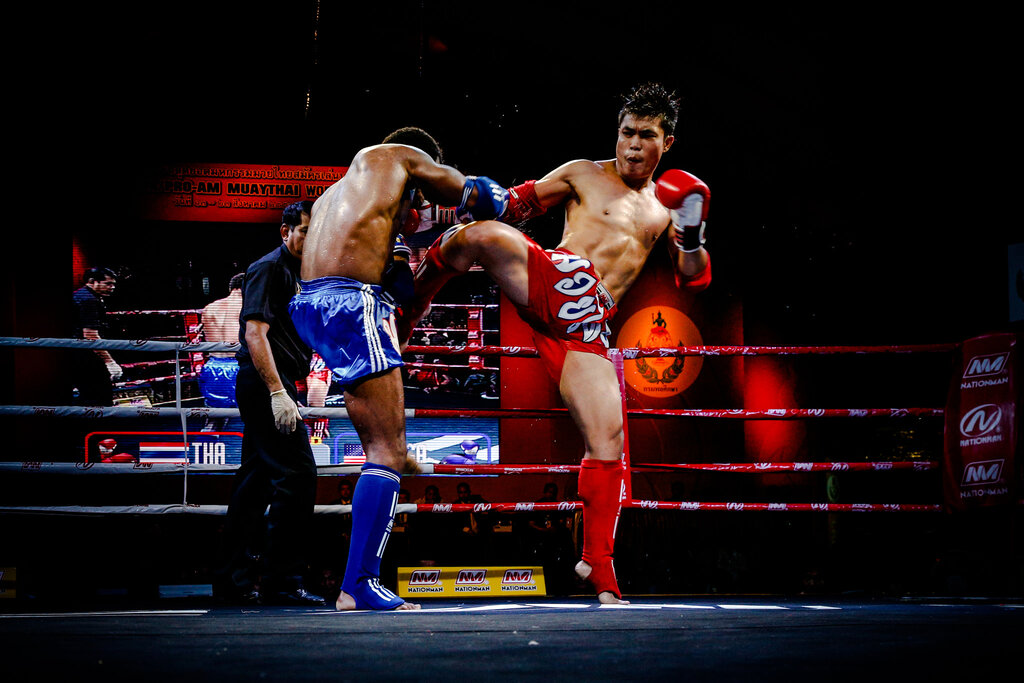
Styles like Muay Thai and boxing are masters of rotational mechanics. A Muay Thai roundhouse kick isn't just a leg swing; it's a violent rotation of the entire body. The practitioner pivots on their standing foot, whips their hips around, and lets the core and torso amplify that movement. This creates immense torque—a twisting force—that accelerates the striking limb to devastating speeds. The arm in a boxer's cross punch acts similarly, following the powerful rotation of the hips and shoulders. Here, the entire body becomes a whip, with the fist as its tip.
In contrast, arts like Shotokan Karate and Wing Chun often favour linear momentum. Instead of twisting, they generate power by shifting their entire body mass directly towards the target. Think of a Shotokan karateka's reverse punch. They drive off the back leg, shifting their centre of mass forward in a straight line. The power comes from committing their body weight behind the strike. This method relies less on rotational speed and more on the principle of mass in the equation (Force = mass × acceleration). The goal is to make the fist feel as if it's backed by the weight of the entire body moving in a single, focused direction.
Rotational styles multiply force through speed and torque. Linear styles multiply force by committing body mass directly into the target.
The Core and Elasticity
Regardless of the path, all power must pass through the core. The muscles of your abdomen, lower back, and pelvis act as the transmission of the kinetic chain. A strong, stable core ensures that the energy generated by the legs and hips is transferred efficiently to the upper body, without being wasted or dissipated. It connects the lower body's engine to the upper body's weapons.
Finally, advanced strikers harness the body's natural elasticity. Just before a strike, muscles and tendons are quickly stretched and then released, like a rubber band. This plyometric effect creates an explosive recoil, adding a final 'snap' to the technique. It's the difference between pushing a punch and cracking a whip. This elastic power is honed through specific training that teaches the body to store and release energy with split-second timing, maximizing impact force while conserving effort.
According to the principle of the kinetic chain, what is the initial source of power for a powerful martial arts strike?
A martial art that generates power primarily by twisting the body to create a whiplike effect is using which mechanical principle?
Understanding these mechanical principles transforms training from simply mimicking movements to engineering powerful, efficient techniques from the ground up.