Martial Arts Systems and Applications
Striking Dynamics
Power from the Ground Up
Effective striking isn't just about arm or leg strength; it's a full-body event. The real source of power is the ground. By pushing off the floor, a fighter initiates a sequence of movements that transfers energy up through the legs, into the hips, through the core, and finally out through the striking limb. This sequence is called the kinetic chain, and mastering it is the key to unlocking devastating power.
Every powerful strike, whether a punch or a kick, begins with this connection to the ground. The rotation of the hips and torso acts as a force multiplier, transforming a simple limb movement into a high-impact blow. This is why a smaller, technically proficient fighter can often strike harder than a larger, less-skilled opponent. They have learned how to recruit their entire body mass and channel it efficiently into a single point of contact.
The Circle and the Line
While both Muay Thai and Karate use the kinetic chain, they apply it in different ways, creating distinct striking dynamics. Think of the difference between swinging a baseball bat and cracking a whip. This is the core mechanical distinction between a Muay Thai roundhouse kick and a Karate snap kick.
The Muay Thai kick is a rotational, circular attack. The fighter pivots on their standing leg, swinging the striking leg and hip through the target. The power comes from the full, committed rotation of the body. It’s designed to do maximum damage, treating the leg as a heavy, bludgeoning weapon.
In contrast, the traditional Karate kick is more linear. It “snaps” out from the knee. The power is generated quickly and relies on speed and precision, culminating in a sharp, penetrating impact at the very end of the kick's extension. This makes it faster and harder to see coming, but it often sacrifices the raw power of a fully rotational strike.
Our data indicates that the typical Karate and Taekwondo snap-like kick is based heavily on rapid knee extension, while Muay Thai uses a technique that places greater emphasise on COM movements to develop high impact forces.
The choice between these paths is a strategic trade-off. The circular path of the Muay Thai kick generates more momentum and is harder to stop once launched. The linear path of the Karate kick is quicker to deploy and retract, making it a better tool for a high-volume, point-scoring style of fighting or for catching an opponent off guard.
Stance, Distance, and Control
These different striking mechanics are born from different philosophies of combat, which are reflected in stance and distance management. Karate often employs a longer, more bladed stance. This presents a smaller target to the opponent and allows for explosive in-and-out movement. The goal is to control the engagement distance, a concept known as Ma-ai—the perfect distance from which to launch an attack while remaining safe from a counter.
Muay Thai, on the other hand, uses a more square-on, upright stance. This stance is less mobile for linear blitzes but provides a stable base for throwing powerful, rotational kicks with either leg. It also serves a crucial defensive purpose: it's the ideal platform from which to check incoming low kicks and to transition into the clinch.
Where Karate uses to dominate the space between fighters, Muay Thai seeks to dominate the space where fighters are physically connected. This leads directly to one of its most defining techniques: the clinch.
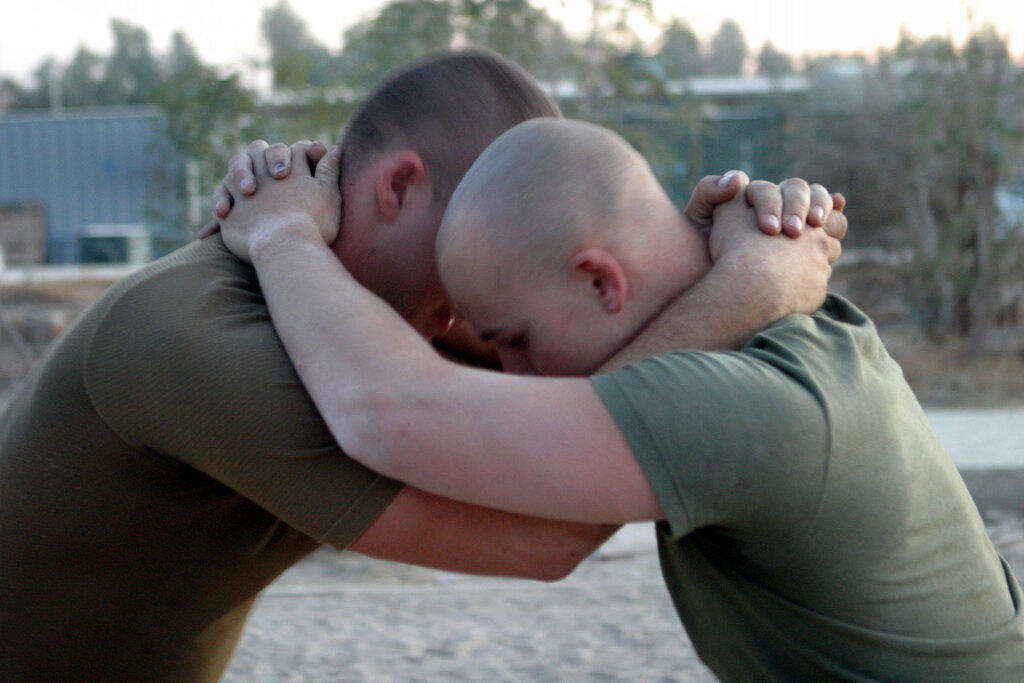
The Thai clinch, often called the , involves controlling the opponent's head and neck. From this position, a fighter can break their opponent's posture, off-balance them, and deliver devastating knees and elbows. It effectively neutralises a long-range striker's advantages. While Karate has its own grappling and close-quarters techniques, they are typically designed for quick escapes or takedowns, not the sustained control and attrition warfare of the Thai clinch.
Ultimately, the mechanics of striking, stance, and distance management are all interconnected. A Karateka's bladed stance facilitates the linear speed needed to manage Ma-ai, while a Nak Muay's square stance provides the rotational base for power kicks and a direct entry into the fight-altering clinch.
Ready to test your understanding of these dynamics?
What is the true origin of power for an effective strike, according to the principle of the kinetic chain?
Which analogy best describes the mechanical difference between a Muay Thai roundhouse kick and a Karate snap kick?
Understanding these mechanical principles allows a martial artist to look beyond superficial styles and see the underlying physics of combat.