Martial Arts Mechanics and Strategy
Striking Biomechanics Compared
Power from the Ground Up
In striking, power isn't just about muscle. It's about physics. Both boxing and Muay Thai generate force by transferring energy from the ground, through the body, and into the opponent. However, the way they manage this transfer—the kinetic chain—is fundamentally different.
A boxer's hook is a marvel of rotational efficiency. Power starts from the back foot pushing off the canvas, travels up the leg, and ignites a rapid, violent twist of the hips and torso. The arm acts almost like the tip of a whip, accelerating through the turn to deliver a compact, snapping impact. The goal is to rotate the body's mass as quickly as possible around a central axis.
In contrast, the is a study in momentum. The fighter takes a preparatory step, pivots on the supporting foot, and swings the kicking leg and hip through the target as a single, unified lever. Instead of snapping back, the entire body's weight follows through the point of impact. It's less of a whip and more of a battering ram.
This leads to a different use of the hips. A boxer's hip rotation is sharp and often returns to the neutral position quickly to set up the next punch. In a kick, the hip turns over completely, committing the fighter's full body weight into the strike. There is no quick return; the power comes from a full, committed follow-through.
Stance Dictates Strategy
Biomechanics directly influence stance, and stance determines your offensive and defensive options. A traditional boxing stance is bladed, with weight often favoring the back foot. This facilitates quick lateral movement, head slips, and powerful crosses, but it leaves the lead leg extended and vulnerable to low kicks.
A Muay Thai stance is more square and upright, with weight distributed evenly or slightly forward. This posture makes it easier to lift a leg to or to fire off your own kicks without much preparatory movement. The trade-off is that it limits the quick, evasive head movement and in-and-out footwork central to boxing.
| Stance Attribute | Western Boxing | Muay Thai |
|---|---|---|
| Weight Distribution | Typically 60% rear foot | 50/50 or slightly forward |
| Primary Mobility | Lateral, in-and-out | Forward and back, pivoting |
| Key Defense | Head movement, parries | Blocking, checking kicks |
| Offensive Bias | Punching combinations | All eight limbs |
| Vulnerability | Lead leg kicks | Body punches, takedowns |
Transitioning between styles requires understanding these trade-offs. A fighter with a boxing-heavy stance in a kickboxing match must constantly be aware of their exposed leg. Conversely, a Muay Thai fighter adopting boxing techniques must learn to incorporate head movement without compromising their ability to defend against kicks.
Impact and Leaks
The final variable is the impact surface itself. A boxer's power is channeled through a padded glove into two knuckles. This focuses the force onto a small, precise area. A Thai kick delivers force with the shin, a long, hard bone that acts like a baseball bat, creating widespread impact trauma.
In both arts, an intermediate practitioner's main challenge is plugging in their kinetic chain. This occurs whenever a part of the body is misaligned or absorbs force that should be transferred to the target. For a boxer, it might be a wrist that isn't perfectly straight on impact or a failure to pivot the back foot. For a kicker, a common leak is failing to fully pivot on the support foot, which prevents the hip from turning over completely and robs the kick of its devastating power.
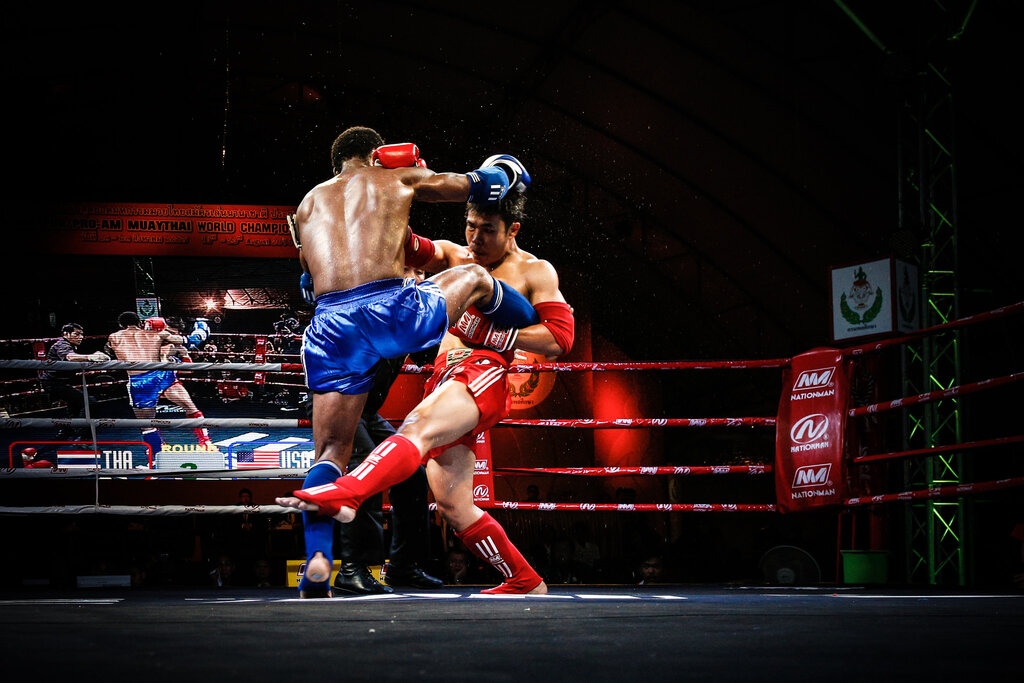
Mastering striking isn't just about learning moves; it's about understanding the underlying mechanics. By analyzing how your body generates and transfers force, you can refine your technique, maximize power, and seamlessly blend principles from different disciplines.
Ready to test your understanding of these striking principles?
What is the primary mechanical principle behind a powerful boxer's hook?
How does the hip action in a Muay Thai roundhouse kick differ from that in a boxer's punch?
Understanding these differences is the first step toward building a versatile and powerful striking arsenal.