Martial Arts Mechanics and Strategy
Striking Kinetic Chains
The Body as a Whip
A powerful strike isn’t just about arm strength. The force that lands a knockout punch or a heavy kick starts from the ground. Think of your body not as a collection of separate parts, but as a linked system—a kinetic chain. The secret to power is transferring energy efficiently through this chain, from your feet all the way to your fist or shin.
This process begins with ground reaction force. When you push against the floor, the floor pushes back with an equal and opposite force. By driving off the ground, you initiate a wave of energy that travels up your legs, into your hips, and through your core. Each segment of the chain adds its own momentum to the mix in a process called force summation. Like cracking a whip, the energy accelerates as it moves from the large, strong muscles of your base to the smaller, faster muscles at the end of the chain.
Your core is the critical link. As your hips rotate, your torso follows, creating separation between your hips and shoulders. This separation stretches the muscles of your core like a rubber band. The subsequent explosive contraction is part of the stretch-shortening cycle, a key biomechanical principle for generating power. The faster you can stretch and then shorten these muscles, the more velocity you add to the strike. The final movement of the shoulder and arm is just the release—the tip of the whip cracking forward.
Power isn't muscle, it's sequence. The force flows from the ground, through the body, and into the target. A break anywhere in the chain bleeds power.
Kicks, Chains, and Tactics
The same principles apply to kicks, but the mechanics adapt to the tactical goal. Compare a roundhouse kick with a Karate or Taekwondo snapping kick. They use different kinetic chains to achieve different outcomes.
A Muay Thai roundhouse is all about generating maximum force. The practitioner pivots on their lead foot, swinging the kicking leg like a baseball bat. The hips and torso rotate fully into the kick, transferring the body's entire mass into the target. There is little to no retraction; the goal is to drive through the opponent. This makes for a devastatingly powerful strike, but it's slower to execute and recover from.
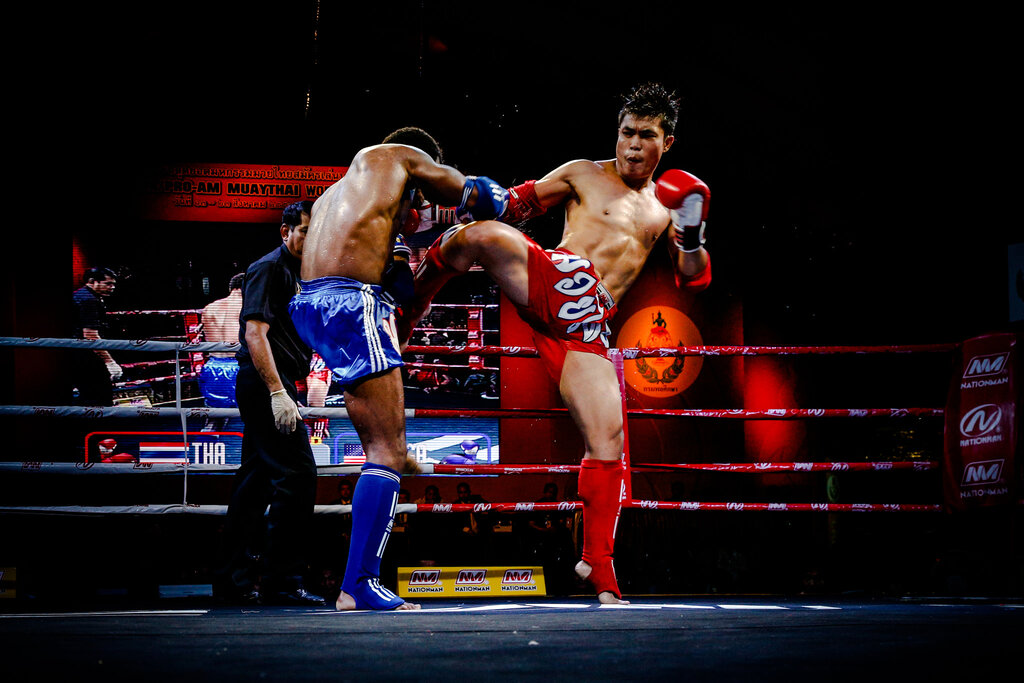
Conversely, a Karate or Taekwondo kick often prioritizes speed and a quick recovery. The kick chambered (the knee is brought up high) and then the lower leg snaps out to the target before quickly retracting. While there is still hip rotation, it's less pronounced than in the Muay Thai style. The kinetic chain is more linear and focuses on limb velocity rather than transferring full body mass. This makes the kick faster and allows the fighter to return to a stable stance more quickly, ready for the next move.
Efficiency and Injury Prevention
Understanding your kinetic chain isn't just about hitting harder; it's about being more efficient and staying safe. A properly aligned and sequenced movement uses less energy to produce more force. This is crucial for endurance in sparring or a real fight.
Furthermore, when your body moves as a connected unit, the stress of impact is distributed across your entire structure. If you throw a punch with only your arm, the force reverberates back into your shoulder and elbow joints. By using the whole chain, that shock is absorbed by the larger, more robust structures of your legs and core, significantly reducing the risk of joint and muscle injuries over time.
Understanding how to optimize the transfer of energy from the ground through the body can enhance the power and effectiveness of strikes and kicks.
Before we wrap up, let's review some of the key ideas we've covered.
Ready to test your knowledge?
What is the initial source of force that begins the kinetic chain for a powerful strike?
The process where energy accelerates as it moves from the large muscles of your legs to the smaller muscles of your arm is called:
By mastering the sequence of movement, you turn your entire body into a finely tuned engine for generating power.