Martial Arts Mechanics and Strategic Foundations
Kinetic Chains and Striking
The Body as a Whip
A powerful strike isn't just about arm or leg strength. The real source of power is the ground beneath your feet. By pushing off the floor, you create a force that travels up through your body, gaining speed and momentum at each joint. This sequence of movement is known as the kinetic chain—a system where energy is transferred from one body part to the next, much like the crack of a whip starts at the handle and accelerates to the tip.
Every powerful strike begins with this ground reaction force. You push against the floor, and the floor pushes back with an equal and opposite force. The trick is to efficiently channel that energy up through your ankles, knees, hips, and torso, finally delivering it through your fist or foot. A breakdown anywhere in this chain means a loss of power.
Two Paths to Power
While the principle of the kinetic chain is universal, different martial arts have perfected distinct ways of using it. The two main approaches are generating rotational torque and harnessing linear acceleration.
Think of it as the difference between a swinging gate and a battering ram. Both are effective, but they deliver force in fundamentally different ways.
In styles like Muay Thai, power comes from rotation. A roundhouse kick isn't just a leg movement; it's a full-body rotation that starts with pivoting the standing foot and violently twisting the hips. This motion swings the entire body's mass into the strike, creating immense torque. The leg itself is almost like a dead weight at the end of a chain, propelled by the core's rotation. This method generates continuous, crushing power.
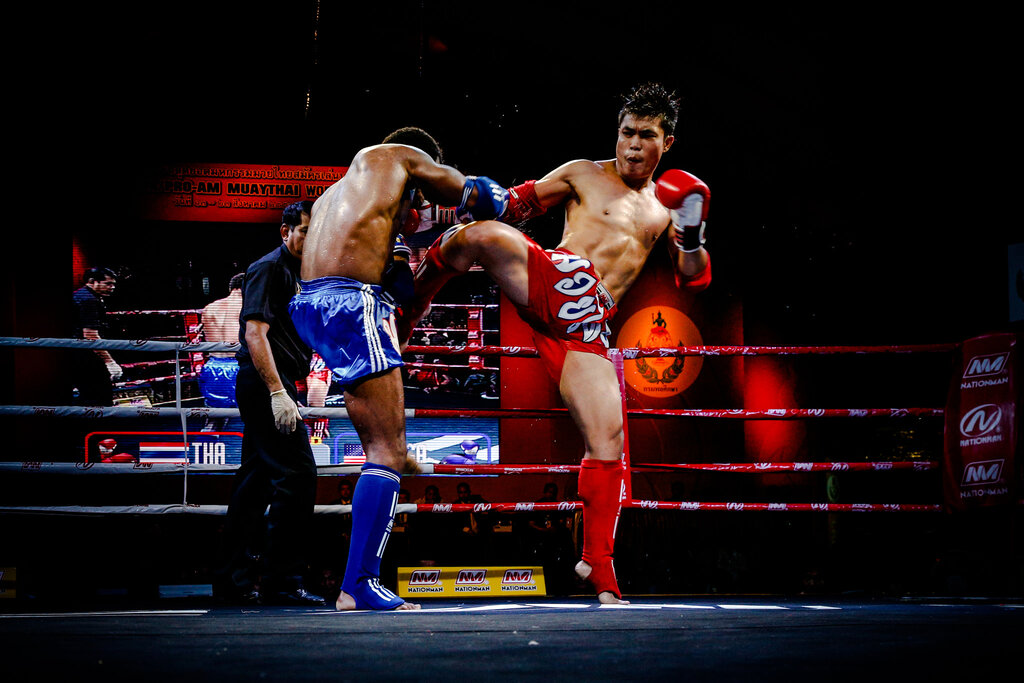
In contrast, styles like Karate often prioritise linear acceleration and structural alignment. The goal is to create a direct, explosive line of force from the ground to the target. Instead of a wide, swinging motion, the body drives forward. Power is magnified at the very last moment through a concept known as kime—a sharp, whole-body tension at the point of impact. This focuses all the generated energy into a single, penetrating point in a fraction of a second. The body acts like a piston, with the hips driving forward rather than rotating.
Optimising the Chain
Regardless of the method, efficiency is key. A strong, stable core is essential for transferring energy between the lower and upper body. If your core is weak, energy dissipates, and the chain is broken.
Timing and relaxation are just as crucial. A tense muscle is a slow muscle. The kinetic chain must remain fluid and relaxed until the final moment of impact. By staying loose, you allow each link in the chain to build upon the momentum of the last, maximising the final velocity of the strike.
| Feature | Rotational Power (Muay Thai) | Linear Power (Karate) |
|---|---|---|
| Primary Mover | Hip Rotation | Hip Drive (Forward) |
| Energy Path | Circular | Direct, Straight Line |
| Force Application | Continuous, Swinging | Explosive, Focused at Impact |
| Key Concept | Torque & Mass | Acceleration & Kime |
| Analogy | Swinging a baseball bat | A piston firing |
Ready to test your understanding of how the body generates power?
What is the primary function of the “kinetic chain” in generating a powerful strike?
How does Muay Thai primarily generate power for its strikes, such as the roundhouse kick?
Understanding these biomechanical principles is the first step toward transforming a simple strike into a truly powerful technique. It's not about raw strength, but about how effectively you can link your body together to deliver force.