Martial Arts Mastery and Tactical Integration
Combat Biomechanics
The Kinetic Chain
Power in martial arts doesn't come from just your arm or leg. It starts from the ground up. Think of cracking a whip: the energy flows from the handle, accelerating through the length of the whip until it culminates in a supersonic crack at the tip. Your body works the same way. This sequence of generating and transferring energy from your feet through your body and into a target is called the kinetic chains.
Every powerful strike or throw begins with ground reaction force. By pushing against the floor, you initiate a chain reaction. This force travels up through your legs, is amplified by the rotation of your hips and core, and is finally channelled through your torso, shoulder, and into your limb. A breakdown anywhere in this chain—a weak core, poor footwork, or a disconnected shoulder—will bleed power, resulting in a weak, ineffective technique.
This principle applies universally, whether you're throwing a punch, a kick, or executing a hip toss. Mastering this energy transfer is the key to unlocking real power, separating a novice's flailing from an expert's devastatingly efficient movement.
Push vs. Snap
Not all strikes are created equal. We can broadly categorise them into two families based on their biomechanics: 'pushing' strikes and 'snapping' strikes. Neither is inherently better; they simply serve different purposes and rely on different physical principles.
A pushing strike, common in heavyweight boxing, focuses on transferring as much body mass as possible into the opponent. The goal is to move them. The striking limb remains in contact with the target for a fraction longer, driving through it. This requires a strong, stable base and a linear transfer of force.
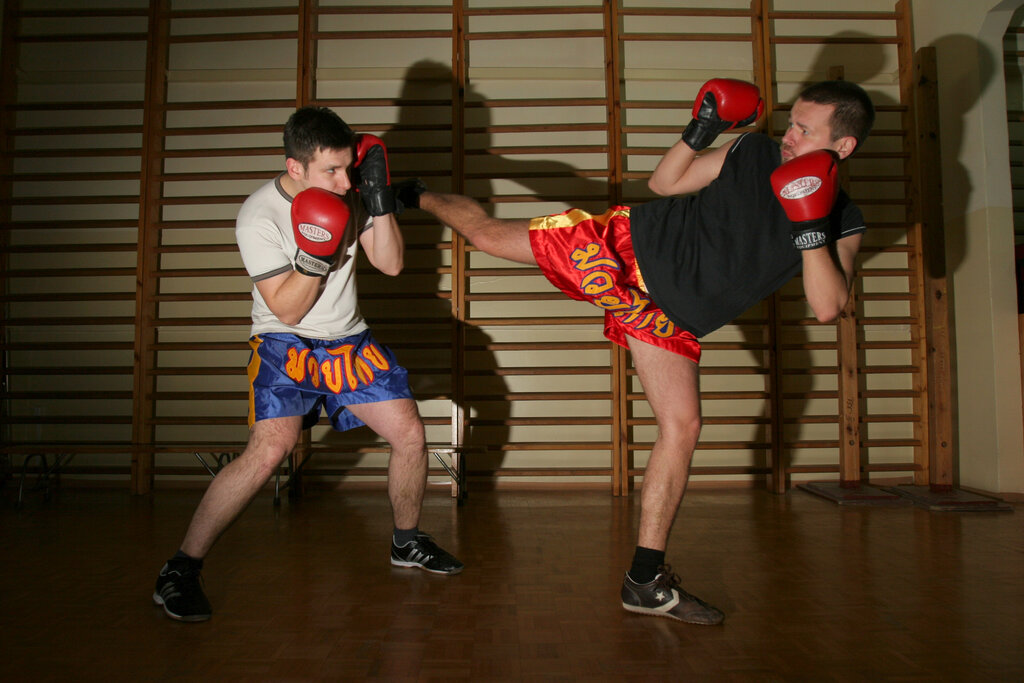
A snapping strike, typical in Muay Thai and Karate, is about speed and rapid acceleration and deceleration. The limb retracts almost immediately upon impact, like a rubber band snapping back. The damage comes from the immense, focused shockwave of the impact itself, not from pushing the opponent's mass.
| Feature | Pushing Strike (e.g., Boxer's Cross) | Snapping Strike (e.g., Muay Thai Kick) |
|---|---|---|
| Goal | Move opponent's mass, drive through. | Create a shockwave, penetrate the surface. |
| Contact Time | Longer | Extremely short |
| Force Type | Momentum-driven () | Impulse-driven () |
| Energy Source | Linear weight transfer, ground drive. | Rotational velocity, elastic recoil of muscles. |
| Recovery | Slower; committed follow-through. | Faster; limb retracts to guard position. |
The choice between these strikes often depends on range and intent. Pushing strikes are excellent for disrupting an opponent's base and setting up combinations, while snapping strikes excel at causing sharp, debilitating pain and damage from a longer range.
Balance and Control
Combat is a constant battle for stability. Your ability to control your own center of mass while manipulating your opponent's is fundamental to both striking and grappling. A fighter with a lower center of mass is generally more stable and harder to move, which is why wrestlers adopt low stances.
In striking, every movement slightly displaces your center of mass. A well-trained fighter minimizes this displacement, staying balanced and ready to defend or attack again. An over-extended punch, for example, shifts your center of mass too far forward, leaving you vulnerable to counter-attacks and takedowns.
In grappling, the game is entirely about this principle. A takedown is achieved by getting your center of mass lower than your opponent's and using leverage to disrupt their connection to the ground. In the clinch, you're constantly fighting for inside control to pull your opponent off-balance, breaking their posture and creating openings for knees, elbows, or throws. This is often achieved through torque—applying a rotational force to their head or upper body to twist their spine and destabilise their base.
torque
noun
A measure of the force that can cause an object to rotate about an axis. In combat, it's the 'twisting' force used to off-balance an opponent or generate power in rotational strikes.
Understanding these physical forces moves you beyond simply memorising techniques. It allows you to feel why a move works and to adapt it to dynamic, unpredictable situations. It's the difference between being a technician and being a fighter.
Grappling techniques, including takedowns, submissions, and ground control, heavily rely on biomechanical principles.
Now, let's review some of the key ideas we've covered.
Ready to test your knowledge?
What is the term for the sequence of generating and transferring energy from the ground, through the body, and into a target in martial arts?
A martial artist who over-extends a punch becomes vulnerable primarily because they have...
By applying these principles of biomechanics, you can analyse your own movements, identify inefficiencies, and build a more powerful, stable, and effective martial arts game.