Martial Arts Mastery and Methodology
Martial Physics
From Movement to Mechanics
Knowing how to stand is one thing; understanding how to move is another. The true art of combat isn't just about executing a technique, but about harnessing the physical principles that give it power. It's about turning your body into an efficient system for generating and delivering force.
Every powerful strike or stable defensive posture begins from the ground up. The force you generate doesn't magically appear in your fist or foot. It's the result of a sequential transfer of energy that starts with your connection to the floor. This sequence of movement is known as the kinetic chain—a system of linked body segments that work together to create motion.
The engine of this chain is rotational force, or torque. By driving off the ground, you initiate a rotation in your hips and torso. This core rotation generates the vast majority of the power, which is then channeled through the limbs to the point of impact. Think of it like cracking a whip; the energy starts at the handle (your core) and accelerates dramatically as it travels to the tip (your fist or foot).
Strikes and Holds
The physics of striking and grappling are fundamentally different. Striking is about maximizing —delivering the greatest amount of force in the shortest possible time. It's not just about being strong; it's about being fast and focused. The goal is to change the opponent's momentum as rapidly as possible.
Grappling, however, relies on sustained force and leverage. Instead of a quick impact, you apply controlled pressure over time to manipulate your opponent's body. Techniques like joint locks and chokes don't require explosive power. They work by exploiting the biomechanical limits of the human body, using your skeletal structure as a lever to multiply force.
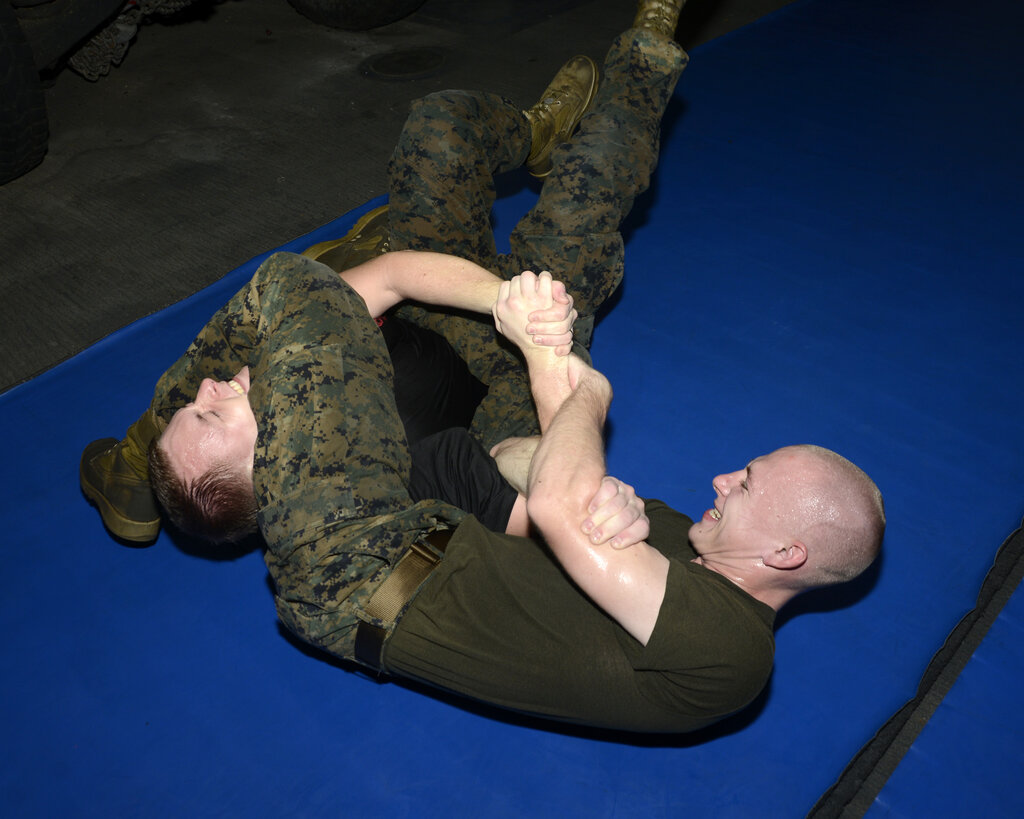
Consider an armbar. The grappler uses their hips as a fulcrum and their legs and arms to create a long lever, applying breaking pressure to the opponent's elbow joint. A small amount of force applied at the end of this lever system generates immense pressure at the joint, forcing a submission. It's a pure application of mechanical advantage.
Controlling the Center
Every physical object has a (CG), the single point where its weight is evenly balanced. In martial arts, managing your own CG while disrupting your opponent's is the key to victory. A stable stance is one where your CG is low and positioned directly over your base of support—the area between your feet.
When you see a judo practitioner execute a perfect throw, what you're really seeing is a masterclass in physics. The thrower first breaks the opponent's balance, shifting their CG outside of their base of support. Once the opponent is unstable, a simple trip or hip rotation is enough to bring them to the ground. You aren't lifting their entire body weight; you're simply guiding their already-falling momentum.
To control the fight, control where the weight is. A low, wide stance makes you a difficult object to move. A high, narrow stance makes an opponent easy to topple.
By understanding these core principles—the kinetic chain, force application, and center of gravity—you can begin to analyze your own movements. You can identify inefficiencies and unlock new levels of power and control, transforming your techniques from simple motions into precise applications of physics.
Time to see if these concepts have landed.
What is the primary engine for generating power in the kinetic chain, as described in the text?
A martial artist executing a judo throw is primarily attempting to do what?
Thinking like a physicist is the first step to moving like a master.