Martial Arts Mastery and Mechanics
Strike Mechanics and Kinetics
The Body as a Whip
A powerful strike isn't just about arm strength. It's a full-body event, a sequence of motion that starts from the ground and ends at your knuckles or shin. This sequence is called the kinetic chain—a system of linked body segments that transfer energy from one part to the next. Think of it like cracking a whip. The handle moves first, but the real speed and power are concentrated at the very tip, which moves last.
In striking, your feet are the handle. By pushing against the floor, you generate a that travels up your legs, into your hips, and through your core. Your hips and torso then rotate, amplifying this energy and channeling it through your shoulder, down your arm, and into your fist. Each link in the chain adds velocity to the next, culminating in a massive release of energy at the point of impact. Without this chain, a punch is just an arm movement. With it, it's a focused expression of your entire body's mass and velocity.
Stance, Stability, and Strategy
How a fighter stands is a direct reflection of their strategy. It’s a constant trade-off between stability, mobility, and power. Two excellent examples are the stances found in traditional Karate and Muay Thai—both are effective, but they are optimized for entirely different approaches to combat.
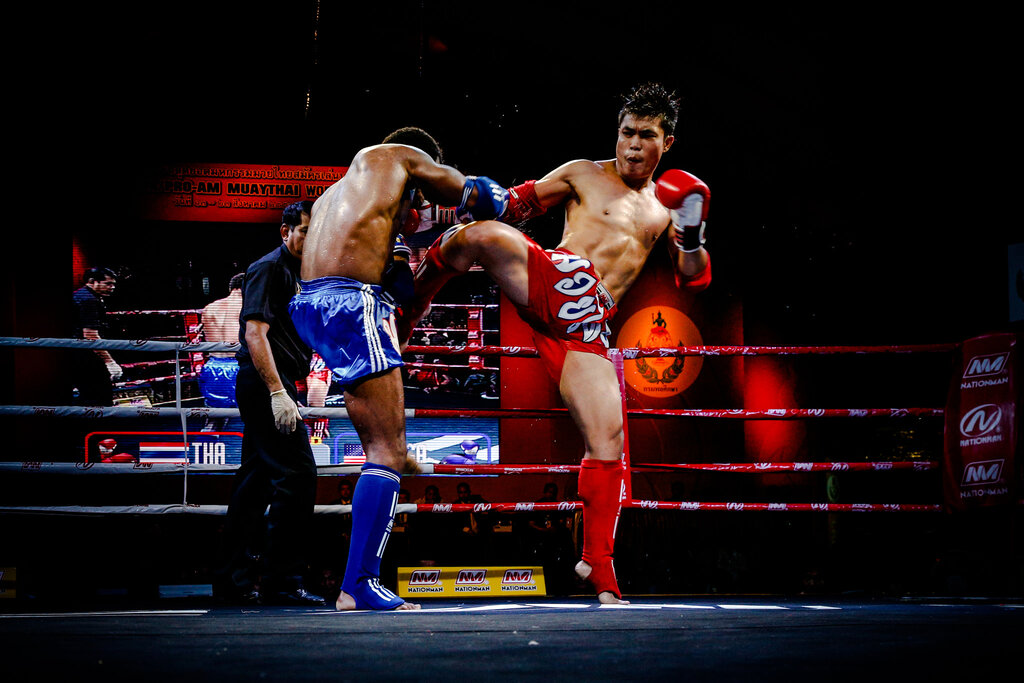
Karate often employs a narrow, bladed stance (hanmi). The body is turned sideways to the opponent, presenting the smallest possible target. This stance is built for speed and linear movement. It allows the practitioner to close distance rapidly for a quick strike and then retreat just as fast. Power comes from driving forward, transferring mass directly toward the target. It's a precise, in-and-out system.
Muay Thai, in contrast, uses a more square-on stance. The feet are about shoulder-width apart, and the weight is evenly distributed. This creates a stable, solid base. It's not as fast for linear movement, but it's perfect for generating immense rotational power for kicks, elbows, and knees. This stable platform also makes it much easier to lift a leg to "check" or block an incoming low kick without losing balance.
| Feature | Karate Stance | Muay Thai Stance |
|---|---|---|
| Orientation | Bladed / Sideways | Square / Forward-facing |
| Primary Goal | Linear speed, small target | Stability, rotational power |
| Mobility | High (in/out) | Moderate (pivoting) |
| Defense | Evasion, blocking | Blocking, checking kicks |
| Power Source | Forward mass transfer | Hip/torso rotation |
Generating Force
The different stances directly influence how power is generated. Physics tells us that kinetic energy is calculated as (half the mass times the velocity squared). Martial artists find different ways to maximize the 'm' and 'v' in that equation.
A Karate lunge punch is a masterclass in mass transfer. By driving off the back leg and lunging forward, the practitioner puts their entire body weight behind the strike. The power comes from the linear momentum of that forward charge, focused into the small area of the knuckles.
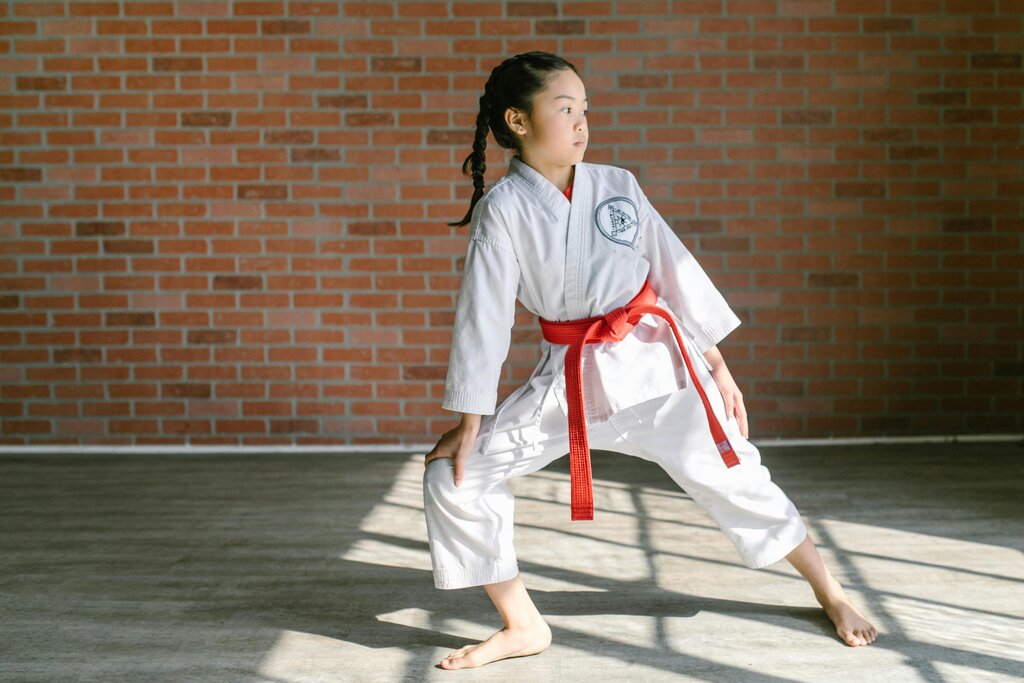
Muay Thai excels at generating rotational velocity. A roundhouse kick doesn't travel in a straight line; it whips around. By planting the support foot and violently rotating the hips and torso, a fighter creates tremendous torque. This rotational speed is what makes a Muay Thai kick so devastating. The leg becomes the end of a kinetic whip, snapping into the target with incredible force. Here, the emphasis is less on moving the entire body's mass forward and more on maximizing the angular velocity of the striking limb.
Neither approach is inherently superior. They are different physical solutions to the same problem: how to hit an opponent as hard and effectively as possible. The choice between a linear, mass-driven strike and a rotational, velocity-driven one depends on the situation, the range, and the fighter's strategy.
What is the term for the system of linked body segments that transfer energy from the ground up through the body to the point of impact in a strike?
A fighter who wants to prioritize rapid, linear in-and-out movements and present the smallest possible target would likely adopt which type of stance?