Marketing in the Age of AI and Digital Twins
Introduction to Ubiquitous AI
AI Is Everywhere
Artificial intelligence is no longer just a concept from science fiction. It has become a background hum in our daily lives, much like electricity or the internet. This is what's known as ubiquitous AI. It's not about a single, all-knowing computer, but a vast network of specialized AI systems woven into the fabric of our world, often working so seamlessly that we don't even notice them.
Think of it this way: you don't actively think about the electrical grid when you flip a light switch. Similarly, you use AI when you get driving directions, stream a movie, or unlock your phone with your face.
This pervasive integration means AI is constantly learning from and adapting to our behaviors, shaping our experiences in subtle yet powerful ways. From the news articles suggested in your feed to the spam filtered from your inbox, AI is quietly making decisions on your behalf.
From Theory to Reality
AI didn't just appear overnight. Its journey spans decades of theoretical work, ambitious experiments, and steady technological progress. Early concepts in the mid-20th century imagined machines that could reason like humans. While that grand vision remains a work in progress, the practical advancements have been staggering.
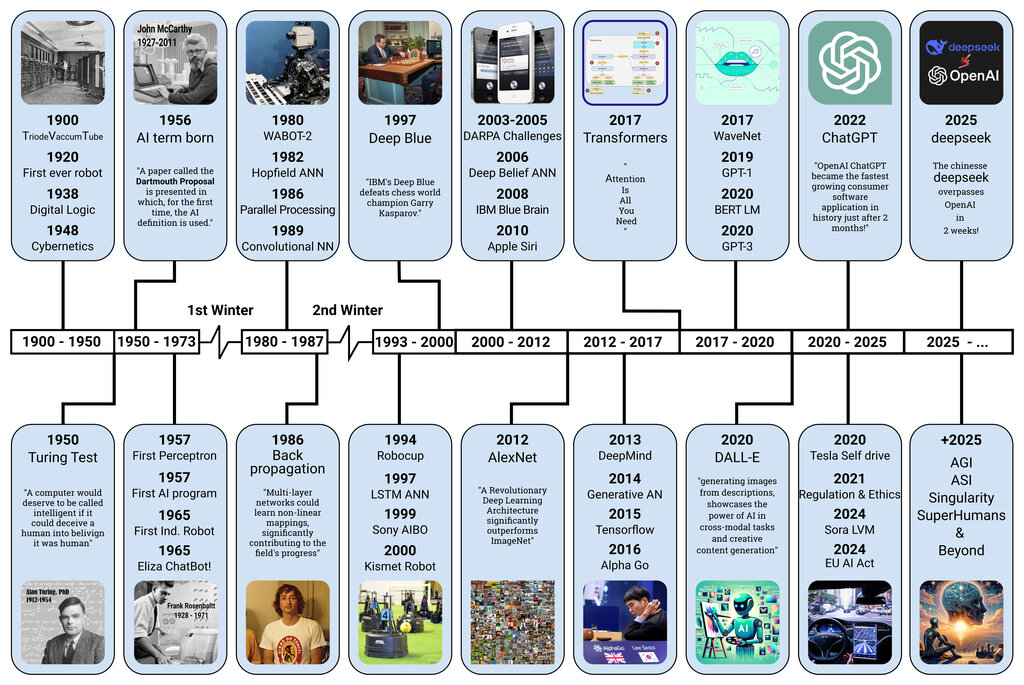
The field has gone through periods of intense optimism, known as "AI summers," followed by funding droughts and skepticism, or "AI winters." Key developments, like the invention of new algorithms and massive increases in computing power, have fueled its growth. The rise of "big data" gave these algorithms the vast amounts of information they needed to learn effectively, transforming AI from a niche academic pursuit into a powerful commercial technology.
AI Across Industries
Today, AI is not confined to tech companies. It's a versatile tool being applied in nearly every sector to improve efficiency, solve complex problems, and create new possibilities. Its impact is broad and continues to expand as the technology becomes more accessible.
| Industry | Application |
|---|---|
| Healthcare | Analyzing medical images like X-rays to detect diseases earlier. |
| Finance | Detecting fraudulent transactions in real-time. |
| Entertainment | Recommending movies, music, and shows based on viewing habits. |
| Automotive | Powering driver-assistance features and navigation systems. |
| Retail | Personalizing shopping experiences and managing inventory. |
| Agriculture | Optimizing crop yields with data on weather and soil conditions. |
These applications show AI's ability to handle tasks ranging from pattern recognition to complex optimization. While we often interact with consumer-facing AI like digital assistants, countless other systems work behind the scenes in manufacturing, logistics, and scientific research.
What's on the Horizon
The integration of AI is only accelerating. One of the most significant emerging trends is the shift towards more autonomous, proactive systems. Instead of just reacting to our commands, future AI will anticipate our needs and take action on our behalf.
Agentic AI represents a fundamental paradigm shift in artificial intelligence, moving from passive, prompt-driven systems to autonomous, goal-oriented agents that can plan, learn, and execute complex tasks with minimal human intervention.
We're also seeing AI become more deeply embedded into the physical world through the Internet of Things (IoT). Smart homes, smart cities, and connected vehicles all rely on AI to process data from sensors and make intelligent decisions. This convergence of the digital and physical realms will make AI's presence even more seamless and impactful.
What is the defining characteristic of "ubiquitous AI"?
The history of AI development has been characterized by periods of intense optimism and funding followed by periods of skepticism and budget cuts. What are these cycles called?
As these technologies mature, they will continue to reshape industries and our daily routines, creating a future where artificial intelligence is a fundamental, and often invisible, part of human experience.