Marketing Essentials
Introduction to Marketing
What is Marketing?
Marketing is often mistaken for just advertising or selling, but it's much broader. Think of it as the entire process of bringing a product or service to its ideal customer. It starts with an idea and ends with a happy, loyal customer. This involves understanding what people want, creating something that meets that want, and then letting them know it exists in a way that resonates with them.
Marketing
noun
The strategic process of creating, communicating, and delivering value to customers and for managing customer relationships in ways that benefit the organization.
At its core, marketing is about creating connections. It’s the bridge between a company and its customers. Without it, even the best product in the world might sit on a shelf unnoticed. A solid marketing strategy ensures that the right people find the right solutions for their problems, which is how businesses grow and thrive.
Marketing fundamentals are the essential principles that help businesses connect the right product with the right audience at the right time — and do it in a way that consistently drives growth.
A Quick Look Back
Marketing hasn't always been about deep customer understanding. In the early days, the focus was almost entirely on the product. Companies operated on a simple philosophy: if you build a great product, customers will find it. This was the production era, where efficiency and quality were paramount.
Then, as competition grew, just having a good product wasn't enough. The focus shifted to selling. This sales era was characterized by aggressive promotional tactics. The goal was to persuade customers to buy, whether they truly needed the product or not.
Today, we're in the customer-centric era. The most successful companies have realized that marketing starts and ends with the customer. The goal is no longer to just sell a product, but to understand customer needs so deeply that the product almost sells itself. It’s about building relationships and creating genuine value.
The Marketing Mix
To build a strategy around the customer, marketers use a framework called the marketing mix. The most common version of this is the 4Ps. These are the key ingredients that you can control to meet your customers' needs and achieve your business goals.
Here’s a quick breakdown of each one:
-
Product: This is what you sell. It can be a physical good, a service, or an experience. The key is that it must provide value by solving a problem or satisfying a need for your customer.
-
Price: This is what the customer pays for the product. Setting the right price isn't just about covering costs; it’s about communicating value. A price that’s too high might deter buyers, while a price that’s too low might make them question the quality.
-
Place: This refers to where and how customers access your product. It’s about distribution. Do you sell in a physical store, online, or through a partner? The goal is to make it as easy as possible for customers to buy.
-
Promotion: This is how you communicate with your customers. It includes all the activities you undertake to make your target audience aware of your product, such as advertising, social media, and public relations.
Finding Your People
A common mistake is trying to be everything to everyone. The reality is, not everyone is your customer. To be effective, you need to identify your target market—the specific group of people most likely to buy your product.
Trying to market to everyone is like trying to catch fish in the ocean with a small net. It's better to find a well-stocked pond where you know your fish are swimming.
Once you know your target market, you can go a step further with customer segmentation. This means dividing that larger group into smaller, more defined subgroups based on shared characteristics. By doing this, you can tailor your marketing messages and strategies to be far more relevant and effective for each group.
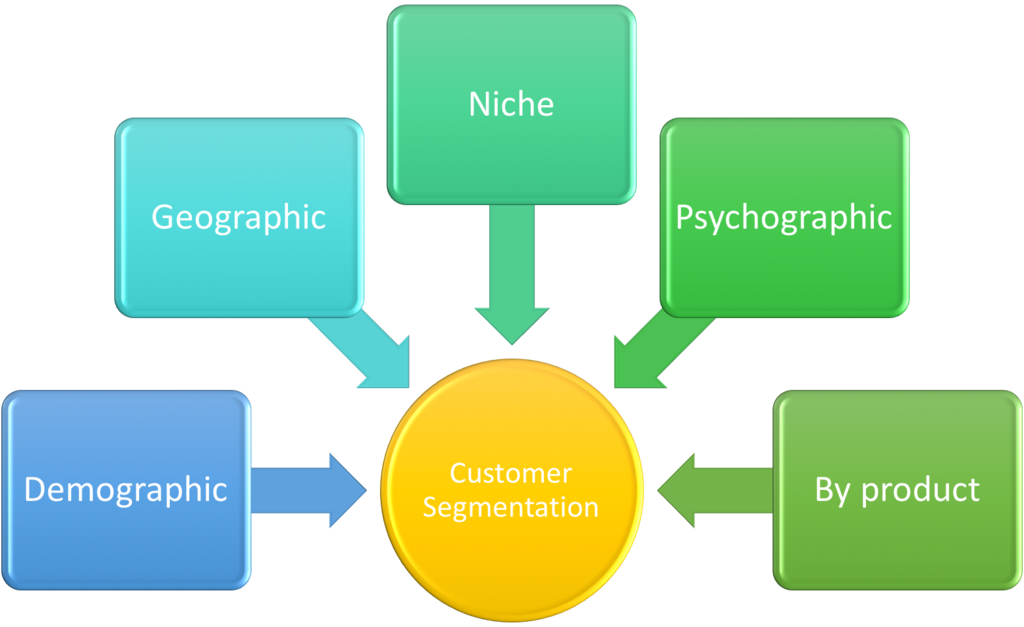
For example, a company that sells running shoes might segment its market into serious marathon runners, casual joggers, and people who just want comfortable shoes for walking. Each of these groups has different needs and will respond to different marketing messages. The marathon runner cares about performance and durability, while the casual walker is more interested in style and comfort.
Ready to check your understanding? Let's see what you've learned about the foundations of marketing.
What is the primary focus of the modern, customer-centric era of marketing?
A company decides to make its new eco-friendly cleaning product available only in health food stores and online. This decision relates primarily to which of the 4Ps of marketing?
Understanding these core components—the marketing mix, your target market, and customer segmentation—is the first step to building a strong and effective marketing strategy.