Marine Electrical Systems Explained
Electrical Basics
The Flow of Energy
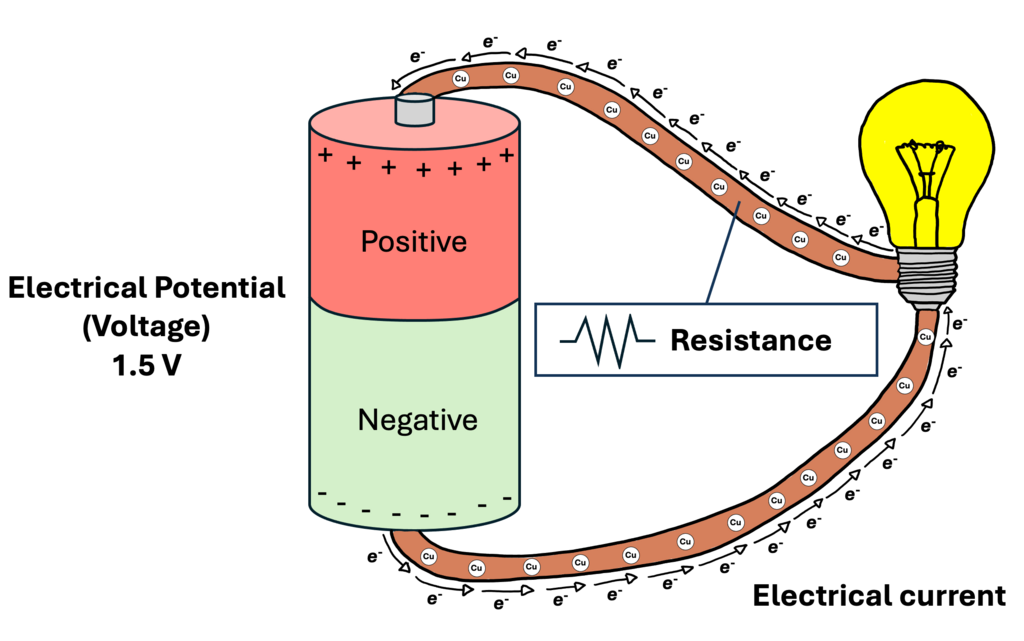
At its heart, electricity is all about the movement of tiny particles called electrons. Everything is made of atoms, and atoms have a nucleus at the center with electrons orbiting it. In some materials, like copper wire, the outermost electrons aren't tightly bound. They can be pushed from one atom to the next.
This flow of electrons is what we call an electric current. But electrons don't just move on their own. They need a push to get going and something to flow through, and they'll always face some opposition along the way.
A common way to visualize this is to think of water in a plumbing system. The pressure that the pump creates to move the water is like voltage. The amount of water flowing through the pipes is like current. And the friction from the pipe walls, especially if a pipe is narrow, is like resistance.
Voltage
noun
The pressure from an electrical circuit's power source that pushes charged electrons (current) through a conducting loop. It's measured in Volts (V).
Voltage is the potential difference between two points. Without voltage, there's no push, and electrons stay put.
Current
noun
The rate at which electrons flow past a point in a complete electrical circuit. It's measured in Amperes, or Amps (A).
Current is the actual movement of charge. A higher current means more electrons are flowing by per second.
Resistance
noun
A measure of the opposition to current flow in an electrical circuit. It's measured in Ohms (Ω).
Everything has some resistance. Wires, light bulbs, motors—they all impede the flow of current to some degree. This opposition is what allows electrical components to do work, like creating light or heat.
The Fundamental Relationship
These three concepts—voltage, current, and resistance—are not independent. They are linked by a fundamental principle of electricity known as Ohm's Law. It describes exactly how they relate to each other in a circuit.
Ohm's Law states that the voltage across a conductor is directly proportional to the current flowing through it, provided all physical conditions and temperatures remain constant.
Where:
- is Voltage (in Volts)
- is Current (in Amps)
- is Resistance (in Ohms)
This simple equation is incredibly powerful. If you know any two of the values, you can always calculate the third. For example, if a small heater with a resistance of 12 Ω is connected to a 120 V outlet, you can find the current it draws.
The heater will draw 10 Amps of current.
Measuring Electrical Power
While Ohm's Law is essential, there's one more piece to the puzzle: power. Power is the rate at which electrical energy is transferred by a circuit. It's a measure of how much work the electricity is doing per unit of time, like how bright a bulb is or how much heat a stove element produces.
Power
noun
The rate, per unit time, at which electrical energy is transferred by an electric circuit. It is measured in Watts (W).
Power is calculated with the Power Equation, which relates power to voltage and current.
Where:
- is Power (in Watts)
- is Voltage (in Volts)
- is Current (in Amps)
Let's return to our heater example. We know it's connected to 120 V and draws 10 A. We can now calculate its power consumption.
The heater has a power rating of 1200 Watts, or 1.2 kilowatts.
Because we have Ohm's Law, we can also substitute parts of the Power Equation to find power if we only know current and resistance, or voltage and resistance.
These foundational principles govern how all simple circuits work. Understanding them is the first step to mastering more complex systems.
Ready to check your understanding?
What is an electric current?
In the common analogy of water flowing through pipes, what does the water pressure represent?
With these basics down, you have the tools to analyze and understand any electrical circuit.