Mandarin Chinese Shanghai Dialect
Mandarin Phonetics
Sounding It Out with Pinyin
Before diving into Chinese characters, you need to learn how the language sounds. Mandarin Chinese uses a system called Pinyin to write out sounds using the familiar Roman alphabet. It’s a pronunciation tool, not a writing system for daily use, but it’s the essential first step for any learner.
Pinyin is the Romanization system for Chinese characters and is crucial for beginners to learn pronunciation and tones accurately.
Every Pinyin syllable is made of two parts: an initial and a final. Think of them like onsets and rimes in English. The initial is the starting consonant sound, and the final is the vowel sound that follows.
For example, in the syllable
mā,mis the initial andais the final. Inhǎo,his the initial andaois the final.
There are 23 initial sounds and 24 final sounds in Mandarin. Some are very similar to English, like b, p, m, and f. Others will feel new, like zh, ch, sh, and r, which are pronounced with the tongue curled back slightly.
| Part | Description | Examples |
|---|---|---|
| Initial | The starting consonant sound | b, p, m, f, d, t, n, l |
| Final | The ending vowel sound (can be simple or compound) | a, o, e, i, u, ü, ai, ei, ao, ou |
Combining them is straightforward. The initial d plus the final a creates the sound da. The initial n plus the final i creates the sound ni. Getting comfortable with these building blocks is the key to pronouncing any word in Mandarin.
The Music of Mandarin
Mandarin is a tonal language. This means the pitch you use to say a syllable changes its meaning entirely. The same sound, ma, can mean "mother," "hemp," "horse," or "to scold," all depending on your tone. There are four main tones, plus a fifth neutral tone.
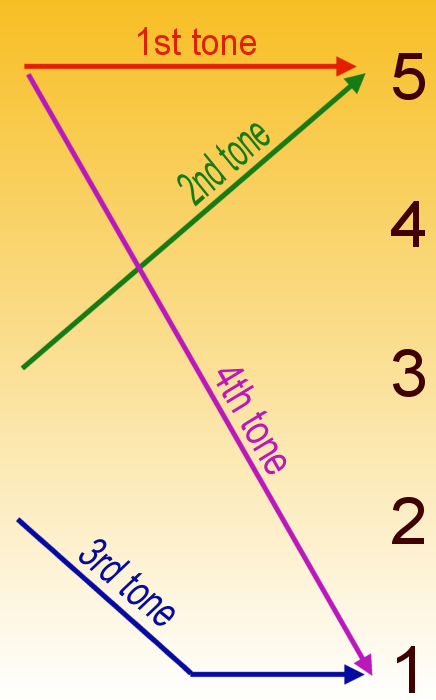
Let's break them down using ma as our example:
- First Tone (mā): A high, flat sound. Imagine a doctor asking you to say "ahhh." It’s steady and doesn't rise or fall.
- Second Tone (má): A rising sound. It starts in the middle of your vocal range and goes up, like you're asking a question: "Hm?"
- Third Tone (mǎ): A dipping sound. It goes down, then back up. It’s the most complex tone. Think of the intonation in the word "well..." when you're hesitating.
- Fourth Tone (mà): A sharp, falling sound. It starts high and drops quickly, like a short, firm command: "Stop!"
- Neutral Tone (ma): This one has no tone mark. It’s short, light, and unstressed. You just say the syllable quickly and let it piggyback on the tone of the syllable before it.
Tones are usually marked above the main vowel in a Pinyin syllable. If there are multiple vowels, the mark goes on the one that makes your mouth open widest (
a,o,e,i,u,üin that order).
Putting It All Together
When you speak, tones don't exist in a vacuum. They flow into each other, and sometimes they even change. The most common tone change rule involves two third tones in a row.
If you have two third-tone syllables back-to-back, the first one changes to a second tone. It's much easier to say and sounds more natural.
Hello
The Pinyin is nǐ hǎo. Both nǐ and hǎo are third tones. But when you say them together, you pronounce it as if it were ní hǎo (second tone + third tone). This is a fundamental rule you'll use constantly.
Ready to test your understanding of these core concepts? This quiz will cover initials, finals, and the four tones.
What is the primary function of Pinyin in learning Mandarin Chinese?
Every Pinyin syllable is composed of two main parts. What are they?
Mastering Pinyin and tones is your foundation for speaking clear, accurate Mandarin. Practice them daily, and you'll build the muscle memory needed for fluent conversation.