Mandarin Chinese HSKK A1 A2 Vocabulary Builder
Pinyin Basics
What is Pinyin?
Before diving into Chinese characters, you need a way to read and pronounce them. That tool is called Pinyin. It uses the same letters we use in English to represent the sounds of Mandarin Chinese. Think of it as a bridge that connects what you see to what you say.
Think of pinyin as the foundation of your Mandarin journey.
Essentially, Pinyin is the official romanization system for Mandarin. Mastering it first means you can pronounce any word correctly without knowing a single character. It's the key to building strong speaking and listening skills from day one.
The Building Blocks
Every Pinyin syllable is made of two parts: an initial and a final.
An initial is the consonant sound that starts the syllable. A final is the vowel sound that follows. It's similar to how English words are constructed. In the word "cat," 'c' is the initial sound and 'at' is the final sound. In Mandarin, the syllable māo (cat) has the initial m and the final ao.
| Initial | Final | Pinyin Syllable |
|---|---|---|
| b | a | ba |
| n | i | ni |
| h | ao | hao |
Nearly every sound in Mandarin can be broken down into one of these initial-final pairs. Learning them separately makes pronouncing full syllables much easier.
The Music of Mandarin
Here’s where Mandarin gets really interesting. It’s a tonal language, which means the pitch of your voice changes a word's meaning. The same syllable, like ma, can mean completely different things depending on its tone.
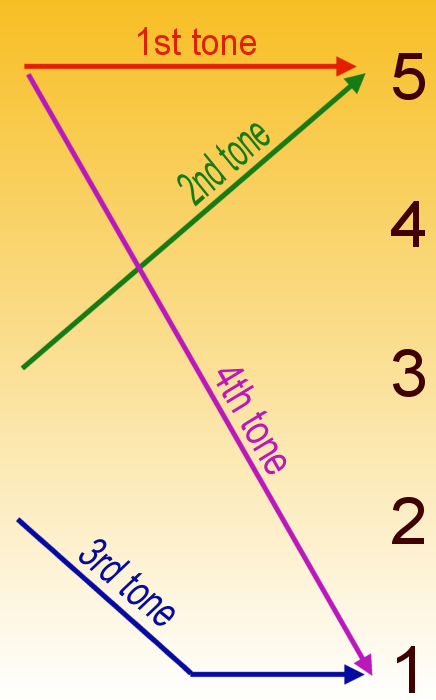
There are four main tones in Mandarin, plus a fifth neutral tone.
- First Tone (mā): A high, flat sound. Imagine a singer holding a high note. The tone mark is a straight line: .
- Second Tone (má): A rising sound. It sounds like you're asking a question, like "Huh?" The tone mark rises: .
- Third Tone (mǎ): A dipping and then rising sound. It’s the lowest and longest tone. The tone mark is a dip: .
- Fourth Tone (mà): A sharp, falling sound. Say it like you're giving a command, like "Stop!" The tone mark falls: .
A syllable with no tone mark is called the neutral tone. It's short, light, and takes its pitch from the syllable before it.
Let's see the tones in action with ma:
- mā (妈): mother
- má (麻): hemp
- mǎ (马): horse
- mà (骂): to scold
- ma (吗): a question particle
Common Sticking Points
For English speakers, some Pinyin sounds can be tricky because they don't map perfectly to English sounds. A little practice goes a long way.
One common challenge is distinguishing between sounds like j, q, and x. The Pinyin q is not like the English 'q'. It's closer to the "ch" sound in "cheese," but with a stronger puff of air. The Pinyin x is like the English 'sh', but with your tongue tip down behind your bottom teeth, creating a sharper, hissing sound.
Another tricky set is z, c, and s versus zh, ch, and sh. The first group is made with the tip of your tongue flat. The second group (zh, ch, sh) requires you to curl your tongue back slightly, similar to the 'r' sound in English.
Don't worry about getting these perfect right away. The goal is to be aware of the differences and listen carefully to native speakers. Consistent practice is the key to mastering them.
What is the primary purpose of Pinyin for a beginner learning Mandarin?
The Mandarin syllable māo (cat) is composed of the initial m and the final ao.
Getting a handle on these basics gives you a powerful tool for learning Mandarin. You're now ready to start pronouncing words and building your vocabulary.