Mandarin Chinese HSK 1
Chinese Phonetics
The Music of Mandarin
Before you can read or write a single Chinese character, you need to learn how to speak. Unlike English, where spelling can be wildly inconsistent, Mandarin Chinese has a clever tool to help you with pronunciation. It's called Pinyin.
Pinyin is the Romanization system for Chinese characters and is crucial for beginners to learn pronunciation and tones accurately.
Pinyin uses the same alphabet you already know to spell out the sounds of Mandarin words. It's not a new language; it's a pronunciation guide. For example, the character for "hello," 你好, is written in Pinyin as nǐ hǎo. Once you learn the rules of Pinyin, you can pronounce any word you see written this way.
Pitch Makes Perfect
Here's the most important new concept for English speakers: Mandarin is a tonal language. The pitch of your voice when you say a syllable can completely change its meaning. Think of it like a simple melody. The same syllable sung on a different note becomes a different word.
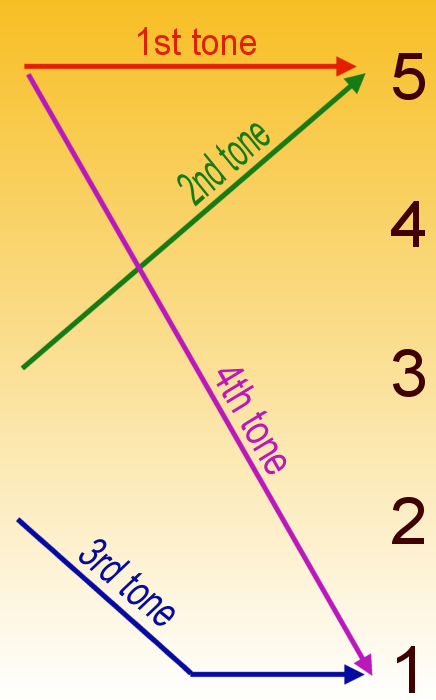
Mandarin has four main tones, plus a fifth neutral tone. Let's look at them using the Pinyin syllable ma.
First Tone (mā): This is a high, flat sound. Imagine a doctor asking you to say "ahhh." It's that steady, high pitch. The Pinyin mark is a straight line: mā.
mom
Second Tone (má): This tone rises. It sounds like you're asking a question, like "Huh?" Your voice starts in the middle and goes up. The mark is a rising line: má.
hemp
Third Tone (mǎ): This is a dipping tone. Your voice starts in the middle, drops low, and then rises again. It's the most complex tone. The mark is a small v-shape: mǎ.
horse
Fourth Tone (mà): This is a sharp, falling tone. Imagine you're giving a command, like "Stop!" Your voice starts high and drops quickly. The mark is a falling line: mà.
to scold
There's also a Neutral Tone. It has no mark and is pronounced lightly and quickly. You'll often find it on the second syllable of a two-syllable word. For example, the word for "mom" is māma. The first ma has the first tone, and the second is neutral.
Sound Components
Every Pinyin syllable is made of two parts: an initial and a final.
An initial is the consonant sound at the beginning of the syllable. Think of sounds like b, p, m, f, d, t, n, and l.
A final is the rest of the syllable, which always includes a vowel sound. For example, in the syllable bāo (meaning "bun"), b is the initial and āo is the final. The tone mark always goes over the main vowel in the final.
Initial (Consonant) + Final (Vowel part) = Pinyin Syllable
Some syllables don't have an initial. Words like ài (love) or ān (peace) consist only of a final. But every single syllable in Mandarin has a final.
When Tones Change
Tones can sometimes change when they're next to each other. This makes the language flow more smoothly. The most important rule for a beginner is what happens when two third tones are together.
If you have a word made of two third-tone syllables, it's difficult to do that full dip-and-rise twice. To make it easier, the first third tone changes into a second (rising) tone.
For example, the word for "hello" is nǐ hǎo. Both nǐ and hǎo are third tones. But when you say them together, you pronounce it as if it were ní hǎo (second tone + third tone).
This might seem tricky, but it happens automatically in speech. The Pinyin spelling stays the same, so you still write nǐ hǎo. It's just a pronunciation shortcut.
Ready to check your understanding? Let's see what you've learned about Pinyin and tones.
What is the primary function of Pinyin in learning Mandarin Chinese?
The Pinyin syllable mǎ uses the third tone. This tone is best described as having a _______ sound.
Mastering Pinyin and tones is the first, most crucial step in learning to speak Mandarin. With this foundation, you'll be ready to build your vocabulary and start communicating.