Mandarin Chinese Fundamentals
Pinyin and Tones
The Sound of Mandarin
Before you can read or write Chinese characters, you need to learn how they sound. This is where Pinyin comes in. Pinyin is the official system for writing Mandarin sounds using the Roman alphabet. It’s not a separate language; it's a pronunciation tool. Mastering it is the first and most important step to speaking Chinese clearly.
Pinyin is the Romanization system for Chinese characters and is crucial for beginners to learn pronunciation and tones accurately.
Every sound in Mandarin is a syllable, and every syllable is made of two parts: an initial and a final.
Initials and Finals
Think of initials as the starting consonant sound and finals as the vowel sound that follows. For example, in the Pinyin syllable bāo (meaning “bun”), b is the initial, and ao is the final. Some syllables don't have an initial and are just a final, like ài (love).
| Part | Description | Examples |
|---|---|---|
| Initial | The consonant sound that begins a syllable. | b, p, m, f, d, t, n, l, z, h |
| Final | The vowel sound that ends a syllable. | a, o, e, i, u, ü, ai, ei, ao, ou |
By combining one initial with one final, you can form most of the syllables in Mandarin. For instance, the initial h plus the final ǎo creates the syllable hǎo, which means “good.” Simple enough, right? But there's one more layer that gives Mandarin its unique musicality: tones.
Pitch Makes Perfect
Mandarin is a tonal language. This means the pitch you use to say a syllable changes its meaning completely. The syllable ma can mean “mother,” “hemp,” “horse,” or “to scold,” depending entirely on how your voice rises or falls. There are four main tones, plus a fifth neutral tone.
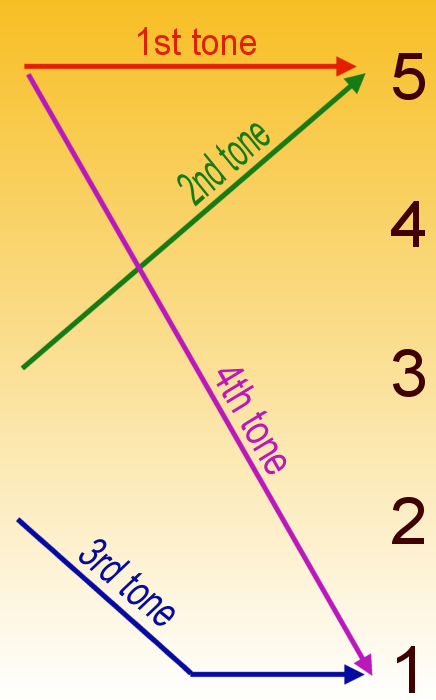
Let's break down each tone using the syllable ma.
The First Tone (mā) is high and flat. Imagine a doctor asking you to say “ahhh.” Your voice stays at a high, level pitch. The tone mark is a flat line: ¯.
The Second Tone (má) is a rising tone. It sounds like you're asking a question, like “Huh?” Your pitch starts in the middle and goes up. The tone mark is a rising line: ´.
The Third Tone (mǎ) is a dipping tone. Your pitch starts mid-level, drops low, and then rises again. It's the longest and most complex tone. The tone mark is a small v-shape: ˇ.
The Fourth Tone (mà) is a sharp, falling tone. It sounds like a command, like saying “Stop!” Your pitch starts high and drops quickly. The tone mark is a falling line: ˋ.
| Tone | Pinyin | Character | Meaning |
|---|---|---|---|
| 1st (high, flat) | mā | 妈 | mother |
| 2nd (rising) | má | 麻 | hemp |
| 3rd (dipping) | mǎ | 马 | horse |
| 4th (falling) | mà | 骂 | to scold |
There's also a Neutral Tone, which has no tone mark. It's pronounced lightly and quickly, often taking its pitch from the syllable before it. You can see it in the word māma (mom), where the second ma is neutral.
When writing in Pinyin, you should always include the tone marks. They are usually placed over the main vowel of the final.
Getting the tones right is essential for being understood. At first, it might feel strange, but with practice, distinguishing and producing them becomes second nature. Listening to native speakers is the best way to train your ear.
What is the primary purpose of Pinyin?
In the Pinyin syllable hǎo, what are the initial and the final?