Mandarin Chinese for Beginners
Mandarin Pronunciation
The Building Blocks of Sound
To speak Mandarin, you don't need to learn a new alphabet right away. Instead, you'll use a system called Pinyin. It uses the letters you already know from the Roman alphabet to show you how to pronounce Mandarin words. Think of it as a pronunciation guide that makes the language accessible from day one.
Every syllable in Pinyin is built from two parts: an initial and a final. The initial is the consonant sound that starts the syllable, and the final is the vowel sound that follows.
Initials and Finals
Initials are the starting consonant sounds. There are 21 of them, and many sound similar to their English counterparts, like b, p, m, and f. Others are new and require some practice.
For example, the sound for zh is like the 'j' in 'jeep', but with the tip of your tongue curled back slightly. The sound for c is like the 'ts' in 'cats'.
| Pinyin Initial | Approximate English Sound |
|---|---|
| b, p, m, f | Similar to English |
| d, t, n, l | Similar to English |
| g, k, h | Similar to English |
| j, q, x | No direct English equivalent; require tongue placement behind bottom teeth |
| zh, ch, sh, r | Sounds made with the tongue curled back |
| z, c, s | Similar to 'dz', 'ts', and 's' |
Finals are the rest of the syllable, typically a vowel or a combination of vowels. Sometimes they end with n or ng. Every single syllable in Mandarin has a final.
A syllable can exist with just a final (like ài or ān), but it cannot exist with just an initial.
The Music of Mandarin
Here’s where Mandarin gets its unique musical quality. It's a tonal language. This means the pitch you use to say a syllable changes its meaning completely. The syllable ma can mean 'mother', 'hemp', 'horse', or 'to scold', all depending on your tone.
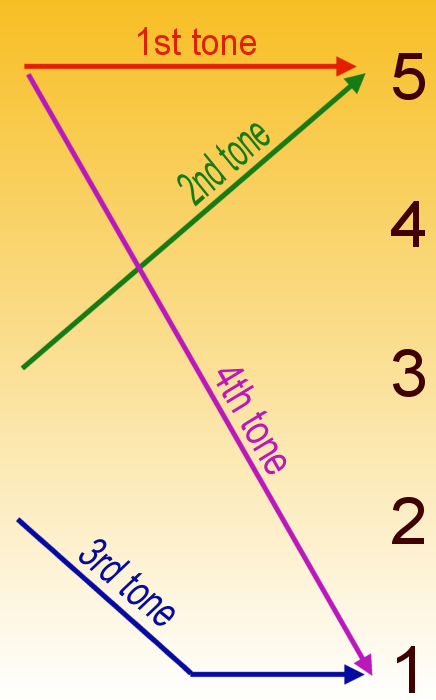
There are four main tones, plus a fifth neutral tone.
| Tone | Name | Description | Example |
|---|---|---|---|
| 1st | High Tone (—) | A high, flat pitch. Like singing a high note. | mā (媽/妈 - mother) |
| 2nd | Rising Tone (ˊ) | Starts mid-range and rises. Like asking, "Huh?" | má (麻 - hemp) |
| 3rd | Dipping Tone (ˇ) | Starts mid-low, dips down, then rises. | mǎ (馬/马 - horse) |
| 4th | Falling Tone (ˋ) | Starts high and falls sharply. Like a command, "Stop!" | mà (罵/骂 - to scold) |
| Neutral | Neutral Tone | Has no tone mark. It's short, light, and unstressed. | ma (嗎/吗 - question particle) |
Tones That Change
Sometimes, tones change to make speaking smoother. This is called tone sandhi. The most important rule to learn is what happens when two third tones appear back-to-back.
When two words with a third tone are said together, the first word changes to a second tone.
Third Tone Sandhi Rule:
3rd tone + 3rd tone → 2nd tone + 3rd tone
A perfect example is the most common greeting in Mandarin, 你好 (nǐ hǎo).
Individually, nǐ (you) is a third tone, and hǎo (good) is also a third tone. But when you say them together, it sounds unnatural to do two full dips. So, nǐ changes to a second tone, and you pronounce the phrase as ní hǎo.
This happens automatically in speech. You'll get the hang of it just by listening and practicing common phrases.
What is the primary purpose of Pinyin in learning Mandarin?
Every Pinyin syllable is made up of which two components?
Mastering Pinyin and tones is the single most important step you can take at the beginning of your Mandarin journey. With a solid foundation in pronunciation, everything else will be much easier to learn.