Managing Uncertainty and External Factors
Understanding Uncertainty
What is Uncertainty?
Uncertainty is the gap between what we know and what we need to know to make a perfect decision. It’s a state of incomplete information about the future. While we often lump all kinds of uncertainty together, it’s helpful to split them into two main categories.
Think about predicting the weather. A forecast might say there's a 70% chance of rain. This is one type of uncertainty. We know the possible outcomes (rain or no rain) and can assign probabilities. Now, think about predicting whether a brand-new technology will be widely adopted in ten years. The possible outcomes are much harder to define, and assigning a probability is mostly guesswork. This is a different, deeper kind of uncertainty.
| Type | Description | Example |
|---|---|---|
| Aleatory Uncertainty | Often called risk. The outcomes are unknown, but the probabilities are known. It's randomness within a defined system. | Rolling a fair six-sided die. You don't know if you'll get a 4, but you know the probability is 1/6. |
| Epistemic Uncertainty | Often called ambiguity or radical uncertainty. It stems from a lack of knowledge. The outcomes, the probabilities, or both are unknown. | Predicting the social impact of artificial intelligence in 30 years. We don't fully know the variables at play. |
Understanding this distinction is key. Aleatory uncertainty can often be managed with statistics and probability. Epistemic uncertainty, on the other hand, requires a different approach. You can't calculate your way out of it because the fundamental rules of the situation are unclear.
The Brain on Uncertainty
Our brains are prediction machines. They constantly build models of the world to anticipate what will happen next. This ability to predict helps keep us safe and allows us to plan. Uncertainty throws a wrench in this process.
When faced with ambiguity, the brain can trigger a threat response similar to the one caused by physical danger. This isn't a flaw; it's a feature designed for survival. An ancient human who was uncertain about a rustling in the bushes and assumed it was a predator was more likely to survive than one who assumed it was just the wind.
This response can lead to feelings of anxiety, stress, and a desire to regain control. It’s why we check the weather forecast obsessively before a trip or refresh a tracking page for a package. We're seeking information to close the uncertainty gap and calm our internal alarm bells.
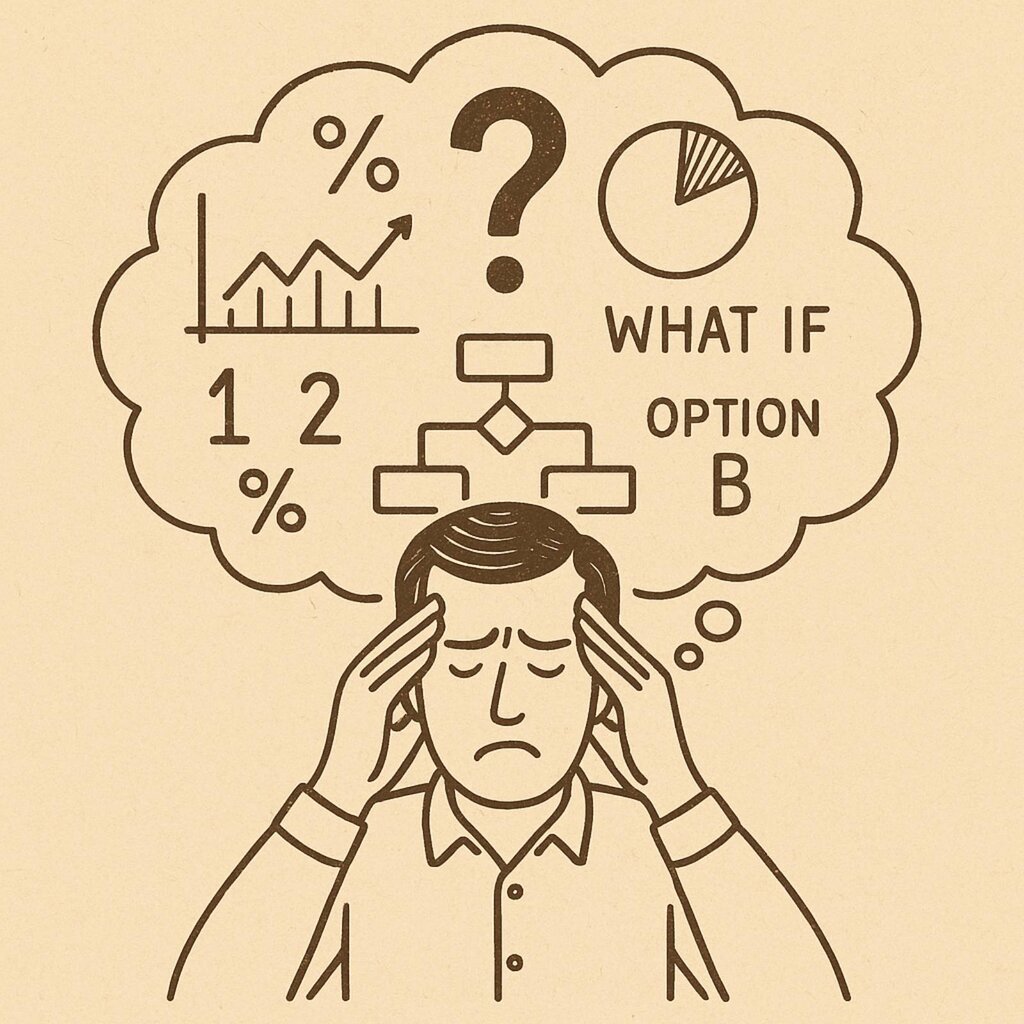
The psychological weight of uncertainty also affects how we think. It can lead to analysis paralysis, where the fear of making the wrong choice in an unpredictable situation makes us choose nothing at all. We might also fall back on cognitive biases, like focusing only on the worst-case scenario (catastrophizing) or sticking to a familiar but potentially worse option just because it feels more certain.
Chronic uncertainty can be exhausting. The brain uses a lot of energy trying to model an unpredictable future, leading to mental fatigue.
How Uncertainty Shapes Decisions
When the path forward is clear, making a decision is straightforward. You weigh the known pros and cons and choose the best option. Uncertainty removes that clarity and forces us to make choices with incomplete information.
Imagine you have two job offers. One is a stable, predictable role at a large corporation with a clear salary and career path. The other is at an early-stage startup. The startup offers equity and a chance to work on groundbreaking technology, but its future is highly uncertain. It could become hugely successful, or it could fail within a year.
Without uncertainty, the decision would be easy—you'd know the startup's future. With uncertainty, the decision becomes about your tolerance for risk and ambiguity. Do you prioritize stability or the potential for a higher reward? Uncertainty forces us to shift from simple calculation to strategic judgment.
This effect scales up from personal choices to major business and policy decisions. Companies must decide whether to invest in new, unproven markets. Governments have to create policies for complex, unpredictable challenges like climate change or pandemics. In these scenarios, waiting for certainty isn't an option. The ability to make sound decisions despite uncertainty becomes a critical skill.
By first understanding what uncertainty is and how it affects us, we can begin to build a framework for navigating it more effectively. It’s not about eliminating uncertainty, which is often impossible, but about learning to operate and thrive within it.