Managing a Solo Business Unit in a Corporation
Understanding Corporate Structures
How Companies Organize Themselves
Every large company needs a blueprint for how it operates. This blueprint is its organizational structure. It dictates who reports to whom, how teams are grouped, and how information flows. Think of it as the company's skeleton. The shape of that skeleton determines how the company moves, reacts, and grows.
Understanding these structures is key because they directly affect how individual business units, even a one-person unit, function within the larger corporate body. Your unit's autonomy, access to resources, and communication pathways all depend on the company's chosen structure.
The Functional Structure
The most traditional approach is the functional structure. Companies using this model group employees based on their skills and expertise. You'll have a marketing department, a finance department, an engineering department, and so on. Everyone in a specific department reports up to a single manager, like a Vice President of Marketing.
This structure is efficient. It allows for deep specialization, as everyone is working with peers in their field. The downside? It can create silos. The marketing team might not communicate well with engineering, slowing down projects that require collaboration across departments. It works best for smaller companies or those with a narrow product line.
The Divisional Structure
As companies grow and diversify, many adopt a divisional structure. Here, the organization is split into semi-autonomous divisions. Each division is dedicated to a specific product, market, or geographic region. For example, a global electronics company might have a "North America Division," an "European Division," and an "Asia Division."
This setup is often called the multi-divisional form, or M-form. Each division operates almost like its own small company, equipped with its own resources for functions like marketing, sales, and operations.
The major advantage of the M-form is focus. Each division can concentrate on its specific market or product and respond quickly to changes. This also creates clear accountability; the performance of each division is easy to measure. However, it can lead to redundant roles and resources across the company. The divisions might also end up competing with each other instead of cooperating.
The Matrix Structure
Some companies need the best of both worlds: the specialization of a functional structure and the focus of a divisional one. The result is a matrix structure, a hybrid model where employees have dual reporting relationships. An engineer, for instance, might report to the head of the Engineering department (a functional manager) and also to a Project Manager for a specific product they're working on.
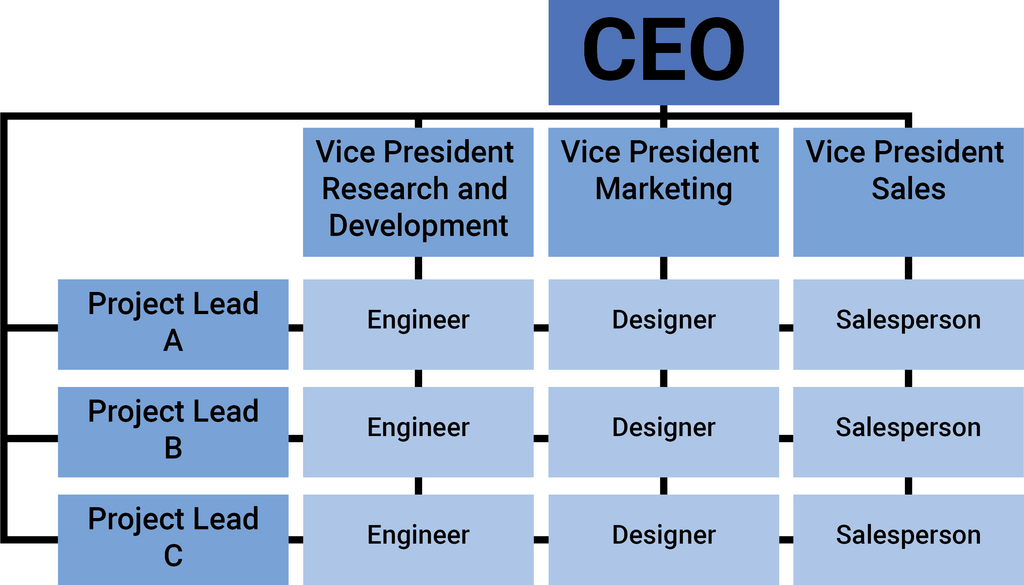
This structure is flexible and promotes collaboration across departments. It allows for dynamic team creation and efficient sharing of specialized resources. The big challenge? It's complex. Having two bosses can lead to conflicting priorities and power struggles. Clear communication is essential for a matrix structure to work effectively.
The structure a company uses shapes the daily reality of its business units. In a divisional M-form, a unit enjoys significant independence. In a functional structure, it's deeply tied to its department but must coordinate with others to get things done. And in a matrix, life is a constant balance of functional duties and project goals. Knowing the layout of the land is the first step to navigating it successfully.
Now, let's check your understanding of these different corporate structures.
In a functional organizational structure, how are employees typically grouped?
A large corporation operates with separate, self-contained units for its North American, European, and Asian markets. Each unit has its own marketing and sales teams. What type of structure does this company most likely use?