Mammalian Maternal Instincts
Introduction to Maternal Care
The First Job
For mammals, a mother's work begins the moment her offspring is born. This investment of time and energy is called maternal care. It's any behavior a mother performs that increases her offspring's chances of survival. This care is crucial for the continuation of a species.
The forms of maternal care are incredibly diverse. A mother might build a nest, produce milk, protect her young from predators, or teach them essential survival skills. Some mammals, like certain species of hamsters, provide care for only a few weeks. Others, like elephants and primates, care for their young for many years, sometimes for their entire lives.

An Evolutionary Edge
Maternal care isn't just a nice gesture; it’s a powerful evolutionary strategy. By investing in her offspring, a mother increases the likelihood that her young will survive, grow to adulthood, and reproduce. This ensures that her own genes are passed on to the next generation.
Larger animals generally have fewer offspring, and spend more time and effort caring for them.
Think of it as quality over quantity. Instead of having many offspring with a low chance of survival, many mammals have fewer young and invest heavily in each one. This approach has proven to be highly successful, allowing mammals to thrive in nearly every environment on Earth.
Born Helpless or Ready to Go?
Mammalian offspring can be broadly divided into two categories based on how developed they are at birth. This classification has a huge impact on the type of maternal care they require.
altricial
adjective
Born in an undeveloped state and requiring care and feeding by the parents.
Altricial young are essentially helpless. Think of newborn kittens, puppies, or human babies. They are often born blind, without fur, and unable to move around or regulate their own body temperature. They depend completely on their mother for warmth, protection, and nutrition. This requires intensive, around-the-clock maternal care.
precocial
adjective
(of a young bird or other animal) hatched or born in an advanced state and able to feed itself almost immediately.
On the other end of the spectrum are precocial offspring. These animals are born in a much more advanced state. Horses, giraffes, and guinea pigs are great examples. A foal can often stand and walk within an hour of birth. While they still rely on their mother for milk and protection from predators, they are far more independent than altricial young. Their maternal care focuses more on guidance and defense rather than constant nursing and warming.
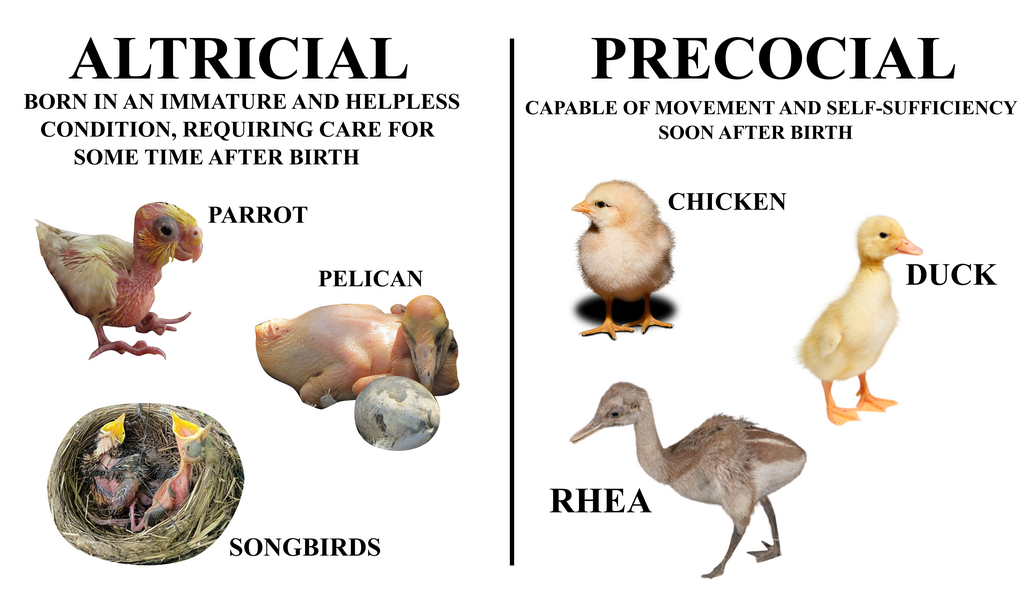
The distinction between altricial and precocial young helps explain the vast differences in maternal strategies across the mammalian world. The needs of the newborn dictate the job of the mother.
Let's check your understanding of these key ideas.
What is the primary definition of maternal care in mammals?
An animal is born blind, without fur, and unable to move on its own. This type of young is known as ______.
Ultimately, maternal care is a fundamental aspect of mammalian life, a diverse and adaptive strategy that ensures the survival of the next generation.