Mammalian Gonad Differentiation Comparative Study
Bipotential Gonad Formation
The Common Ground
Long before any distinction between male and female reproductive organs exists, an embryo lays down a common foundation. This process begins with the intermediate mesoderm, a strip of tissue running along the back of the early embryo. Around the fifth week of development in humans, a specific section of this mesoderm begins to change.
This section, known as the genital ridge or gonadal ridge, starts to thicken. It's not just a simple swelling of tissue. The process involves active proliferation of two key cell populations: the coelomic epithelium on the surface and the underlying mesenchyme. Together, they build a pair of elongated bulges that are the precursors to both testes and ovaries.
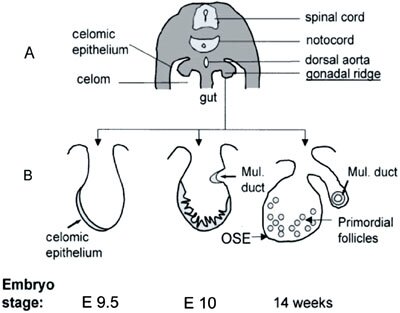
In both male and female embryos, the same group of cells has the potential to develop into either the male or female gonads; this tissue is considered bipotential.
Molecular Architects
This initial construction is tightly controlled by specific genes that act as architects. Two of the most critical are WT1 and SF1. They don't determine the sex of the gonad, but they ensure it can form in the first place.
The gene Wilms Tumor 1 (WT1) is essential for the very first step: the formation of the genital ridge. It directs the mesenchymal cells to transform and prepare for gonad development. Without functional WT1, the ridge fails to form properly and the cells undergo apoptosis, or programmed cell death. Development simply stops.
Once the ridge is established, Steroidogenic Factor 1 (SF1) takes a leading role. This transcription factor, encoded by the NR5A1 gene, is crucial for the survival and proliferation of the cells within the developing gonad. It keeps the growth process going, building up the structure that will eventually house the germ cells. SF1 essentially tells the gonadal cells to expand and prepare for their future role.
Arrival of the Germ Cells
While the genital ridge is forming, another critical event is happening elsewhere. The primordial germ cells (PGCs), the precursors to sperm and eggs, are on a journey. They originate in a region outside the embryo proper, in the wall of the yolk sac.
Guided by chemical signals, these cells migrate through the developing gut and into the dorsal mesentery. From there, they enter the newly formed genital ridges. Their arrival is a crucial milestone. The structural cells of the gonad, directed by WT1 and SF1, have built the house; the PGCs are the residents who will move in and define its ultimate purpose.
At this point, with the structure built and the germ cells in place, the gonad is in a neutral, or bipotential, state. It is anatomically identical in both XX and XY embryos, ready and waiting for the specific genetic signals that will direct it down either the male or female developmental pathway.
What is the primary function of the gene WT1 (Wilms Tumor 1) in the early development of the reproductive system?
Primordial germ cells (PGCs), the precursors to sperm and eggs, originate in which location?