Mah Jong Fundamentals
Mahjong Tiles
The Building Blocks
A standard Mahjong set is a treasure chest of symbols and characters. It contains 144 tiles, divided into three main categories: Suits, Honors, and Bonuses. Think of these as the fundamental pieces you'll use to build winning hands. Each tile has a specific identity and value within the game.
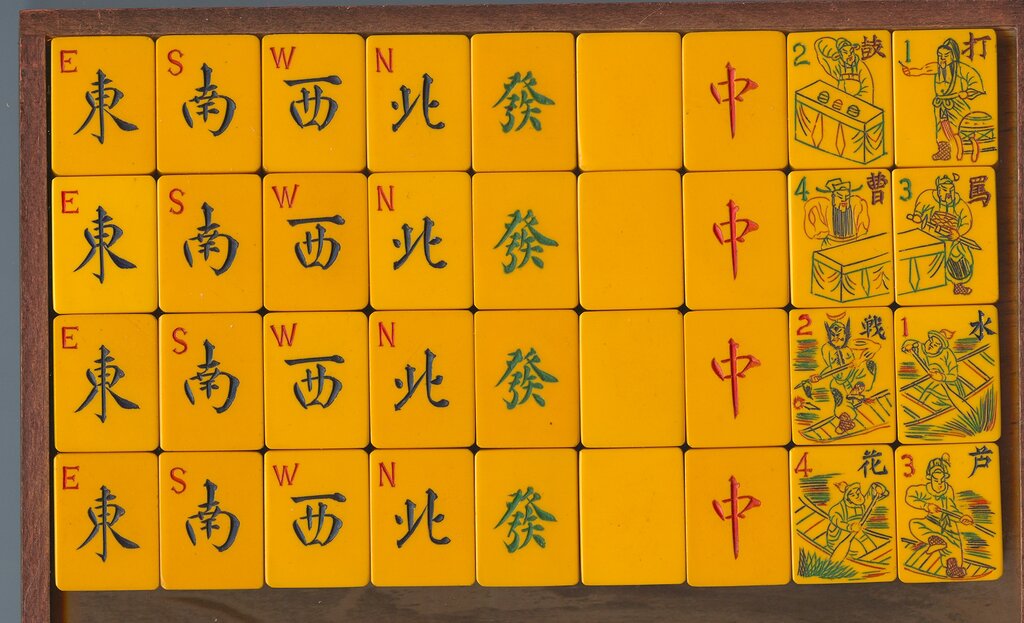
Let's break down the entire set. The vast majority of tiles belong to one of three suits. These are followed by the powerful Honor tiles, and finally, the optional Bonus tiles that can add an element of luck to the game.
The Three Suits
Just like a deck of playing cards, Mahjong has suits. There are three of them: Characters, Bamboos, and Dots. Each suit contains tiles numbered from one to nine, and there are four identical copies of each tile. This gives us 3 suits × 9 numbers × 4 copies = 108 suit tiles in total.
The numbered tiles from 2 through 8 in any suit are called Simples. The 1s and 9s are called Terminals because they're at the ends of the sequence.
The first suit is Characters. These tiles feature a Chinese character on the bottom, 萬, which represents the number 10,000. The character on top, from one to nine, indicates the tile's number.
Character suit
Next is the Bamboo suit. These tiles show a number of bamboo sticks, from two to nine. The 1 Bamboo is an exception; it's usually depicted as a bird, often a sparrow or peacock, perched on a bamboo stalk.
Bamboo suit
The final suit is Dots, also known as Circles or Coins. These tiles are straightforward, featuring one to nine circles, which are said to represent copper coins.
Dot suit
Honors and Bonuses
Beyond the numbered suits are the Honor tiles. These tiles don't have a numerical sequence but are very important in the game. They are split into two groups: Winds and Dragons. Like the suit tiles, there are four copies of each Honor tile.
The Wind tiles are East (東), South (南), West (西), and North (北). The Dragon tiles are Red (中), Green (發), and White (白板). The White Dragon is often a blank tile, but some sets have a blue border on it.
Finally, we have the Bonus tiles. These are the eight remaining tiles in the 144-tile set. They consist of four Flowers and four Seasons. Unlike other tiles, there is only one of each. Their use varies depending on the regional rules being played, and in some variations, they are not used at all.
Flower tiles are typically Plum, Orchid, Chrysanthemum, and Bamboo. Season tiles are Spring, Summer, Autumn, and Winter.
To bring it all together, here is the complete breakdown of a standard Mahjong set.
| Category | Type | Tiles | Count |
|---|---|---|---|
| Suits | Characters | 1-9 | 36 |
| Bamboos | 1-9 | 36 | |
| Dots | 1-9 | 36 | |
| Honors | Winds | East, South, West, North | 16 |
| Dragons | Red, Green, White | 12 | |
| Bonuses | Flowers | Plum, Orchid, Chrysanthemum, Bamboo | 4 |
| Seasons | Spring, Summer, Autumn, Winter | 4 | |
| Total | 144 |
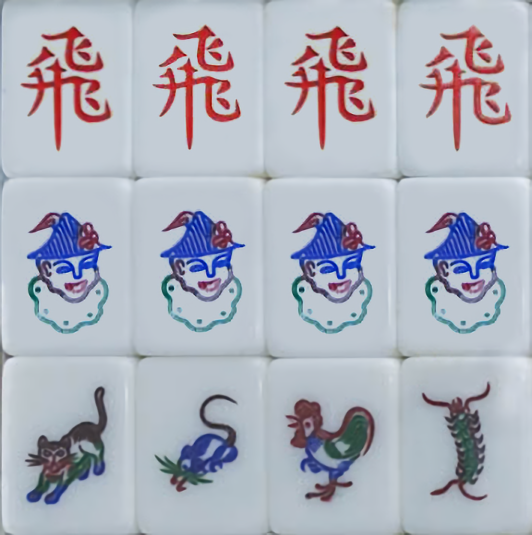
Some Mahjong sets, particularly American and Singaporean versions, include additional tiles like Jokers or Animals, but the 144 tiles described here form the basis for most traditional forms of the game.
Now, let's test your knowledge of the tiles.
How many suit tiles (Characters, Bamboos, and Dots) are in a standard 144-tile Mahjong set?
What is typically depicted on the 1 Bamboo tile?
Understanding these tiles is the first step. Once you can identify each piece, you're ready to learn how they come together in the game.