Magnetic Circuits Explained
Magnetic Flux
Counting Invisible Lines
Imagine holding a net in a river. The amount of water flowing through the net depends on how fast the river is moving, the size of your net, and the angle you hold it at. If you hold it facing the current, you catch the most water. If you hold it parallel to the current, no water flows through it at all.
Magnetic flux is a similar idea. Instead of water, we're measuring an invisible magnetic field. And instead of a net, we have a surface or an area. Magnetic flux is a way to count the total amount of magnetic field passing through a specific area.
To visualize this, physicists use the concept of magnetic field lines. These are imaginary lines that show the direction and strength of a magnetic field. Where the lines are close together, the field is strong. Where they're spread out, it's weaker. Magnetic flux, then, is simply the total number of these lines passing through our surface.
How We Measure Flux
As the river analogy suggests, three key factors determine the amount of magnetic flux:
| Factor | Description |
|---|---|
| Magnetic Field Strength () | A stronger magnetic field (denser field lines) results in more flux. |
| Area () | A larger area will have more field lines passing through it, increasing the flux. |
| Angle () | The orientation of the area relative to the field lines is crucial. |
The angle is the most interesting part. Maximum flux occurs when the area is perfectly perpendicular to the magnetic field lines, allowing the most lines to pass through. If the area is parallel to the field, no lines actually pass through it, so the flux is zero.
We can put this all together in a single equation:
Here, is the symbol for magnetic flux. The angle is measured between the magnetic field lines and the "normal" line, which is a line that sticks straight out from the surface, perpendicular to it.
When the surface directly faces the field, the normal line and the field lines are parallel, so . Since , the flux is at its maximum value: . When the surface is edge-on to the field, the normal line is perpendicular to the field lines, so . Since , the flux is zero.
Weber
noun
The standard unit of magnetic flux. One Weber (Wb) is equal to one Tesla (the unit of magnetic field strength) multiplied by one square meter.
From Lines to Reality
While magnetic field lines are a helpful drawing tool, they represent a very real phenomenon. You can see their pattern by sprinkling iron filings around a magnet. The filings align themselves along the field lines, giving us a map of the invisible field.
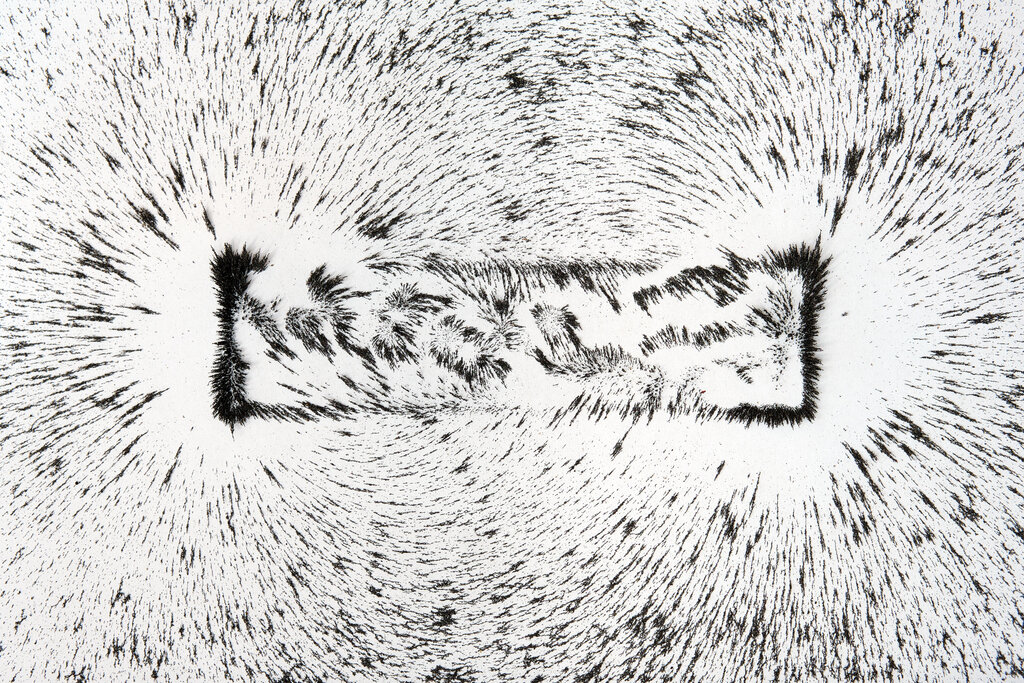
The density of the filings shows the field's strength, . Magnetic flux, , isn't just about the density, but about the total number of lines we can count passing through a given area. It's the big-picture view of how much magnetism is available in a certain space.
This concept is more than just an accounting trick for invisible lines. The idea of changing magnetic flux is the foundation for how we generate electricity in power plants and how electric motors work, making it one of the most important concepts in electromagnetism.
What does magnetic flux quantify?
To achieve the maximum possible magnetic flux through a flat surface, what should the angle be between the magnetic field lines and the 'normal' line of the surface?