Machine Learning with Python
Introduction to Machine Learning
What Is Machine Learning?
Machine learning teaches computers to learn from experience, much like humans do. Instead of writing explicit, step-by-step instructions for every possible scenario, developers create systems that can recognize patterns in data and make predictions or decisions on their own.
Think of it like this: you can tell a computer exactly what a stop sign looks like—an octagon, red, with the letters S-T-O-P. But what about a sign that's faded, partially covered by a tree branch, or seen at a weird angle? Explicit programming struggles here. With machine learning, you can show the computer thousands of pictures of stop signs in different conditions and let it figure out the essential characteristics on its own. It learns what a stop sign is rather than just memorizing a single description.
Machine learning is the science of getting computers to act without being explicitly programmed.
The Three Flavors of Learning
Machine learning isn't a single technique but a broad field with several different approaches. The three main types are supervised, unsupervised, and reinforcement learning.
Supervised Learning
other
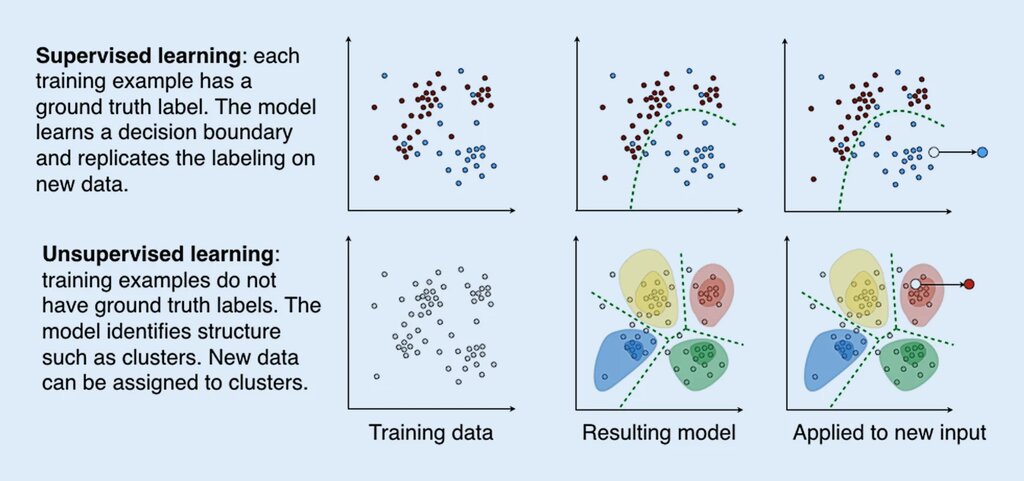
Learning from labeled data to make predictions. The model is 'supervised' because the correct answers are provided during training.
In supervised learning, the machine learns from a dataset that has been neatly labeled with the correct answers. It's like studying for a test with a complete answer key. The goal is to learn the relationship between the input data and the output labels so it can predict the labels for new, unseen data. For example, to predict house prices, you would train a model on a dataset of houses that includes features (like square footage and number of bedrooms) and the final sale price (the label).
Unsupervised Learning
other
Finding hidden patterns or structures in unlabeled data. There is no 'teacher' or answer key.
Unsupervised learning is about exploration. The machine is given a dataset without any labels and tasked with finding interesting patterns or structures on its own. Think of sorting a mixed bag of LEGO bricks by shape and color without being told what the categories are. This method is great for customer segmentation, where a business might want to discover different groups of customers based on their purchasing behavior.
Reinforcement Learning
other
An agent learns to make decisions by performing actions in an environment to achieve a goal. It learns through trial and error, guided by rewards or penalties.
This type of learning is modeled on how we train pets. An algorithm, or 'agent', learns by interacting with an environment. It receives rewards for actions that get it closer to a goal and penalties for actions that move it further away. Over many trials, the agent figures out the best strategy to maximize its total reward. This is the magic behind AIs that can master complex games like Go or robots that learn to walk.
A Typical Workflow
Developing a machine learning model isn't a single event but a cycle. While the specifics can change, most projects follow a general path from an idea to a functioning application.
-
Define the Problem: What question are you trying to answer? Do you want to classify something (e.g., spam or not spam), predict a value (e.g., house price), or find groups (e.g., customer segments)? A clear goal is crucial.
-
Collect and Prepare Data: This is often the most time-consuming step. Data must be gathered from various sources, cleaned of errors and inconsistencies, and formatted correctly for the model. The quality of your data directly determines the quality of your model. This is where the principle of "garbage in, garbage out" is most apparent.
-
Train the Model: Here, you select an appropriate learning approach (like supervised or unsupervised) and feed your prepared data into it. The model learns the patterns from the data through an iterative process.
-
Evaluate the Model: Once trained, the model's performance is tested on a separate set of data it hasn't seen before. This evaluation shows how well it will perform in the real world. Is it accurate? Is it reliable?
-
Deploy and Monitor: If the model performs well, it's deployed into a live environment where it can start making predictions on new data. The work isn't over, though. The model must be monitored to ensure its performance doesn't degrade over time as new data comes in. This often leads back to step 2, creating a continuous cycle of improvement.
Ready to check your understanding of these core concepts?
Which statement best describes the fundamental difference between machine learning and traditional programming?
A bank wants to group its customers into different segments based on their transaction history to offer tailored services. The bank does not have any pre-defined group labels for these customers. Which type of machine learning is most suitable for this task?
Machine learning is a powerful tool for solving complex problems, from recommending your next movie to helping doctors diagnose diseases. By understanding its fundamental concepts and workflow, you can better appreciate the technology that shapes so much of our digital world.