Machine Learning with Python
Introduction to Machine Learning
What Is Machine Learning?
Machine learning is a way of teaching computers to find patterns. Instead of writing step-by-step instructions for every possible situation, we give the computer a lot of data and let it figure out the rules for itself. It’s a bit like how a child learns to recognize a dog. You don't list all the rules for what makes a dog; you just show them lots of dogs. Eventually, they learn to spot one on their own.
At its core, machine learning is the process of a computer learning from data without being explicitly programmed.
In traditional programming, you'd write code like, "If an email contains the words 'free' and 'money,' mark it as spam." A machine learning approach would be to show the computer thousands of emails that humans have already marked as spam. The computer then learns the common characteristics of spam emails on its own, which might be far more complex and accurate than any rules we could write by hand.
Types of Machine Learning
Machine learning isn't just one single technique. It's a broad field with several different approaches. The three main types you'll encounter are supervised, unsupervised, and reinforcement learning.
Supervised Learning
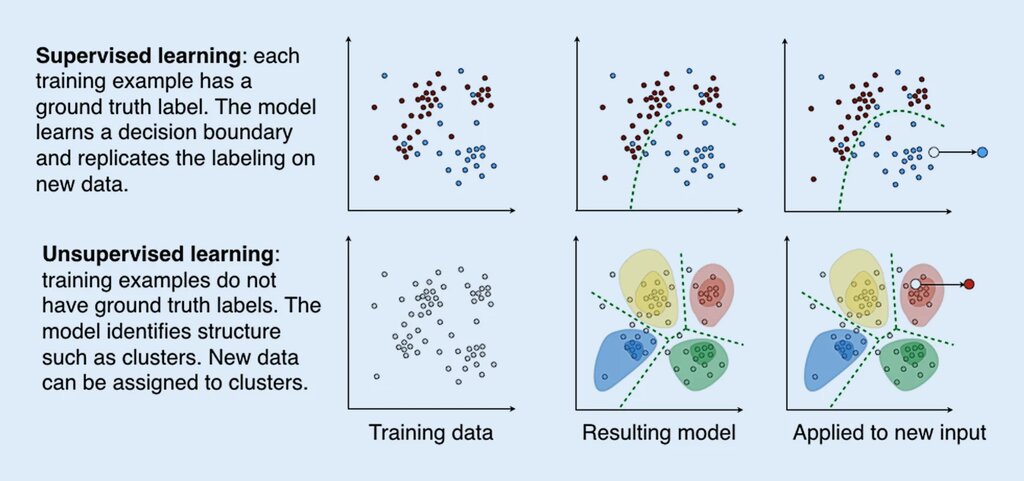
This is the most common type of machine learning. The word "supervised" means we give the model labeled data—essentially, an answer key to learn from. We provide input data along with the correct output.
For example, to train a model to identify pictures of cats, we would feed it thousands of images, each one labeled either "cat" or "not a cat." The model learns the relationship between the pixels in the images and the labels. The goal is for it to accurately label new, unseen images.
Unsupervised Learning
What if you don't have an answer key? That's where unsupervised learning comes in. With this approach, we give the model unlabeled data and ask it to find patterns or structures on its own. It's like handing someone a box of mixed-up Lego bricks and asking them to sort them into groups by color and size.
A common application is customer segmentation. An e-commerce company might use unsupervised learning to group its customers based on their purchasing behavior. This can reveal natural groupings of customers that the company wasn't aware of, allowing for more targeted marketing.
Supervised learning is about prediction. Unsupervised learning is about discovery.
Reinforcement Learning
Reinforcement learning is all about learning through trial and error. It's modeled after how humans and animals learn. An algorithm, or "agent," learns to make decisions by performing actions in an environment to achieve a goal. When it takes an action that gets it closer to the goal, it receives a reward. When it takes a bad action, it gets a penalty.
Think of training a dog. When it sits, you give it a treat (a reward). When it chews on the furniture, you say "No!" (a penalty). Over time, the dog learns which actions lead to rewards. Reinforcement learning is used to train computers to play games like Go or Chess, and it's also used in robotics, where a robot might learn to walk by being rewarded for moving forward without falling.
The Machine Learning Workflow
A machine learning project isn't just about choosing an algorithm. It's a multi-step process that requires careful planning and execution. While the details can vary, most projects follow a general workflow.
-
Define the Problem: First, you need to know what you're trying to achieve. Are you trying to predict house prices, classify customer emails, or recommend movies? A clear goal is essential.
-
Gather & Prepare Data: This is often the most time-consuming step. Data rarely comes in a clean, ready-to-use format. It might need to be cleaned, formatted, and combined from various sources.
-
Choose a Model: Based on the problem you're trying to solve, you select an appropriate type of machine learning model.
-
Train the Model: This is the learning phase. You feed your prepared data to the model. The model adjusts its internal parameters to find patterns in the data.
-
Evaluate the Model: Once the model is trained, you need to see how well it works. You test it on a separate set of data it has never seen before to gauge its real-world performance.
-
Deploy & Monitor: If the model performs well, it's put into production where it can start making predictions on live data. It's also important to monitor its performance over time to ensure it remains accurate.
And that's the basic idea. Machine learning helps us tackle complex problems by enabling computers to learn from experience, much like we do.