Machine Learning Systems and Implementation
Machine Learning Lifecycle
From Idea to Impact
Building a machine learning model isn't just about training an algorithm. In a professional setting, it’s a disciplined engineering process with a clear beginning, middle, and end. Simply creating a model with high accuracy in a notebook is a world away from deploying a reliable, useful system that generates real business value. The difference is the lifecycle.
Think of it like building a bridge. You don't just start welding steel beams together. You begin with understanding the need: who needs to cross, what are they carrying, and where do they need to go? You survey the land, test the soil, and create detailed blueprints. The actual construction is just one phase of a much larger project. Similarly, the ML lifecycle provides the blueprint for building and managing a model from concept to retirement.
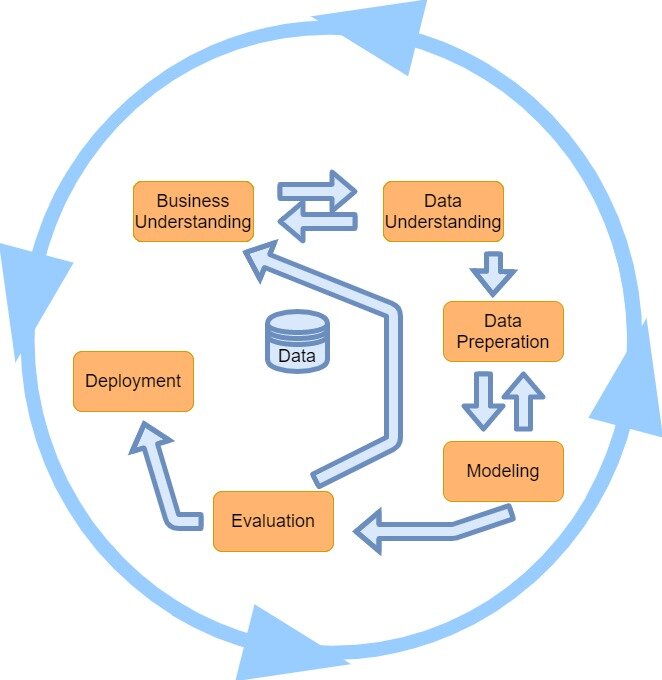
A popular framework for this is the Cross-Industry Standard Process for Data Mining, or CRISP-DM . While originally for data mining, its structure is the foundation for most modern ML workflows. It organizes the process into a series of iterative phases: business understanding, data understanding, data preparation, modeling, evaluation, and deployment.
The CRISP-ML(Q) Framework
To adapt this for modern machine learning, especially systems that need to be reliable and high-quality, we use an extended framework called CRISP-ML(Q). The '(Q)' stands for Quality, emphasizing the continuous monitoring and maintenance required for production systems. This framework helps teams align business goals with technical steps.
1. Business and Data Understanding: This is the most critical phase. Before writing any code, you must define the problem and the desired outcome. What business metric are you trying to improve? Are you trying to reduce customer churn, increase sales, or detect fraud? This is where you work with stakeholders to define success. A model that's 95% accurate is useless if it doesn't solve the business problem.
Part of this phase is also understanding your data. Where will it come from? Is it clean? Does it contain the signals needed to predict the outcome? Sometimes, the necessary data doesn't exist yet, requiring a new collection strategy or even the use of synthetic data generation.
2. Data Preparation: Real-world data is messy. This phase, which often takes up to 80% of a project's time, involves cleaning, transforming, and structuring the data. You'll handle missing values, normalize formats, and perform feature engineering to create variables that the model can effectively learn from.
The distinction between a research project and a production system often comes down to this: in research, you find a dataset to fit your model. In production, you build a data pipeline to fit your business problem.
3. Model Engineering: This is the phase most people associate with machine learning. Here, you select potential algorithms, train various models on your prepared data, and tune their hyperparameters. This is an iterative process of experimentation to find the most promising model architecture for the task.
4. Evaluation: A model that performs well on training data might fail completely on new, unseen data. In this phase, you rigorously test the model's performance against a holdout dataset. But you're not just looking at raw accuracy. You evaluate against the business success criteria defined in phase one. For a fraud detection model, for instance, the cost of a false negative (missing a fraudulent transaction) is much higher than a false positive (flagging a legitimate one). Your evaluation must reflect this reality.
5. Deployment: Getting a model into a production environment where it can make live predictions is a significant engineering challenge. Will it be an API that other services call? Will it run in batches overnight? This phase involves setting up the infrastructure, creating deployment pipelines, and ensuring the model can serve predictions reliably and with low latency.
6. Monitoring and Maintenance: The job isn't done after deployment. The world changes, and a model's performance can degrade over time in a process known as model drift . You need to continuously monitor its predictions, track its business impact, and have a plan for retraining or replacing it when necessary. This is why the CRISP-ML(Q) lifecycle is a loop, not a straight line.
Why It Matters
Understanding this lifecycle provides the 'big picture' for everything that follows. When we discuss data pipelines, model architecture, or deployment strategies later on, you’ll know exactly where that piece fits into the puzzle of creating a successful ML product. It shifts the focus from just building models to building systems that solve problems.
What is the primary purpose of the machine learning lifecycle in a professional setting?
According to the provided text, which phase of the machine learning project often consumes the most time, sometimes up to 80%?