Machine Learning Model Training
Introduction to Machine Learning
What is Machine Learning?
Machine learning lets computers learn from data without being explicitly programmed. Think about how you learned to recognize a cat. You weren't given a long list of rules like "if it has pointy ears, whiskers, and a long tail, it's a cat." Instead, you saw many examples of cats, and your brain gradually learned to identify them.
Machine learning works similarly. It's a way of training a computer by showing it a large amount of data. The computer finds patterns in that data and builds its own rules. This is different from traditional programming, where a developer writes every single instruction the computer needs to follow.
The core idea is simple: instead of writing code, you provide data. The machine learns from the data to perform a task.
Three Ways Machines Learn
Just like people, machines can learn in different ways. The method depends on the type of data available and the goal of the task. The three main types are supervised, unsupervised, and reinforcement learning.
Supervised Learning
other
Learning from data that has been labeled with the correct answers. The goal is to make predictions on new, unseen data.
Supervised learning is like studying with flashcards. Each card has a question (the data) and an answer (the label). For example, you might show a machine thousands of pictures of cats, each labeled "cat," and thousands of pictures of dogs, each labeled "dog." Over time, the machine learns the features that distinguish a cat from a dog.
This method is used for two main types of problems:
- Classification: Sorting data into categories. Is this email spam or not? Is this tumor cancerous or benign?
- Regression: Predicting a continuous value. What will the price of this house be? How many customers will visit the store tomorrow?
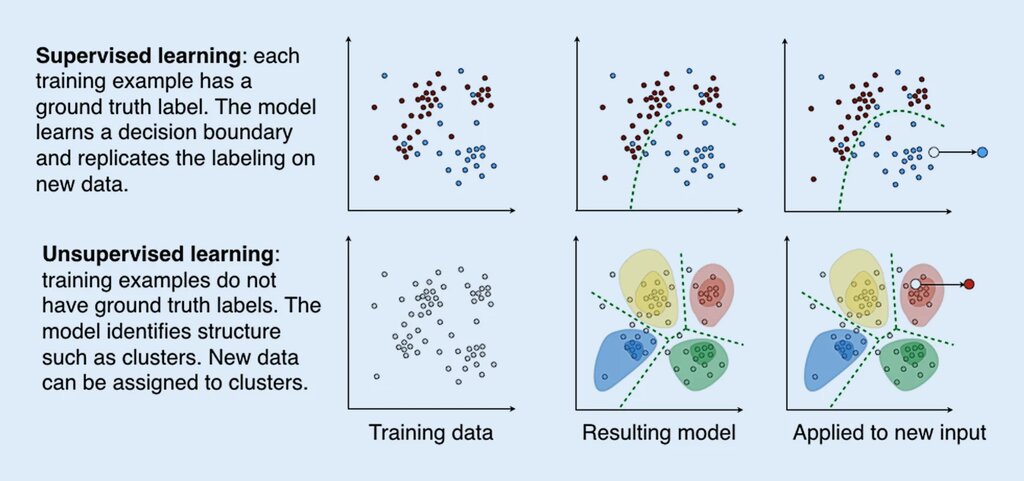
Now, what if your data doesn't have labels?
Unsupervised Learning
other
Learning from unlabeled data. The goal is to find hidden patterns or structures within the data itself.
Unsupervised learning is like being given a box of mixed-up Lego bricks and asked to sort them. You don't know the categories beforehand, but you can start grouping them by color, size, or shape. The machine does the same, finding natural clusters or relationships in the data without any pre-existing labels.
This approach is great for:
- Clustering: Grouping similar data points together, like segmenting customers based on purchasing behavior.
- Association: Discovering rules that describe large portions of your data, such as finding that customers who buy bread also tend to buy milk.
Reinforcement Learning
other
Learning through trial and error. An agent performs actions in an environment and receives rewards or penalties.
Reinforcement learning is how you might train a dog. You tell it to "sit." If it sits, you give it a treat (a reward). If it doesn't, it gets nothing (no reward, or a penalty). Over time, the dog learns that sitting leads to a reward.
In this type of learning, an AI "agent" interacts with an environment. It tries different actions and learns which ones produce the best outcomes by maximizing its total reward. This is the foundation for creating systems that can make complex decisions, like a self-driving car learning to navigate traffic or an AI mastering a complex game like chess or Go.
Where You See Machine Learning
Machine learning isn't just a concept in a lab; it's part of your daily life.
-
Recommendation Engines: When Netflix suggests a movie or Amazon shows you products you might like, that's machine learning at work. It analyzes your past behavior and compares it to millions of other users to predict what you'll enjoy.
-
Voice Assistants: Siri, Alexa, and Google Assistant use machine learning to understand your spoken commands and respond appropriately. This is a field known as Natural Language Processing (NLP).
-
Image Recognition: When you upload a photo to social media and it automatically suggests tags for your friends, it's using machine learning to recognize faces.
-
Fraud Detection: Banks use machine learning to analyze transactions in real-time. It learns your typical spending patterns and can flag unusual activity that might be fraudulent, protecting your account.
What is the primary difference between machine learning and traditional programming?
A bank wants to build a system to identify fraudulent transactions. The system is trained on a large dataset of past transactions, each labeled as either 'fraudulent' or 'not fraudulent'. Which type of machine learning problem is this?
These are the fundamental building blocks of machine learning. By understanding these core concepts, you're ready to explore how these models are actually built and trained.