Machine Learning Mastery from Foundations to Deployment
Introduction to Machine Learning
What Is Machine Learning?
Machine learning is a way of teaching computers to find patterns. Instead of writing explicit, step-by-step instructions for every possible scenario, you give the computer a large amount of data and let it figure out the rules for itself.
Think about how a child learns to recognize a cat. You don't give them a list of rules like "if it has pointy ears, whiskers, and a long tail, it's a cat." Instead, you show them lots of examples. They see cats of different colors and sizes, and over time, their brain learns to identify the key features. Machine learning works in a similar way. It's about learning from examples, not from a rigid set of instructions.
At its core, machine learning is the process of using data to answer questions.
This ability to learn from data makes it incredibly powerful. It can tackle problems that are too complex or change too quickly for a human to program directly. From recommending your next movie to helping doctors diagnose diseases, machine learning is quietly powering many parts of the modern world.
Two Main Styles of Learning
Machine learning isn't just one single technique. It's a broad field with many approaches, but most fall into two main categories: supervised and unsupervised learning.
Supervised Learning
noun
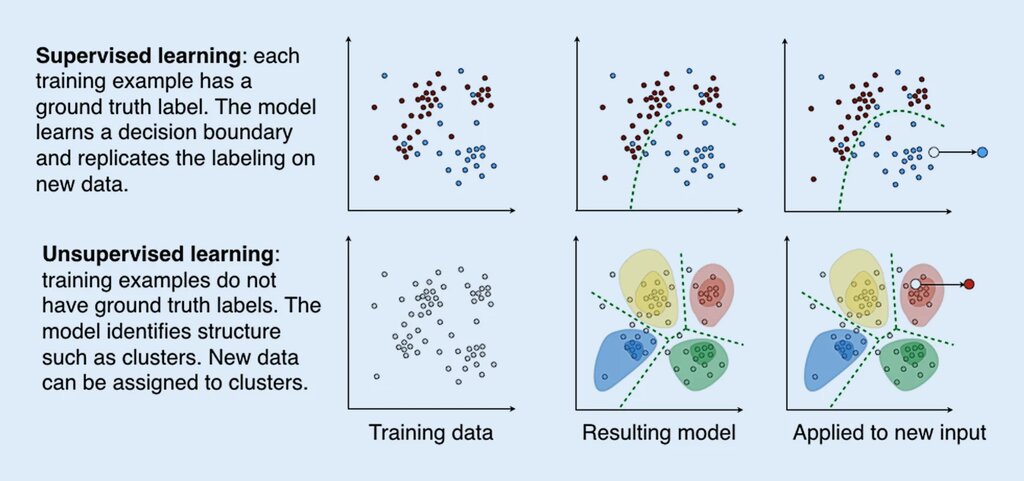
The model learns from data that is already labeled with the correct answers. It's like studying with flashcards that have the question on one side and the answer on the other.
In supervised learning, the goal is to predict an outcome. You provide the model with a dataset where the
In supervised learning, you provide the model with a dataset where the "right answers" are already known. The model's job is to learn the relationship between the inputs and those correct outputs so it can make accurate predictions on new, unlabeled data.
Imagine training a model to identify pictures of apples and oranges. You'd feed it thousands of images, each one labeled "apple" or "orange." The model learns the visual patterns associated with each label. Eventually, you can show it a new, unlabeled picture, and it can confidently tell you which fruit it is.
Unsupervised Learning
noun
The model learns from data that has no labels or correct answers. Its task is to find hidden structures or patterns within the data on its own.
With unsupervised learning, you don't give the model any hints. You just provide the raw data and ask it to make sense of it. The goal isn't to predict a specific outcome, but to explore the data's inherent structure.
A common example is customer segmentation. An e-commerce company might use unsupervised learning to group its customers based on their purchasing behavior. The model might identify a cluster of "frequent bargain hunters," another of "high-spending weekend shoppers," and so on, without being told to look for these specific groups.
The Tools of the Trade
While machine learning concepts can be applied in many programming languages, Python has become the undisputed leader in the field. Its simple syntax, combined with a powerful ecosystem of specialized libraries, makes it the ideal tool for both beginners and experts.
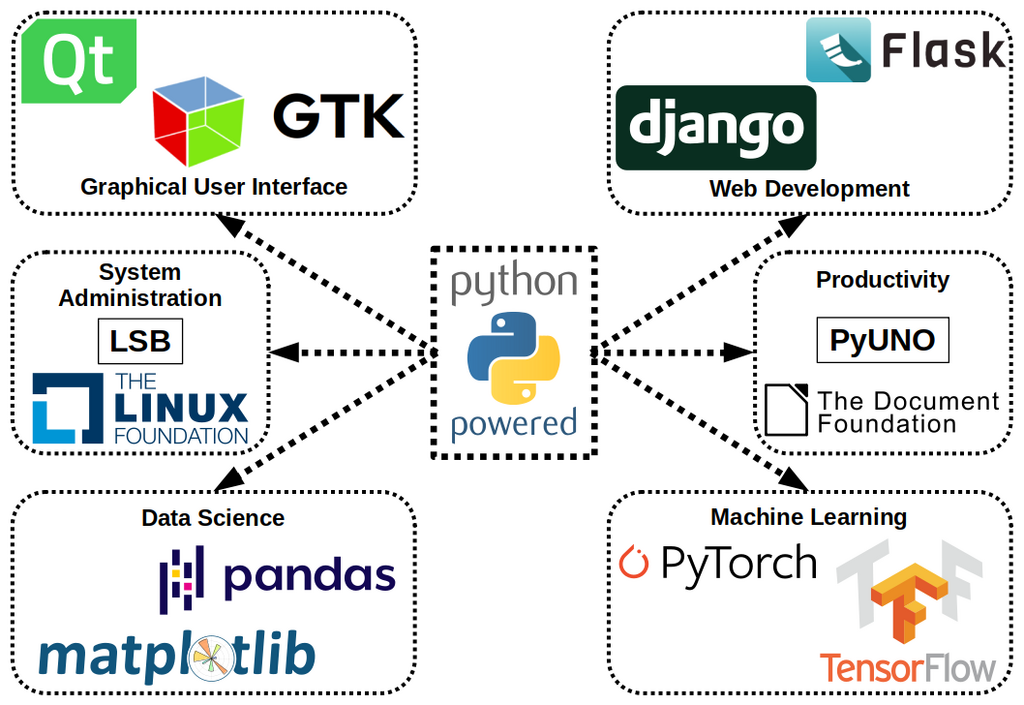
When you work on a machine learning project in Python, you'll almost always use a few core libraries:
| Library | Purpose |
|---|---|
| NumPy | The fundamental package for numerical computing. It provides a high-performance multidimensional array object and tools for working with these arrays. |
| Pandas | Built on top of NumPy, this library offers data structures and operations for manipulating numerical tables and time series. The primary data structure is called a DataFrame. |
| Matplotlib | A comprehensive library for creating static, animated, and interactive visualizations. It allows you to turn your data into informative plots and charts. |
Getting started often begins with simply importing these tools into your programming environment.
# Import the essential libraries

# NumPy is often aliased as 'np'
import numpy as np

# Pandas is often aliased as 'pd'
import pandas as pd

# Matplotlib's pyplot module is aliased as 'plt'
import matplotlib.pyplot as plt

# This line is common in Jupyter notebooks to display plots inline
%matplotlib inline
These three libraries form the foundation for nearly all data science and machine learning work in Python. They give you the power to load, clean, analyze, and visualize your data before you even start building a model.
What is the primary difference between machine learning and traditional programming?
The text compares machine learning to how a child learns to recognize a cat. What key concept does this analogy illustrate?
With these fundamentals in place, you're ready to explore how these concepts and tools are used to build intelligent systems.