Machine Learning Fundamentals
Introduction to Machine Learning
Learning from Patterns
Machine learning gives computers the ability to learn without being explicitly programmed. Instead of writing step-by-step instructions for every possible scenario, we feed a machine data and let it figure out the patterns on its own. It’s a lot like how we learn. A child learns to identify a dog not by memorizing a list of rules, but by seeing many different dogs and gradually understanding what they have in common.
At its core, machine learning is about recognizing patterns in data and using those patterns to make predictions or decisions.
This ability is transformative. It powers everything from the spam filter in your email to the recommendation engine that suggests your next favorite movie. It’s what allows a medical system to spot diseases in scans or a self-driving car to navigate a busy street. The core idea is always the same: learn from the past to act intelligently in the future.
How Machines Learn
Machine learning isn't a single technique but a broad field with several different approaches. The best approach depends on the problem you're trying to solve and, most importantly, the kind of data you have. The main learning methods are supervised, unsupervised, semi-supervised, and reinforcement learning.
Let's look at each of these methods one by one.
Learning with a Teacher
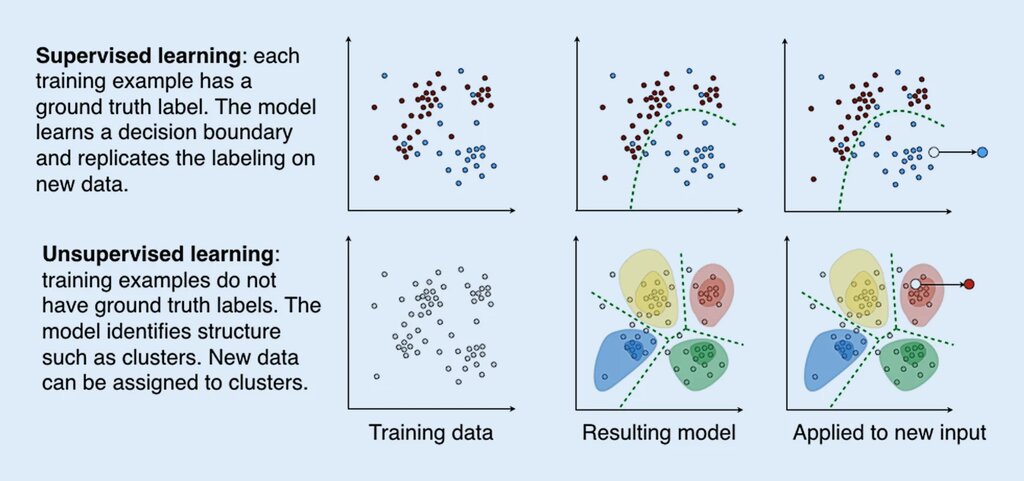
Supervised learning is like studying with flashcards. You're given a problem (the
input
noun
The data provided to a machine learning model to learn from or make predictions on.
) and the correct answer (the
label
noun
The correct answer or category associated with a piece of input data in supervised learning.
). The machine's job is to learn the relationship between the inputs and their corresponding labels. The data is "labeled" because we already know the right answers.
For example, to train a model to identify spam, we would feed it thousands of emails, each labeled as either "spam" or "not spam." After training, the model can look at a new, unlabeled email and predict whether it's junk.
This method is used for two main types of tasks:
- Classification: Assigning an input to a category, like identifying a tumor as malignant or benign.
- Regression: Predicting a continuous value, like forecasting the price of a house based on its features.
Finding Patterns on Its Own
Unsupervised learning is the opposite. Here, the machine is given data without any labels and must find patterns or structures on its own. It's like being handed a box of mixed Lego bricks and asked to sort them into piles without any instructions. You might group them by color, size, or shape.
The most common unsupervised task is clustering, which involves grouping similar data points together. This is incredibly useful for:
- Customer segmentation: Grouping customers with similar behaviors for targeted marketing.
- Topic modeling: Identifying the main themes in a collection of documents.
- Anomaly detection: Finding unusual data points that could indicate fraud or a system failure.
Unsupervised learning excels at exploring data and discovering relationships you didn't know existed.
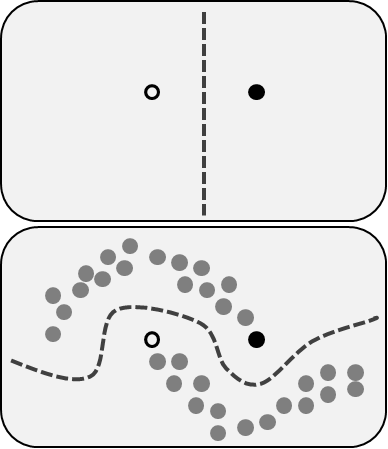
Semi-supervised learning is a hybrid approach. It uses a small amount of labeled data along with a large amount of unlabeled data. This is useful when labeling data is expensive or time-consuming. For instance, a doctor could label a few medical images, and the algorithm could use that knowledge to help classify a much larger set of unlabeled images. It's a practical compromise that often achieves high accuracy without the cost of full supervision.
Learning from Experience
Reinforcement learning is about learning through trial and error. An agent (the learner) interacts with an environment and receives rewards or penalties for its actions. The goal is to learn a strategy, or
policy
noun
In reinforcement learning, a strategy that the agent uses to determine the next action based on the current state.
, that maximizes its total reward over time.
Think of training a dog. When it performs a trick correctly, you give it a treat (a reward). When it doesn't, it gets nothing. Over time, the dog learns which actions lead to treats. Reinforcement learning works the same way and is the technology behind:
- Game playing AI: Systems like AlphaGo learned to master the game of Go by playing against themselves millions of times.
- Robotics: Robots learn to walk or manipulate objects by trying different movements and getting feedback from their sensors.
- Resource management: Optimizing energy consumption in a data center or managing traffic flow in a city.
Ready to check your understanding?
What is the central principle of machine learning?
A bank wants to build a system that analyzes transaction data to identify unusual activities that might indicate fraud. The system has no pre-existing labels for what constitutes a fraudulent transaction. Which type of machine learning is most appropriate for this task?
Each type of machine learning offers a different way to extract insights from data, providing a powerful toolkit for solving a vast range of problems.