Machine Learning Fundamentals
Introduction to Machine Learning
What Is Machine Learning?
In traditional programming, we give a computer a set of explicit rules to follow. If you want to build a spam filter, you might write code that says, "If an email contains the phrase 'free money,' mark it as spam." This works, but it's brittle. What if the spammer changes the phrase to "no-cost cash"? You'd have to write a new rule. And another. And another. It's an endless game of catch-up.
Machine learning flips this around. Instead of giving the computer rules, we give it data. We show it thousands of examples of spam emails and thousands of examples of legitimate emails. The machine learning model then learns the patterns that distinguish spam from non-spam on its own. It's not just looking for specific phrases but for a complex combination of features: words, sender reputation, email structure, and more.
The core idea is that the machine learns from experience, much like a human does, without being explicitly programmed for every scenario.
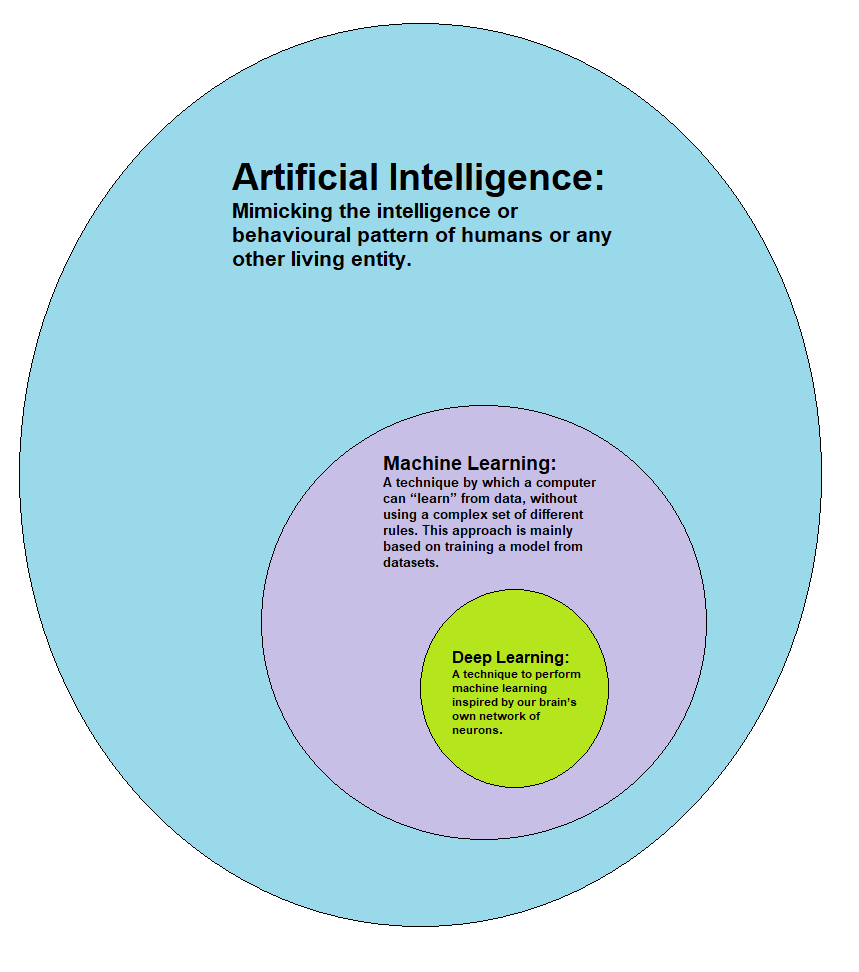
Machine learning enables a computer to learn from data and make predictions, rather than simply following instructions.
Types of Machine Learning
Machine learning isn't a single technique but a broad field with several distinct approaches. The best approach depends on the problem you're trying to solve and the kind of data you have. The main types are supervised, unsupervised, semi-supervised, and reinforcement learning.
Supervised Learning
noun
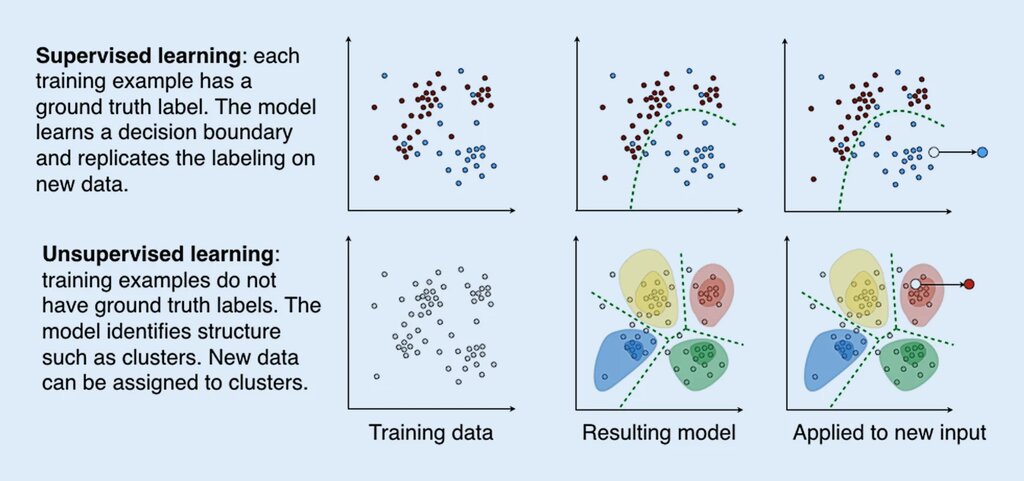
The model learns from data that is already labeled. It's like a student learning with a set of practice questions that already have the answers in the back of the book. The goal is to learn a mapping function that can predict the output for new, unseen data.
In supervised learning, every piece of data you feed the model has a known outcome or label. For an email filter, each email is labeled "spam" or "not spam." For a housing price predictor, each house listing is labeled with its final sale price. The model's job is to find the relationship between the input data (the email's content, the house's features) and the output label.
Unsupervised Learning
noun
The model works with unlabeled data to find hidden patterns or structures on its own. Think of it like being given a box of mixed-up photos and asked to sort them into piles of people who look similar, without being told who anyone is. The goal is to explore the data and find meaningful groupings.
With unsupervised learning, there are no correct answers to learn from. The algorithm sifts through the data and tries to identify clusters or anomalies. This is useful for tasks like identifying different customer segments in a marketing database or detecting unusual transactions that could signal fraud.
Then there are two other types that build on these ideas.
Semi-Supervised Learning: This is a hybrid approach. It uses a small amount of labeled data along with a large amount of unlabeled data. It's useful when labeling data is expensive or time-consuming. The model learns from the few labeled examples and then tries to apply that learning to make sense of the larger, unlabeled dataset.
Reinforcement Learning: This type of learning is all about taking actions in an environment to maximize a reward. It's like training a dog. When the dog performs the correct trick (the action), it gets a treat (the reward). Over time, it learns which actions lead to the best rewards. This method is powerful for teaching machines to play games, control robots, or manage logistics.
Comparing the Four Types
Each learning type is suited for different tasks. Here's a quick comparison to help you keep them straight.
| Learning Type | Input Data | Goal | Common Example |
|---|---|---|---|
| Supervised | Labeled data | Predict outcomes | Spam detection |
| Unsupervised | Unlabeled data | Discover hidden structures | Customer segmentation |
| Semi-Supervised | Mix of labeled and unlabeled | Improve learning with less labeled data | Photo classification |
| Reinforcement | No predefined dataset; agent interacts with an environment | Learn a sequence of actions | Training a bot to play a game |
Now that you have a handle on the basic concepts, let's test your knowledge.
What is the primary difference between how traditional programming and machine learning solve problems?
You are building a system to predict whether a credit card transaction is fraudulent. For your training data, you have thousands of transactions, and each one has been labeled as either 'fraudulent' or 'legitimate'. Which type of machine learning is most suitable for this task?
Understanding these fundamental categories is the first step. As you continue, you'll see how these different learning styles are applied to build the powerful AI tools we use every day.