Machine Learning Fundamentals
Introduction to Machine Learning
What Is Machine Learning?
Machine learning is a way of teaching computers to find patterns. Instead of giving the computer a detailed set of instructions for every task, we give it a lot of data and let it figure out the rules for itself.
Think about how you learned to recognize a cat. No one gave you a strict set of rules like, "If it has pointy ears, whiskers, and a long tail, it's a cat." Instead, you saw many different cats—big, small, fluffy, striped—and your brain gradually learned to identify the key features. Machine learning works in a similar way. An algorithm sifts through thousands of cat photos, learning the patterns that define a cat. Eventually, it can spot a cat in a photo it has never seen before.
Algorithm
noun
A process or set of rules to be followed in calculations or other problem-solving operations, especially by a computer.
This ability to learn from experience makes machine learning powerful. It's used everywhere, from recommending movies you might like to helping doctors diagnose diseases.
A New Way to Program
Traditional programming is all about explicit instructions. A programmer writes code that tells the computer exactly what to do step-by-step. If you're building a simple calculator, you write the rules for addition, subtraction, and so on. The program takes user input (like 2 + 2) and follows your rules to produce an output (4).
Machine learning flips this around. Instead of writing the rules, you provide the computer with data and the desired outcomes. The machine's job is to figure out the rules that connect the two. For example, you could give it thousands of customer profiles and whether they bought a product. The model would then learn the rules for predicting who is likely to buy that product in the future.
How a Project Works
A typical machine learning project follows a general workflow. It’s less of a straight line and more of a cycle, because you often have to go back and adjust earlier steps.
First, you need to understand the problem you're trying to solve and gather the right data. This is often the hardest part. Then, you prepare the data, which might involve cleaning it up or formatting it correctly. The next stage is modeling, where an algorithm is chosen and trained on the data. After the model is trained, it's evaluated to see how well it performs. If it's not good enough, you might go back, get more data, or try a different model. Finally, once you're happy with the results, the model is deployed to make predictions on new, real-world data.
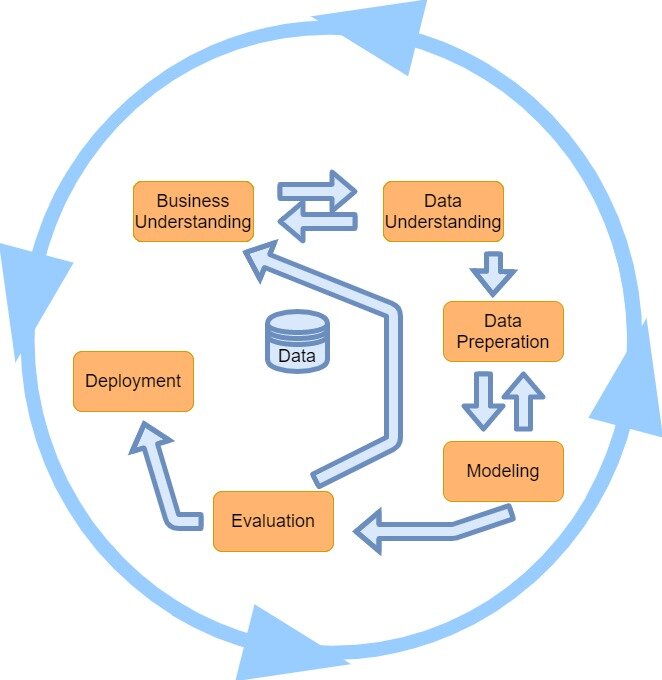
This process emphasizes that machine learning is highly iterative. It's a loop of experimenting, testing, and refining until the model achieves the desired performance.
The most important part of a machine learning project isn't the algorithm—it's the data.
The quality and quantity of data are critical. A machine learning model is only as good as the data it's trained on. If you train a model on incomplete or biased data, its predictions will also be incomplete or biased. For instance, if a facial recognition system is only trained on pictures of a certain demographic, it will struggle to accurately identify people from other groups. More data, and more diverse data, usually leads to a better, more robust model.
Different Ways to Learn
Machine learning isn't a single technique; it's a broad field with several different approaches. The main types are defined by how the algorithm learns from the data.
| Type | Learning Method | Example |
|---|---|---|
| Supervised Learning | Learns from data that is labeled with the correct answer. | Predicting house prices based on historical sales data. |
| Unsupervised Learning | Finds patterns in unlabeled data without any pre-existing answers. | Grouping customers into different segments based on purchasing habits. |
| Reinforcement Learning | Learns by trial and error, receiving rewards for good actions and penalties for bad ones. | Training an AI to play chess by rewarding it for winning moves. |
In supervised learning, you act as a teacher, providing the algorithm with a labeled dataset. In unsupervised learning, the algorithm is on its own, trying to make sense of the data's structure. Reinforcement learning is about learning to make the best decisions over time to maximize a reward.
Each type of learning is suited to different kinds of problems, and understanding their basic differences is the first step to knowing how and when to apply them.
What is the fundamental principle behind how a machine learning model learns?
How does the machine learning approach differ from traditional programming?