Machine Learning Fundamentals
Introduction to Machine Learning
What is Machine Learning?
Machine learning is a way for computers to learn from information without being explicitly programmed. Think about how you learned to recognize a cat. No one gave you a long list of rules like "if it has pointy ears, whiskers, and a long tail, it's a cat." Instead, you saw many examples of cats and eventually, your brain learned to identify them on its own. Machine learning works in a similar way: it finds patterns in data.
It's a major field within the broader world of Artificial Intelligence (AI). While AI is the general science of making machines smart, machine learning is a specific approach to achieving that goal by letting the machines learn for themselves.
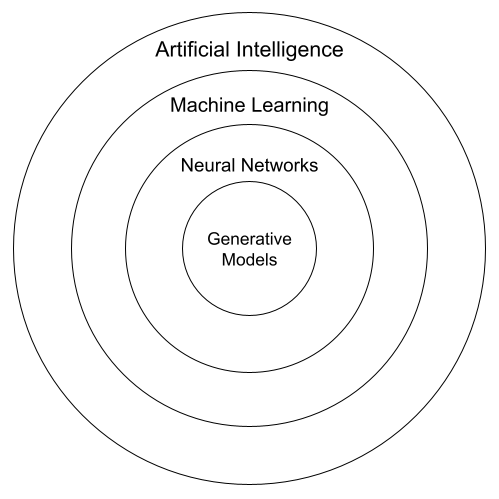
The core idea of machine learning is to use data to answer questions. Instead of writing rules, we feed data into an algorithm and let it figure out the rules on its own.
This process of learning from data can happen in a few different ways. The three main styles of machine learning are supervised, unsupervised, and reinforcement learning. Each is suited for different kinds of tasks.
Learning with a Teacher
Supervised learning is like studying with flashcards. You have a question on one side (the data) and the answer on the other (the label). The goal is to learn the connection so you can eventually predict the answer for a new, unseen question.
In this method, the machine learning model is trained on a dataset where the correct answers are already known. For example, to build a spam filter, you would feed it thousands of emails that have already been labeled as either "spam" or "not spam." The model learns the features of spam emails (like certain keywords or sender patterns) and uses that knowledge to classify new, incoming emails.
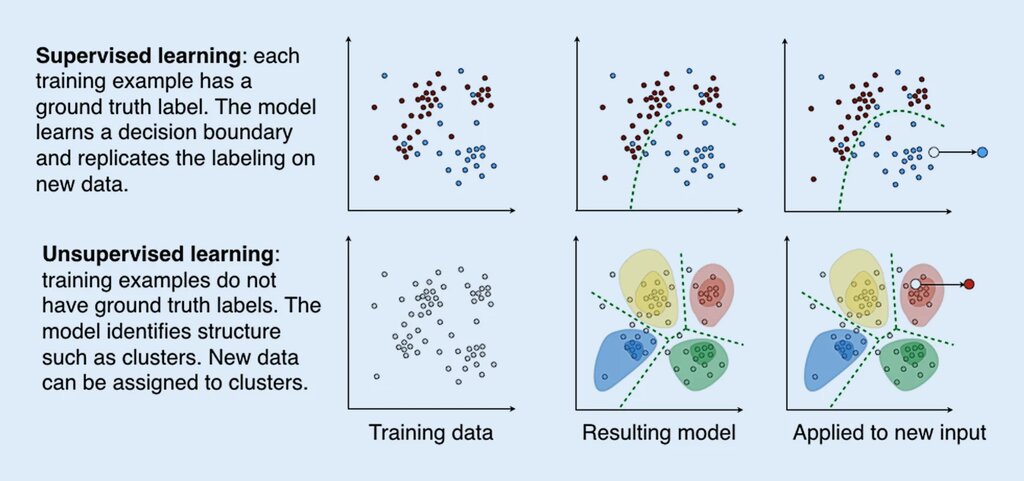
This approach is incredibly useful for prediction tasks. Other examples include predicting a house's price based on its features (square footage, number of bedrooms) and historical sales data, or identifying whether a medical image shows signs of a disease based on a library of labeled images.
Finding Patterns Alone
Unsupervised learning is what happens when you don't have the answers ahead of time. Imagine being handed a box of mixed-up Lego bricks and being asked to sort them. You wouldn't know the "right" way to do it, but you could start making piles based on color, shape, or size. You're finding the underlying structure in the data all on your own.
In this type of learning, the algorithm is given unlabeled data and tasked with discovering hidden patterns or groupings. It isn't told what to look for; it finds the interesting structures by itself.
A common application is customer segmentation. An online store could use unsupervised learning to group customers with similar purchasing habits. This helps the business understand its audience better and tailor its marketing without having to manually label each customer first. It's also used for anomaly detection, like identifying unusual patterns in network traffic that might signal a security threat.
Learning from Experience
Reinforcement learning is about learning through trial and error, much like training a pet. When the pet performs a desired trick, it gets a treat (a reward). When it does something else, it gets nothing. Over time, it learns which actions lead to the best outcomes.
In this model, an AI "agent" operates in an environment and learns to make decisions. It receives rewards for actions that get it closer to its goal and penalties for actions that don't. The agent's objective is to maximize its total reward over time. This method doesn't require a pre-existing dataset of correct answers, just a goal and a way to measure progress toward it.
This is the strategy behind AIs that learn to play complex games like chess or Go. The AI plays millions of games against itself, slowly learning which moves lead to a higher chance of winning. Reinforcement learning is also crucial in robotics, where a robot can learn to walk or manipulate objects through experimentation in a physical or simulated environment.
What is the fundamental principle of machine learning?
A bank wants to create a model that can identify fraudulent credit card transactions. They have a massive dataset of past transactions, each one already labeled as either 'fraudulent' or 'legitimate.' Which type of machine learning is best suited for this task?
Each of these learning styles opens up a different set of possibilities for solving problems with AI. By choosing the right approach, we can teach machines to tackle tasks that would be difficult or impossible to program with a fixed set of rules.