Machine Learning Fundamentals for Beginners
Introduction to Machine Learning
What Is Machine Learning?
Machine learning is a way to teach computers to find patterns in data. Instead of writing step-by-step instructions for every possible scenario, we give the computer a set of examples and let it figure out the rules for itself. It’s like teaching a child to recognize a cat. You don't describe a cat in detail—whiskers, pointy ears, four legs. You just show them lots of pictures of cats. Eventually, they learn to identify a cat they've never seen before.
This ability to learn from data without being explicitly programmed is what makes machine learning so powerful. It's the engine behind many tools we use every day, from Netflix recommendations and email spam filters to language translation and fraud detection.
AI, ML, and Data Mining
The terms artificial intelligence (AI), machine learning (ML), and data mining are often used together, but they mean different things. Think of it as a set of Russian nesting dolls.
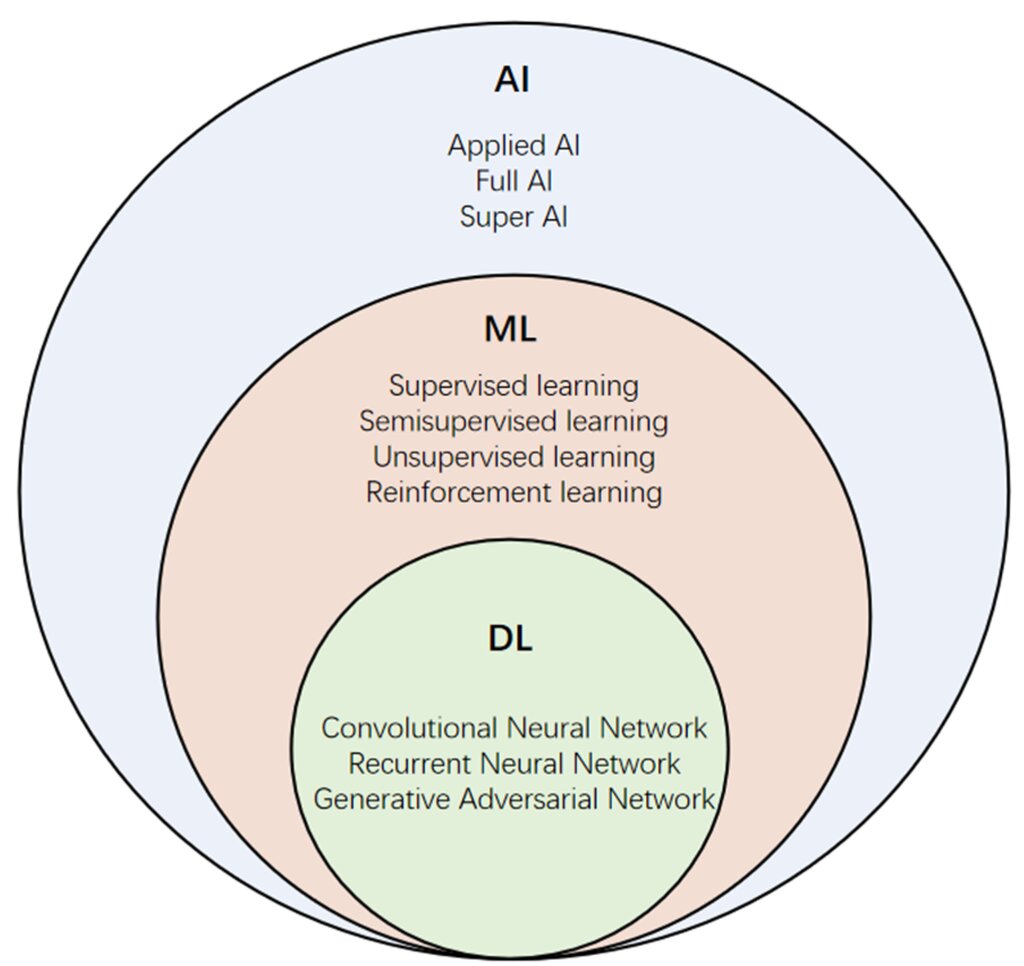
Artificial Intelligence (AI) is the broadest concept. It's the overall field of creating machines that can simulate human intelligence—reasoning, problem-solving, and learning.
Machine Learning (ML) is a subset of AI. It's one of the primary methods used to achieve artificial intelligence. Instead of building a machine with pre-programmed intelligence, we build one that can learn and develop its own intelligence from data.
Data Mining is a related process that involves sifting through large datasets to discover patterns and insights. It often uses machine learning techniques to find those patterns, but its main goal is to extract useful information, not necessarily to build a model that can make future predictions.
Four Flavors of Machine Learning
Machine learning isn't a single technique; it's a collection of different approaches. The best method depends on the problem you're trying to solve and the kind of data you have. The four main types are supervised, unsupervised, semi-supervised, and reinforcement learning.
Supervised Learning
noun
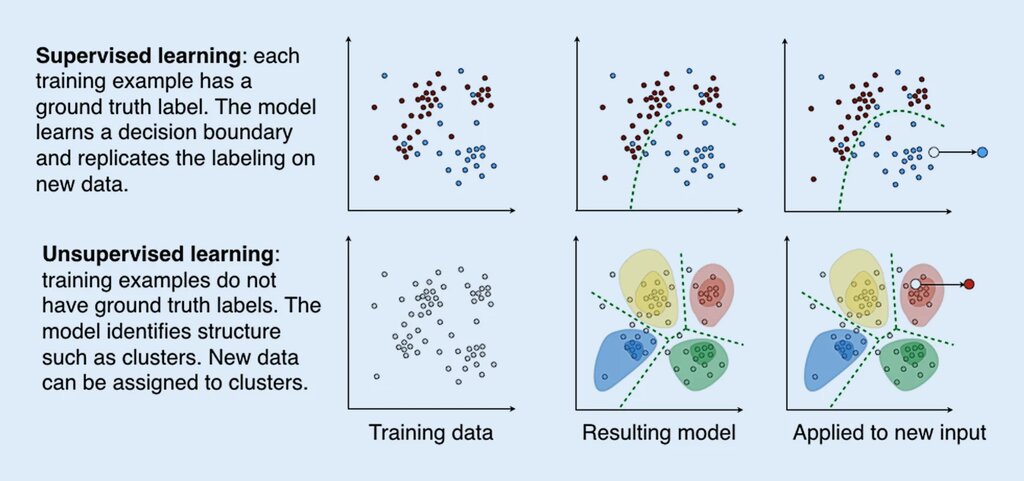
The model learns from data that is already labeled with the correct answers. It's like studying with an answer key.
In supervised learning, you give the model examples with known outcomes. For instance, to predict house prices, you would train a model on a dataset of houses that includes features (square footage, number of bedrooms) and the final sale price (the label). The model learns the relationship between the features and the price, so it can then predict the price of a new house.
Unsupervised Learning
noun
The model works with unlabeled data and must find patterns or structures on its own, without any answers provided.
Unsupervised learning is about exploration. The goal is to discover hidden structures in data. Imagine giving a computer thousands of news articles and asking it to group them by topic. It wouldn't know the topics beforehand, but it could cluster articles together that use similar words.
Semi-Supervised Learning is a hybrid approach. It uses a small amount of labeled data along with a large amount of unlabeled data. This is useful when labeling data is expensive or requires a lot of manual effort. For example, a photo app could learn to identify a person from a few tagged photos and then find that same person across thousands of untagged pictures.
Reinforcement Learning is about learning through trial and error. The model, called an agent, learns to make decisions by performing actions in an environment to achieve a goal. It receives rewards for good actions and penalties for bad ones. Over time, it learns the best strategy to maximize its reward. This is the approach used to train computers to play complex games like chess or Go, and it's also used in robotics and self-driving cars.
The Machine Learning Workflow
While the details can get complex, most machine learning projects follow a similar high-level process. It's a cycle of gathering data, preparing it, and then using it to build and improve a model.
Here's a quick look at each step:
- Data Collection: Gathering all the relevant data needed for the project. This could come from databases, files, or external sources.
- Data Preprocessing: This is often the most time-consuming step. It involves cleaning the data—handling missing values, correcting errors—and getting it into a usable format.
- Model Training: This is where the learning happens. The prepared data is fed into a chosen algorithm, which learns the patterns and relationships within the data. The output is a trained "model."
- Model Evaluation: Once the model is trained, you need to check how well it performs. This is done by testing it on a separate set of data that it hasn't seen before to see how accurate its predictions are.
- Deployment: If the model performs well, it's put into production where it can start making decisions or predictions on new, real-world data.
This workflow is often a cycle. A model in deployment might generate new data, which can be used to retrain and improve it over time.
Ready to check your understanding?
Which statement best describes the relationship between Artificial Intelligence (AI) and Machine Learning (ML)?
A developer wants to build a system that can group thousands of news articles into topics like 'Sports,' 'Politics,' and 'Technology' without being told what the topics are in advance. Which type of machine learning is most suitable for this task?
Now you have a solid foundation in what machine learning is, how it relates to AI, and the general process for building an ML model. From here, you can dive deeper into the specific algorithms and techniques that make it all work.