Machine Learning Fundamentals Explored
Introduction to Machine Learning
What Is Machine Learning?
Instead of writing explicit, step-by-step instructions for a computer, machine learning flips the script. It uses data to teach a computer how to recognize patterns and make decisions on its own. It’s the difference between giving a cook a detailed recipe and having them taste a thousand dishes to figure out the recipe for themselves.
Imagine teaching a child to identify a cat. You wouldn't list rules like "if it has fur, whiskers, and pointy ears, it's a cat." You'd simply show them pictures of cats. After seeing enough examples, the child learns the general pattern of what a cat looks like. Machine learning works in a very similar way. An algorithm sifts through vast amounts of example data—pictures, text, numbers—and learns the underlying patterns.
Machine learning is the science of getting computers to act without being explicitly programmed.
This ability to learn from data is what powers everything from your email’s spam filter to the recommendation engine that suggests your next favorite movie. The machine isn't following a rigid set of commands; it's using what it has learned from past data to make a prediction or a decision.
Three Flavors of Learning
Machine learning isn't a single, monolithic thing. It's a broad field with several distinct approaches. The three main types are supervised, unsupervised, and reinforcement learning. The difference between them comes down to the kind of data they use and the problem they're trying to solve.
Think of it this way:
- Supervised learning is like studying with flashcards that have answers on the back.
- Unsupervised learning is like being given a box of mixed-up photos and asked to sort them into piles that make sense.
- Reinforcement learning is like teaching a dog a new trick with treats and praise.
Supervised Learning
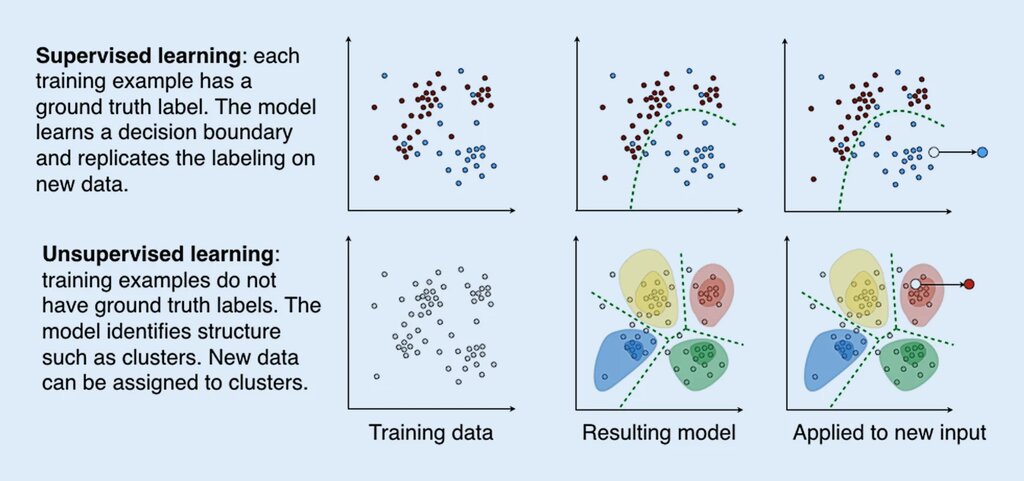
In supervised learning, the algorithm learns from a dataset that has been labeled with the correct answers. Each piece of data is tagged with an outcome. For example, to train a model to identify spam, you would feed it thousands of emails, each one labeled as either "spam" or "not spam." The model's job is to learn the relationship between the content of the email and its label. Over time, it gets good at predicting the correct label for new, unseen emails.
Unsupervised Learning
Unsupervised learning is the opposite. The algorithm is given data without any labels and must find patterns or structures on its own. It's about discovery, not prediction. A common use is customer segmentation. A company might feed an unsupervised model its customer purchase data. The model could then identify distinct groups of customers—like "frequent bargain hunters" or "high-end luxury buyers"—without being told what to look for.
Reinforcement Learning
Reinforcement learning is about learning through trial and error. An algorithm, often called an "agent," learns to make decisions by performing actions in an environment to achieve a goal. When it takes an action that gets it closer to the goal, it receives a reward. When it takes a wrong turn, it gets a penalty. This is how AI learns to play complex games like chess or Go, and it's a key technology behind self-driving cars and robotics.
| Learning Type | Goal | Data Requirement | Example |
|---|---|---|---|
| Supervised | Predict an outcome | Labeled data | Spam detection |
| Unsupervised | Find hidden structure | Unlabeled data | Customer segmentation |
| Reinforcement | Learn a series of actions | Environment with rewards | Game-playing AI |
The Machine Learning Pipeline
Creating a machine learning model isn't a single event. It's a process, often called a pipeline or lifecycle, that involves several distinct stages. While the details can vary, the general flow is consistent. It's an iterative loop, not a straight line; steps are often revisited to refine and improve the final result.
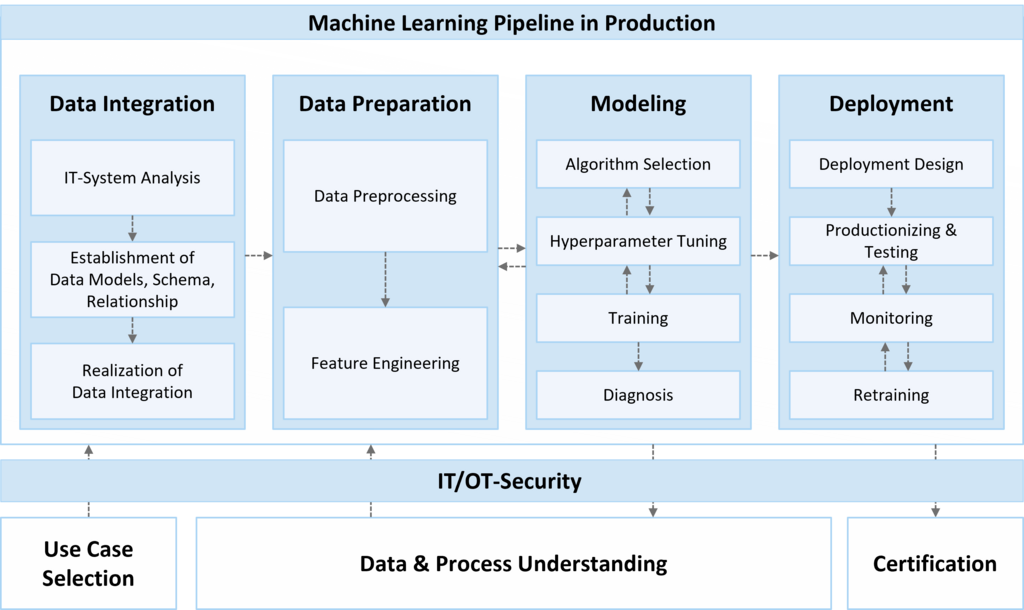
The process generally includes these key phases:
-
Data Collection: It all starts with data. This is the raw material for machine learning. Data can come from anywhere: spreadsheets, databases, sensors, user activity on a website, and so on. The quality and quantity of this data are critical for the success of the project.
-
Data Preparation: Raw data is almost never ready to use. It's often messy, with missing values, errors, or inconsistencies. This stage, sometimes called data cleaning or preprocessing, involves tidying up the data to make it suitable for a model.
-
Model Training: This is where the learning happens. The prepared data is split into a training set and a testing set. The algorithm is fed the training data, and it adjusts its internal parameters to find patterns. This process is repeated, often millions of times, until the model performs well on the training data.
-
Model Evaluation: Once the model is trained, it's time to see how well it actually works. The model is given the testing data—data it has never seen before—to make predictions. These predictions are then compared to the actual outcomes to measure the model's accuracy and performance.
-
Model Deployment: If the model performs well, it's deployed into a real-world application. This could mean integrating it into a website, an app, or a business's internal software. Once deployed, the model starts making predictions on live data.
-
Monitoring and Retraining: A model's job is never truly done. Its performance is continuously monitored. Over time, the world changes, and new data can make the model less accurate. This is called "model drift." When this happens, the model needs to be retrained with fresh data to maintain its performance.
Data Science and Machine Learning
You'll often hear the terms "data science" and "machine learning" used together, but they aren't the same thing. Data science is a broad, interdisciplinary field that uses scientific methods, processes, and systems to extract knowledge and insights from data.
Machine learning is one of the most powerful tools in a data scientist's toolkit, but it's just one piece of the puzzle.
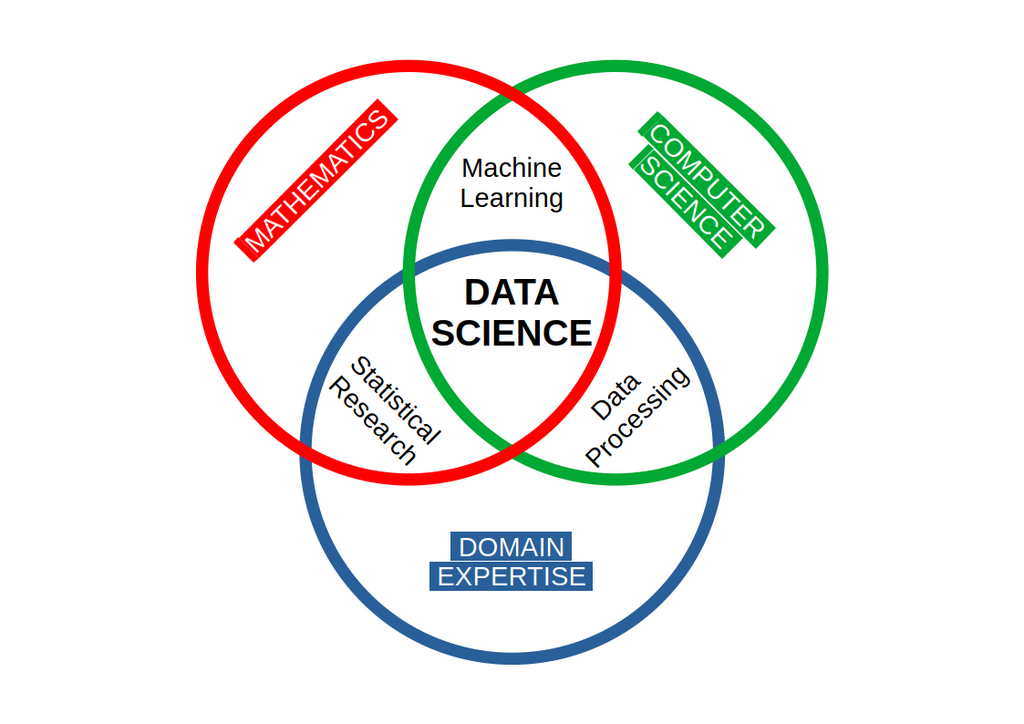
Data science encompasses the entire process of working with data, from framing a business question to collecting and cleaning data, performing analysis, visualizing results, and communicating findings to stakeholders. Machine learning is specifically focused on building predictive models. A data scientist might use machine learning to answer a question, but they also use many other techniques, like statistical analysis and data visualization, that aren't machine learning.
In short, machine learning is a core component of modern data science, but data science is the whole picture.
What is the primary way a machine learning model learns?
An algorithm is trained on a collection of emails, each one already labeled as 'spam' or 'not spam'. What type of machine learning is this an example of?
Now that you've got the basics down, you can see how these concepts form the foundation for building intelligent systems that learn and adapt.