Machine Learning Fundamentals Explained
Introduction to Machine Learning
What is Machine Learning?
Machine learning, or ML, is a way of teaching computers to find patterns. Instead of writing step-by-step instructions for every single task, we give a computer a large amount of data and let it figure out the rules for itself. It's the study of algorithms that allow computers to learn from and make decisions based on data.
Think about how you learned to tell the difference between an apple and an orange. You weren't given a long list of rules like "if it's round and red, it's an apple." Instead, you saw many examples of both. Over time, your brain learned to recognize the key characteristics—color, shape, texture—that distinguish one from the other. Machine learning works in a similar way. It ingests examples, learns the underlying patterns, and then uses that knowledge to make predictions or decisions about new, unseen data.
Machine Learning (ML) is a branch of Artificial Intelligence that enables computers to learn patterns from data and make predictions or decisions without being explicitly programmed.
The Key Ingredients
To get started with ML, you need to understand a few core concepts. These are the building blocks of any machine learning system.
Features
noun
The individual, measurable properties or characteristics of the data that a model uses to make predictions. They are the inputs to your model.
Features are the specific data points your algorithm looks at. If you're trying to predict the weather, your features might be temperature, humidity, and wind speed. If you're trying to identify a bird in a photo, the features could be the colors of its feathers, the shape of its beak, and its size.
Algorithm
noun
The process or set of rules used by a machine learning system to learn from data. It's the method that finds patterns and creates the model.
The algorithm is the recipe the computer follows to learn from the features. There are many different algorithms, each with its own strengths. Some are good at sorting things into groups, while others excel at predicting numerical values. Choosing the right algorithm is a key part of the machine learning process.
Model
noun
The output of a machine learning algorithm after it has been trained on a set of data. It represents the learned patterns and is used to make predictions.
Finally, the model is what you get after the algorithm has finished learning from the data. It's the finished product. You can think of it as the 'brain' that has been trained. You feed it new data (new features), and it gives you a prediction or decision.
Three Styles of Learning
Machine learning isn't a one-size-fits-all tool. There are three main ways a machine can learn, each suited for different kinds of problems.
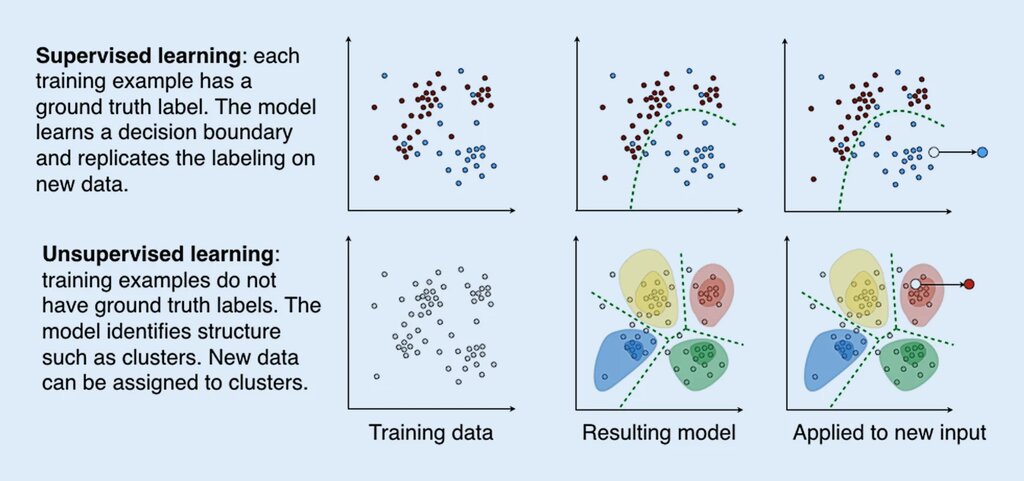
1. Supervised Learning
This is the most common type of machine learning. In supervised learning, the computer learns from data that has already been labeled with the correct answers. It's like studying for a test with an answer key.
The algorithm looks at the labeled examples (the features) and the correct outcomes (the labels) and learns the relationship between them. The goal is to create a model that can accurately predict the label for new, unlabeled data.
A classic example is an email spam filter. It's trained on thousands of emails that have been pre-labeled as either "spam" or "not spam." The model learns the features of spam emails (like certain keywords or sender addresses) so it can flag them in the future.
2. Unsupervised Learning
What if you don't have an answer key? That's where unsupervised learning comes in. With this approach, the algorithm gets a dataset without any labels and has to find the hidden structure or patterns on its own.
The goal isn't to predict a specific outcome, but to explore the data. A common use is clustering, which involves grouping similar data points together. For instance, an online retailer could use unsupervised learning to segment its customers into different groups based on their purchasing habits. This helps the company understand its customer base and tailor marketing strategies without any preconceived notions of what the groups should be.
3. Reinforcement Learning
Reinforcement learning is about learning through trial and error. It's inspired by how humans and animals learn. An algorithm, called an 'agent,' learns to operate in an 'environment.'
The agent takes actions, and for each action, it receives feedback in the form of a reward or a penalty. The agent's goal is to learn a strategy, or 'policy,' that maximizes its total reward over time. Think of training a dog: you give it a treat (a reward) when it follows a command correctly.
This type of learning is powerful for training systems that need to make a sequence of decisions. It's the technology behind self-driving cars learning to navigate traffic, or AI agents learning to play complex games like Chess or Go.
With these core concepts, you now have a foundation for understanding how machines learn from data to perform incredible tasks.
Ready to check your understanding?
What is the primary goal of machine learning?
An email provider trains a system to identify junk mail by feeding it thousands of emails that have already been marked as 'spam' or 'not spam'. What type of machine learning is this?