Machine Learning Fundamentals and Models
Introduction to Machine Learning
What is Machine Learning?
Machine learning is a way of teaching computers to find patterns. Instead of writing step-by-step instructions for every possible scenario, we give a computer data and let it figure out the rules on its own.
Think about how you learned to identify a cat. You weren't given a long list of rules like "if it has pointy ears, whiskers, and a long tail, it's a cat." Instead, you saw many examples of cats. Over time, your brain learned to recognize the general pattern of "cat-ness." Machine learning works in a similar way. We show a computer thousands of cat photos, and it learns the features that define a cat.
Machine learning is about learning from data to make predictions or decisions, rather than being explicitly programmed for a specific task.
Learning with a Teacher
One of the main branches of machine learning is called supervised learning. The "supervised" part means the computer learns from data that has already been labeled with the correct answers. It’s like learning with flashcards that have the question on one side and the answer on the back.
We provide the machine learning model with an input (the data) and the correct output (the label). The model's job is to learn the relationship between the two. The goal is to get so good at this that it can predict the correct output for new, unlabeled data it has never seen before.
There are two main types of supervised learning problems.
Classification
noun
The process of predicting a discrete category or class.
Classification is about sorting things into groups. Is this email spam or not spam? Does this tumor look cancerous or benign? Is this picture a cat, a dog, or a bird? The answer is always a fixed category. The model learns from labeled examples and then tries to classify new items.
Regression, on the other hand, is about predicting a continuous number. Instead of a category, the output is a value on a spectrum. How much will this house sell for? What will the temperature be tomorrow? How many minutes until this delivery arrives? In each case, the model learns from past data (e.g., historical house prices, weather patterns) to predict a specific numerical value.
Learning without a Teacher
What if you don't have labeled data? That's where unsupervised learning comes in. In this case, we give the model a dataset without any answers or labels. The model's job is to explore the data and find any hidden structures or patterns on its own. It's like being given a box of mixed Lego bricks and asked to sort them into piles without any instructions.
One of the most common unsupervised learning tasks is clustering.
Clustering
noun
The task of grouping a set of objects in such a way that objects in the same group are more similar to each other than to those in other groups.
Clustering algorithms try to find natural groupings in data. For example, a company might use clustering to analyze customer purchase history and discover different segments of shoppers, like "budget buyers," "brand loyalists," or "weekend shoppers." The algorithm doesn't know these labels beforehand; it discovers them by identifying which customers behave similarly.
| Feature | Supervised Learning | Unsupervised Learning |
|---|---|---|
| Input Data | Labeled | Unlabeled |
| Goal | Predict outcomes | Discover hidden patterns |
| Analogy | Learning with an answer key | Sorting without instructions |
| Example Tasks | Classification, Regression | Clustering |
The Machine Learning Workflow
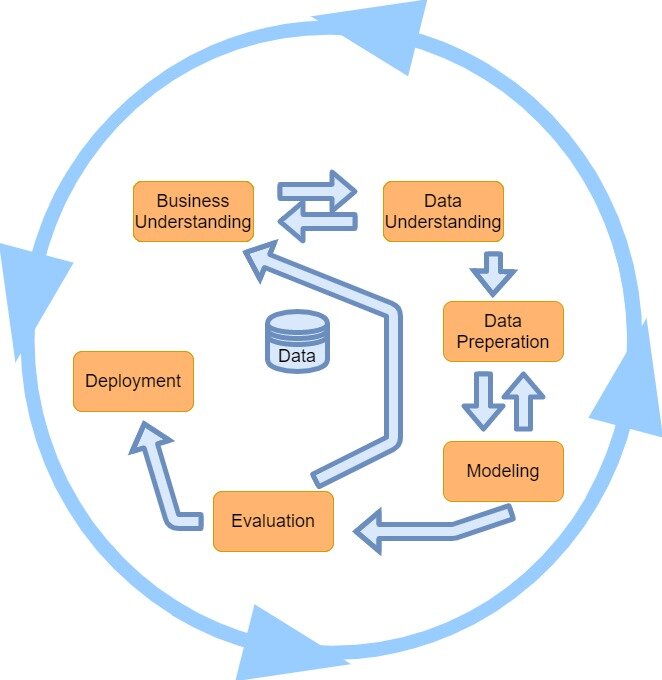
Developing a machine learning model isn't just about picking an algorithm. It's an entire process, often called a workflow or lifecycle. While the details can vary, the core steps are generally the same.
-
Define the Problem: What question are you trying to answer? What do you want to predict? A clear goal is the most important first step.
-
Gather Data: Machine learning models are hungry for data. This step involves collecting all the relevant information needed to solve the problem. The quality and quantity of data are crucial.
-
Prepare the Data: Raw data is often messy. It might have missing values, errors, or be in the wrong format. This step involves cleaning and organizing the data so the model can understand it.
-
Train the Model: This is where the learning happens. You feed the prepared data to your chosen machine learning algorithm. The algorithm adjusts its internal parameters to find patterns and learn the relationship between the inputs and outputs (in supervised learning) or the underlying structure (in unsupervised learning).
-
Evaluate the Model: Once the model is trained, you need to check how well it performs. This is typically done using a separate set of data that the model has never seen before. This tells you if the model can generalize its knowledge to new situations.
-
Deploy and Monitor: If the model's performance is good enough, it can be put into a real-world application. But the job isn't over. You need to monitor its performance over time to make sure it continues to make accurate predictions as new data comes in.
Now let's check your understanding of these fundamental concepts.
What is the fundamental difference between machine learning and traditional programming?
A data scientist is working on a project to predict whether a loan applicant will default or pay back a loan. The dataset contains historical information on applicants, including whether they ultimately defaulted. What type of machine learning problem is this?
These core ideas—supervised learning, unsupervised learning, and the general workflow—form the foundation of almost everything in machine learning.