Machine Learning Fundamentals and Linear Regression
Introduction to Machine Learning
What Is Machine Learning?
Machine learning teaches computers to learn from data. Instead of writing explicit, step-by-step instructions for every possible task, we let the computer figure out patterns on its own. It's like how you learn to ride a bike. No one gives you a perfect formula. You just try, wobble, adjust, and eventually, your brain finds the patterns that keep you upright. Computers do the same thing, but with data.
Machine learning enables a computer to learn from experience (data) rather than from explicit programming.
The goal is to build a mathematical model that can make predictions or decisions. This model is trained on a set of data, and its performance usually improves as it's exposed to more information. This process is at the heart of everything from your streaming service's recommendations to the way your bank detects fraud.
How Machines Learn
Not all learning is the same. Just as people can learn from a teacher, by discovering things for themselves, or through trial and error, machines have different learning styles. The three main types are supervised, unsupervised, and reinforcement learning.
Algorithm
noun
A set of rules or instructions a computer follows to solve a problem. In machine learning, algorithms process data and learn from it to create a model.
Supervised learning is like studying with flashcards. The computer is given data that's already labeled with the correct answer. For example, you'd show it thousands of pictures of cats, each labeled "cat," and thousands of pictures of dogs, each labeled "dog." The model’s job is to learn the relationship between the input (the image) and the output (the label). After enough training, it can look at a new picture and predict whether it's a cat or a dog.
Unsupervised learning is more like being a detective. The computer gets a pile of unlabeled data and has to find hidden patterns or structures on its own. Imagine giving a machine a database of customer purchases without any other information. It might discover groups, or clusters, of customers who buy similar products. Businesses use this for marketing, grouping people into segments like "weekend shoppers" or "bargain hunters."
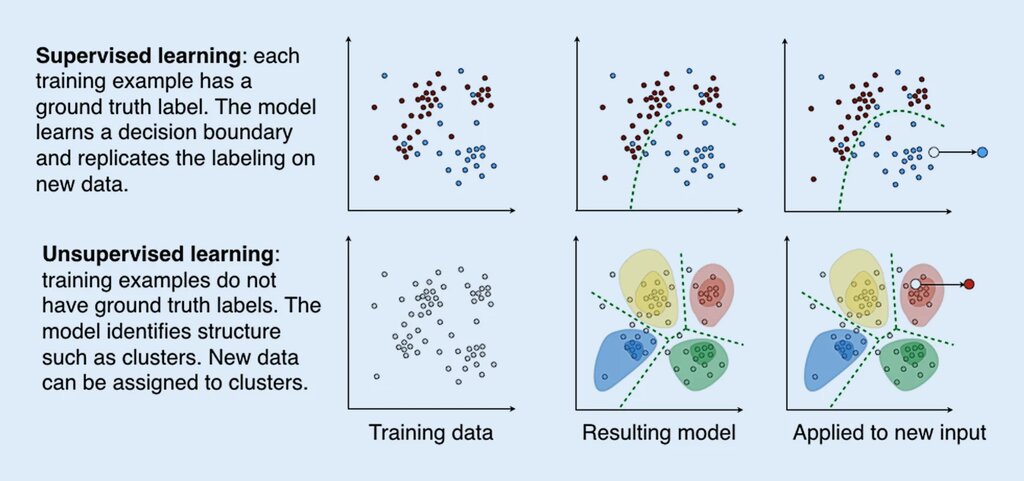
Finally, there's reinforcement learning. This is about learning through trial and error, like training a pet with treats. The algorithm, often called an "agent," learns to operate in an environment. It gets rewards for actions that lead to a good outcome and penalties for those that don't. A self-driving car model might get a reward for staying in its lane and a penalty for swerving. Over time, it learns a strategy, or "policy," that maximizes its total reward.
The Machine Learning Workflow
Building a machine learning model isn't a single step. It's a cyclical process with several key phases. Think of it as a recipe that you might need to adjust and re-test a few times to get it right.
The first step is always data. You can't learn without information. This data is then cleaned and prepared in a process called preprocessing. Real-world data is often messy, with missing values or errors that need to be fixed.
Next, the prepared data is used to train the model. This is where the learning happens. The algorithm adjusts its internal parameters to find patterns in the data.
Finally, the model is evaluated using data it hasn't seen before. This is crucial. A model that only performs well on data it already knows isn't very useful. This step checks if the model can generalize its knowledge to new situations.
Common Challenges
The path to a successful model isn't always smooth. One common issue is data quality. A model is only as good as the data it learns from. If the data is biased, incomplete, or just plain wrong, the model will learn the wrong lessons. This is often summarized as "garbage in, garbage out."
Another challenge is finding the right balance in training. If a model learns the training data too well, it might memorize the details instead of learning the underlying patterns. This is called overfitting. An overfit model does great on the data it was trained on but fails when it sees new data.
On the flip side, a model can also be too simple to capture the patterns in the data. This is underfitting. It performs poorly on both the training data and new data because it hasn't learned enough. The goal is to find that sweet spot, a model that is complex enough to learn but simple enough to generalize.
| Challenge | Description | Analogy |
|---|---|---|
| Data Quality | The model's performance depends heavily on the accuracy and completeness of the data. | Trying to learn a language from a book full of typos. |
| Overfitting | The model learns the training data too well, including noise and random fluctuations. | A student who memorizes the answers to a practice test but can't solve new problems. |
| Underfitting | The model is too simple to capture the underlying structure of the data. | A student who only skims the chapter and can't answer any test questions correctly. |
Machine learning is already a part of your daily life. In healthcare, it helps diagnose diseases from medical images. In finance, it powers credit scoring and algorithmic trading. And in marketing, it personalizes your shopping experience by recommending products you might like.
As you continue your journey, you'll see how these fundamental ideas are the building blocks for more advanced and powerful AI systems.
Now, let's test your understanding of these core concepts.
What is the fundamental goal of machine learning?
An email service provider wants to build a system that automatically categorizes incoming emails as 'Spam' or 'Not Spam'. They have a massive dataset of emails that have already been correctly labeled by users. Which type of machine learning is best suited for this task?
Understanding these basics is the first step to seeing how machine learning is changing the world around us.