Machine Learning Fundamentals
Introduction to Machine Learning
What Is Machine Learning?
Machine learning is a way of teaching computers to find patterns. Instead of writing explicit, step-by-step instructions for every possible scenario, you give the computer a large amount of data and let it figure out the rules for itself.
Think about how you'd write a program to identify a cat in a photo. In traditional programming, you'd have to create a long list of rules: 'If it has pointy ears, and whiskers, and fur, and a long tail... then it's a cat.' This is incredibly difficult and brittle. What if the cat's ears are folded? What if it's a tailless Manx cat?
Machine learning flips this around. You show the computer thousands of photos labeled 'cat' and thousands labeled 'not a cat.' The machine learning model then learns the features that cats tend to have. It builds its own internal rules, which are often far more complex and accurate than any a human could write by hand.
This ability to learn from data makes computers useful for solving problems that are too complex or change too often for traditional programming. Machine learning powers everything from your email's spam filter and your phone's voice assistant to medical diagnoses and self-driving cars. It's significant because it lets us automate tasks that previously required human perception and judgment.
Three Flavors of Learning
Machine learning isn't a single technique. It's a broad field with several different approaches. Most methods fall into one of three main categories: supervised, unsupervised, and reinforcement learning.
Supervised Learning: Learning with an answer key.
In supervised learning, the data is labeled. Each piece of data is tagged with the correct outcome or answer. The goal is for the model to learn the relationship between the input data and the output label so it can predict the labels for new, unseen data.
Imagine studying for a test with flashcards. Each card has a question (the input) and the correct answer on the back (the label). By reviewing the cards, you learn to connect questions with their answers. A supervised learning model does the same thing, but with data.
Common applications include:
- Spam detection: Emails are labeled as 'spam' or 'not spam.'
- Image classification: Photos are labeled with the objects they contain, like 'cat' or 'dog.'
- House price prediction: Houses are labeled with their final sale price.
Unsupervised Learning: Finding patterns on your own.
With unsupervised learning, the data has no labels. The model is given a dataset and must find its own patterns, structures, and relationships. It’s like being handed a box of mixed Lego bricks and asked to sort them into piles. You might group them by color, size, or shape without any prior instructions.
Unsupervised learning is great for exploring data and discovering hidden insights.
Common applications include:
- Customer segmentation: Grouping customers with similar purchasing habits for marketing campaigns.
- Anomaly detection: Identifying unusual credit card transactions that could be fraudulent.
- Topic modeling: Finding the main themes in a large collection of documents.
Reinforcement Learning: Learning through trial and error.
Reinforcement learning involves an 'agent' that learns by interacting with an environment. The agent takes actions, and in return, it receives rewards or penalties. The goal is to learn a strategy, or 'policy,' that maximizes its total reward over time.
This is similar to training a dog. When the dog performs a desired trick, it gets a treat (a reward). When it does something wrong, it gets a gentle correction (a penalty). Over time, the dog learns which actions lead to treats.
Reinforcement learning excels at tasks that involve sequential decision-making.
Common applications include:
- Game playing: An AI learning to play chess or Go by playing millions of games against itself.
- Robotics: A robot learning how to walk or grasp objects.
- Resource management: A system learning to optimize energy consumption in a large building.
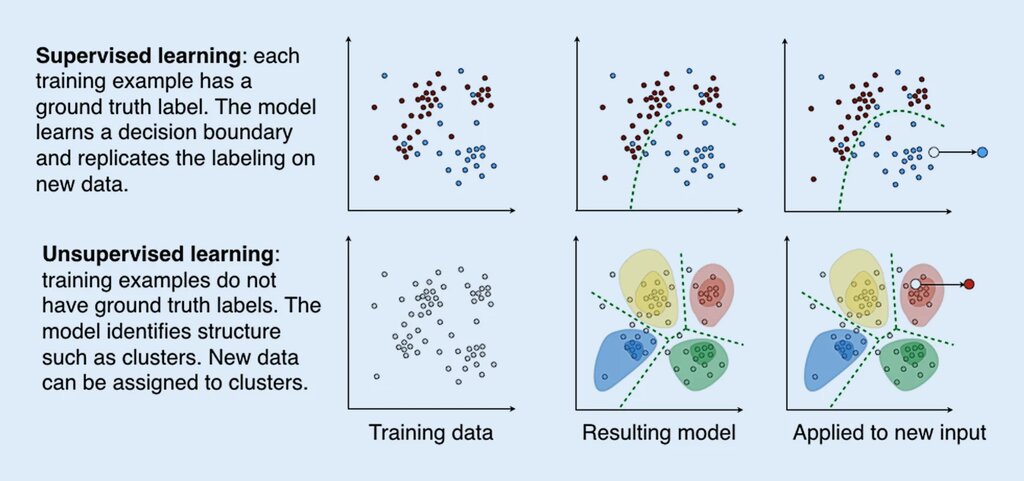
Each type of learning is suited for different kinds of problems, depending on the data you have and the goal you want to achieve.
| Learning Type | Input Data | Goal | Example |
|---|---|---|---|
| Supervised | Labeled | Predict an outcome | Classifying spam email |
| Unsupervised | Unlabeled | Discover hidden structure | Grouping similar customers |
| Reinforcement | No initial data | Learn a sequence of actions | Training an AI to play a game |
Now that you understand the basic landscape of machine learning, let's test your knowledge.
What is the primary difference between machine learning and traditional programming?
A model is trained on a dataset of images, where each image is tagged with a label like 'cat', 'dog', or 'bird'. What type of machine learning is this?
Understanding these core concepts is the first step. Next, we'll look at how a typical machine learning project is structured from start to finish.