Machine Learning Fundamentals
Introduction to Machine Learning
What Is Machine Learning?
Machine learning teaches computers to recognize patterns and make decisions from data, rather than being explicitly programmed for every task. Think of it like teaching a child to identify a dog. You don't list out rules like "has four legs, a tail, and fur." Instead, you show them lots of pictures of different dogs. Eventually, they learn to recognize a dog on their own, even one they've never seen before.
In essence, machine learning is the process of learning from examples.
This approach is incredibly powerful. It's the technology behind spam filters that learn to spot junk mail, recommendation engines that suggest movies you might like, and medical systems that can identify diseases in images. Instead of writing code for every possible scenario, we let the machine build its own logic based on the data it's given.
The AI Family Tree
The terms Artificial Intelligence (AI), Machine Learning (ML), and Deep Learning (DL) are often used interchangeably, but they represent different layers of a single concept.
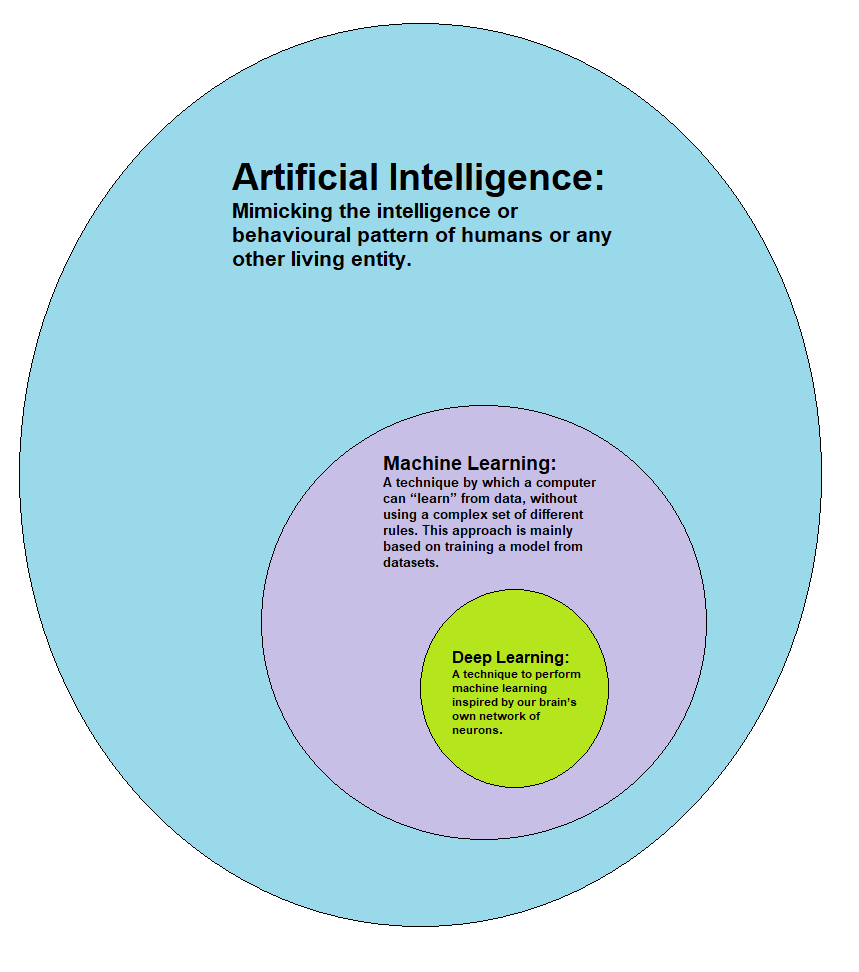
Artificial Intelligence (AI) is the broadest field. It's the overarching idea of creating machines that can simulate human intelligence, from reasoning and problem-solving to understanding language.
Machine Learning (ML) is a subset of AI. It’s one of the primary ways we achieve artificial intelligence. ML focuses on building systems that can learn from and make predictions on data.
Deep Learning (DL) is a specialized subset of machine learning. It uses complex structures called neural networks, which are loosely inspired by the human brain, to find intricate patterns in large amounts of data. Deep learning is the engine behind many of today's most advanced AI applications, like self-driving cars and voice assistants.
How Machines Learn
A machine learning model's training style depends on the problem it needs to solve and the type of data available. There are three main approaches.
Supervised Learning
noun
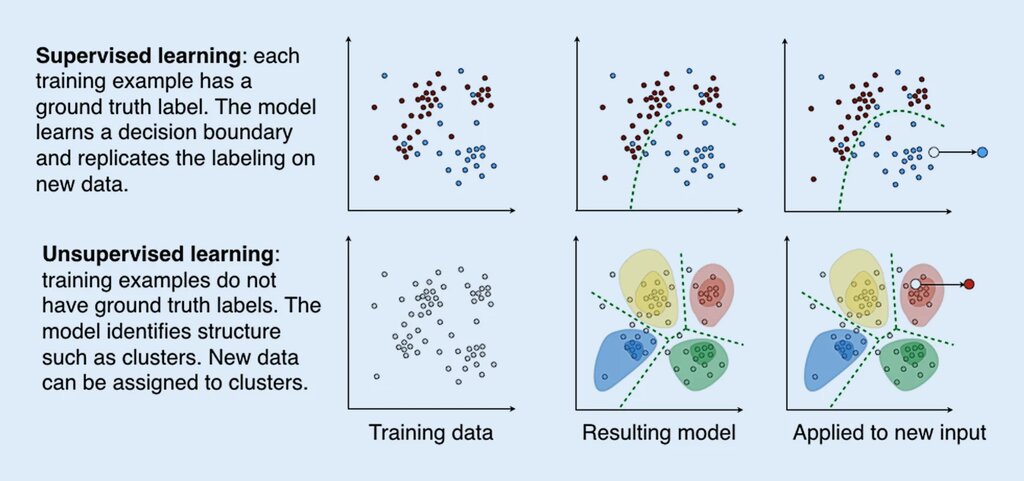
Learning from data that has been labeled with the correct answers. The goal is to learn a mapping function that can predict the output for new, unlabeled data.
This is the most common type of machine learning. It's like studying for a test with a complete answer key. The algorithm is given a dataset where each data point is tagged with the correct outcome or label. For example, to build a model that predicts house prices, you would feed it data on thousands of houses, each labeled with its final sale price. The model learns the relationship between the features of a house (like square footage and number of bedrooms) and its price.
Supervised learning is best for prediction tasks, such as forecasting sales or classifying images.
Unsupervised Learning
noun
Learning from data that has not been labeled or categorized. The algorithm tries to identify patterns, structures, or clusters within the data on its own.
Here, the algorithm gets no answer key. It is given a dataset and must find its own patterns and structures within it. Think of organizing a massive, unsorted pile of photos. You might start grouping them by a common theme: photos of beaches here, photos of cities there. An unsupervised learning algorithm does something similar, identifying hidden groupings in the data. This is useful for tasks like customer segmentation, where you want to find natural groupings of customers based on their behavior.
Reinforcement Learning
noun
A type of learning where an agent learns to make decisions by performing actions in an environment to achieve a goal. It learns through trial and error, receiving rewards for good actions and penalties for bad ones.
This approach is about learning through trial and error. An algorithm, or "agent," interacts with an environment. It receives rewards for actions that get it closer to a goal and penalties for actions that don't. It's like training a dog to do a trick. You give it a treat (a reward) when it does it right. Over time, the agent learns which sequence of actions leads to the biggest reward.
Reinforcement learning is the powerhouse behind AIs that can master complex games like Go or chess, and it’s also used in robotics to teach robots how to perform physical tasks.
The Machine Learning Pipeline
Developing a machine learning model isn't a single step; it's a multi-stage process often called a pipeline. While the details can vary, the core journey from idea to a working model generally follows a consistent path.
1. Data Collection: Every project starts with data. This could come from anywhere: spreadsheets, databases, user activity logs, or sensors. The quality and quantity of this data are crucial for the model's success.
2. Data Preprocessing: Raw data is almost never ready to be used. It's often messy, with missing values, errors, or inconsistencies. This step involves cleaning and transforming the data into a usable format. This is often the most time-consuming part of the process.
3. Modeling: This is where the learning happens. A machine learning algorithm is chosen based on the problem (e.g., classification, regression), and it's trained on the prepared data. The algorithm adjusts its internal parameters to find patterns.
4. Evaluation: Once the model is trained, it needs to be tested to see how well it performs on new, unseen data. This step measures the model's accuracy and ensures it can generalize to real-world situations without just memorizing the training data.
5. Deployment: If the model's performance is good enough, it's put into production. This means integrating it into a software application, a website, or a business process where it can start making predictions on live data.
This pipeline isn't always a straight line. Often, it's a cycle. A model in deployment is monitored, and its performance might lead to collecting new data and retraining it to keep it accurate and relevant.
Which of the following statements best describes the relationship between Artificial Intelligence (AI), Machine Learning (ML), and Deep Learning (DL)?
A bank wants to group its customers into different segments based on their transaction history and spending habits, but it doesn't have any predefined labels for these groups. Which type of machine learning would be most suitable for this task?
You've now covered the core concepts of what machine learning is, how it fits into the world of AI, and the different ways it can learn. These fundamentals are the building blocks for understanding every other topic in the field.