Machine Learning Fundamentals
Introduction to Machine Learning
What Is Machine Learning?
Machine learning is a way for computers to learn from data and make decisions without being explicitly programmed for every task. Think of it like teaching a child. You don't write a rule for every single cat they might see. Instead, you show them pictures of cats, and they learn to recognize them on their own.
In short, machine learning systems find patterns in data and use those patterns to make predictions about new, unseen data.
This ability to learn from experience is what makes machine learning so powerful. It's the engine behind personalized recommendations on streaming services, spam filters in your email, and even the technology that helps doctors diagnose diseases earlier. Instead of relying on a rigid set of instructions, these systems adapt and improve as they are exposed to more information.
Four Ways to Learn
Machine learning isn't a single technique but a collection of approaches. The method used depends on the problem you're trying to solve and the kind of data you have. These approaches are often categorized into four main types.
Supervised Learning
noun
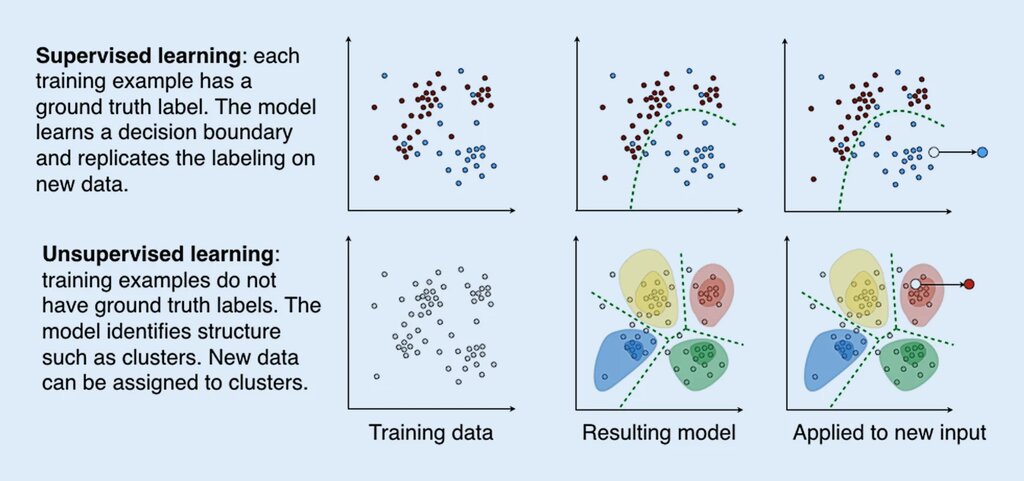
The machine learns from data that is already labeled with the correct answers. It's like studying with flashcards that have both a question and an answer.
The goal in supervised learning is to predict an outcome for new, unlabeled data. This breaks down into two main types of problems:
- Classification: The goal is to predict a category. Is this email spam or not? Does this medical image show a tumor?
- Regression: The goal is to predict a continuous value. What will the price of this house be? How many customers will visit the store tomorrow?
Unsupervised Learning
noun
The machine learns from data that has no labels. The goal is to find hidden patterns or structures within the data on its own.
Here, the algorithm is like a detective thrown into a room full of clues with no instructions. It has to make sense of everything by itself. Common tasks include:
- Clustering: Grouping similar data points together. For example, segmenting customers into different marketing groups.
- Association: Discovering rules that describe large portions of your data, like finding that customers who buy bread also tend to buy milk.
Semi-Supervised Learning
This is a mix of the first two. It uses a small amount of labeled data and a large amount of unlabeled data. This is useful when labeling data is expensive or time-consuming. For instance, a photo service might use the few faces you've manually tagged to help identify those same people in hundreds of other untagged photos.
Reinforcement Learning
This type of learning is about taking actions in an environment to maximize a reward. It’s like training a dog with treats. The algorithm, or "agent," learns through trial and error. It gets a reward for good actions and a penalty for bad ones.
Reinforcement learning is the strategy behind AIs that can play complex games like Chess or Go. It's also used in robotics, where a robot learns to walk by trying different movements and getting feedback on which ones lead to stable forward motion.
Machine Learning in the Real World
Machine learning is already a part of your daily life, often in ways you might not notice. It powers a vast range of applications across many industries.
| Application | Industry | How it Works |
|---|---|---|
| Recommendation Engines | Entertainment | Analyzes your past viewing or listening habits to suggest new content you might like. |
| Fraud Detection | Finance | Identifies unusual patterns in transaction data that could indicate fraudulent activity. |
| Medical Diagnosis | Healthcare | Analyzes medical images (like X-rays or MRIs) to spot signs of disease. |
| Language Translation | Technology | Learns patterns from millions of translated texts to provide instant translations. |
| Autonomous Vehicles | Automotive | Uses real-time data from sensors to make driving decisions and navigate roads safely. |
These examples are just the beginning. As we collect more data and develop better algorithms, machine learning will continue to find new ways to solve problems and change how we live and work.
Let's test your understanding of these core concepts.
What is the fundamental goal of machine learning?
An email provider wants to develop a system that automatically sorts incoming emails into 'Spam' or 'Not Spam'. Which type of machine learning problem is this?
You now have a solid foundation in what machine learning is and the different ways a system can learn. The key takeaway is that it's all about using data to find patterns and make predictions.