Machine Learning for Fermentation
Introduction to Machine Learning
Learning Without Instructions
Imagine trying to teach a computer to recognize a cat. You could write millions of lines of code describing pointy ears, whiskers, and a tail. But what about all the different breeds, colors, and poses? The rules would get impossibly complex.
Machine learning takes a different approach. Instead of giving the computer explicit instructions, you show it thousands of cat pictures. The computer then learns the patterns on its own. This is the core of machine learning: systems that learn from data, identify patterns, and make decisions with minimal human intervention.
Machine learning is the science of getting computers to act without being explicitly programmed.
This ability to learn from experience is what makes machine learning so powerful. It allows us to solve problems that are too complex for traditional programming, from recommending movies to detecting diseases. Instead of coding rules, we let the data do the talking.
Three Ways Machines Learn
Just like people, machines can learn in different ways. The method depends on the type of data available and the problem you're trying to solve. The three main types are supervised, unsupervised, and reinforcement learning.
Supervised Learning
noun
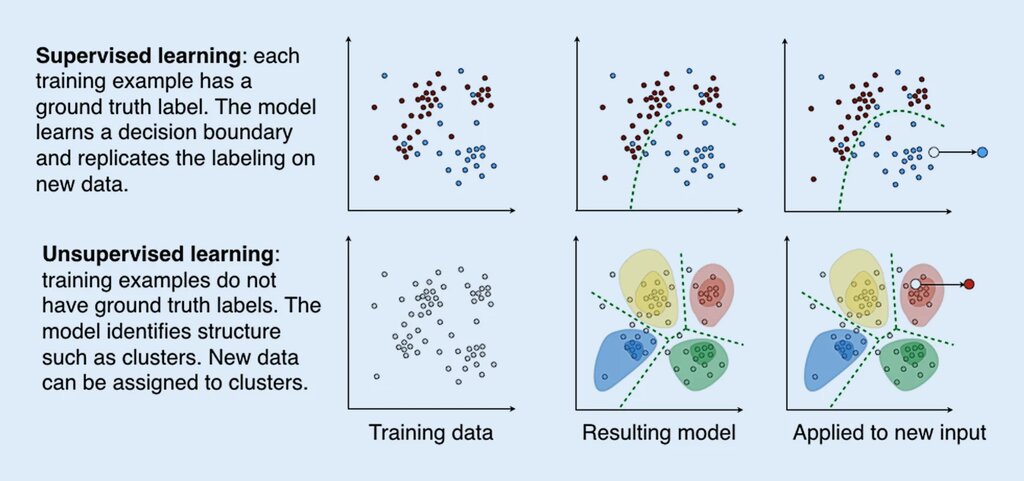
The machine learns from data that is already labeled with the correct answers. It's like learning with a teacher.
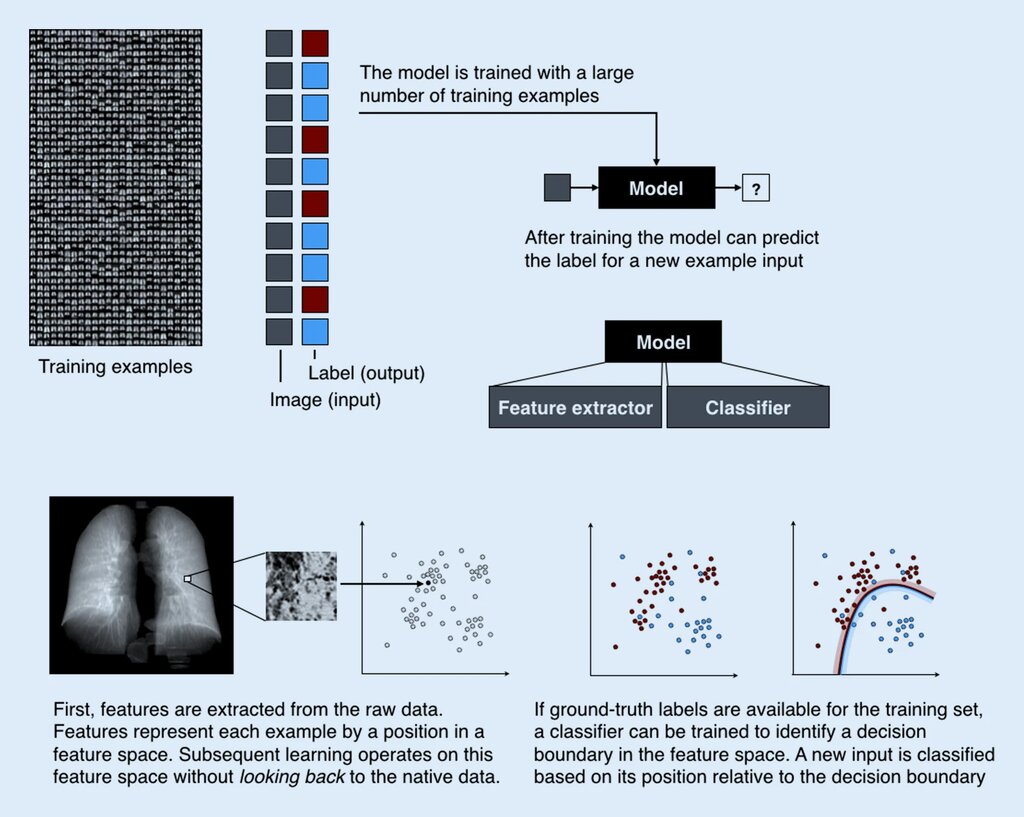
In supervised learning, the algorithm is given a dataset where the outcomes are already known. The goal is to learn the mapping function that turns inputs into outputs. For example, to predict house prices, you would train a model on a dataset of houses where you already know their size, location, and final sale price.
Unsupervised Learning
noun
The machine learns from unlabeled data, finding hidden patterns and structures on its own. It's like learning without a teacher.
With unsupervised learning, there are no correct answers to learn from. The algorithm sifts through the data and tries to find a meaningful structure. This is useful for tasks like identifying customer segments or finding anomalies in a system.
Finally, there's reinforcement learning.
Reinforcement Learning
noun
The machine learns by performing actions and receiving rewards or penalties. It's like learning through trial and error.
This approach is all about taking suitable actions to maximize reward in a particular situation. The algorithm isn't told which actions to take, but instead must discover which actions yield the most reward by trying them. This is common in robotics, game playing, and navigation systems.
The Building Blocks
Regardless of the learning type, all machine learning systems are built from a few key components: datasets, features, and models.
Think of it like cooking. The dataset is your ingredients, features are how you prepare them (chopping, measuring), and the model is your recipe.
A dataset is simply a collection of data. This is the raw material the machine learns from. For our cat identifier, the dataset would be thousands of images. For predicting house prices, it would be a spreadsheet with information about many different houses. The quality and quantity of this data are critical for success.
A feature is an individual measurable property or characteristic of the data. It's a piece of information that the model uses to make a prediction. In our house price example, features would be things like the number of bedrooms, square footage, and the age of the house. For a spam filter, features might include the sender's email address, the use of certain words, or the time the email was sent.
Finally, the model is the output of the machine learning process. After being trained on the dataset, the model is the system that makes predictions or decisions. It's the 'brain' that has learned the patterns from the features. You can give it new, unseen data, and it will use what it learned to predict an outcome.
Understanding these basic concepts is the first step in harnessing the power of machine learning. Now, let's test your knowledge.
What is the core principle that distinguishes machine learning from traditional programming?
You are building a system to identify spam emails. You provide the algorithm with a large dataset of emails that have already been manually labeled as 'spam' or 'not spam'. What type of machine learning is this?
These core ideas—learning from data, the different types of learning, and the fundamental components—form the foundation of every machine learning application.