Machine Learning for CFD
Introduction to Computational Fluid Dynamics
What is CFD?
Imagine trying to predict exactly how water will flow out of a tap or how air will move over a speeding race car. The patterns are incredibly complex, full of swirls and eddies. For centuries, engineers relied on physical experiments, which are often expensive and time-consuming. Today, we have another powerful tool: Computational Fluid Dynamics, or CFD.
CFD is a way to simulate fluid flow using computers. It turns your laptop or a supercomputer into a virtual wind tunnel or water channel. Instead of building physical prototypes, we can create digital models and watch how fluids interact with them. This allows engineers to test thousands of designs for cars, airplanes, and even medical devices, all before building anything in the real world.
At its core, CFD breaks down a large, complex fluid dynamics problem into millions of tiny, simple calculations that a computer can solve one by one.
The Rules of Flow
Fluids don't just move randomly; they follow a strict set of physical laws. These laws can be described mathematically by a set of equations known as the Navier-Stokes equations. They are the cornerstone of fluid dynamics.
Think of these equations as the ultimate rulebook for fluids. They're based on three fundamental principles of conservation you might remember from physics:
- Conservation of Mass: Matter isn't created or destroyed. The amount of fluid flowing into a space must equal the amount flowing out, unless it's being compressed or expanded.
- Conservation of Momentum: This is Newton's Second Law () applied to fluids. A fluid's velocity will only change if a force is applied to it, like pressure or friction (viscosity).
- Conservation of Energy: Energy can't be created or destroyed, only transferred. This becomes important when dealing with heat transfer in the fluid.
The Navier-Stokes equations bundle these principles into a precise mathematical form. For a standard, incompressible fluid, the momentum equation looks like this:
This equation might look intimidating, but it's just a detailed accounting of all the forces acting on a tiny parcel of fluid. Because these equations are so complex, especially for turbulent flows, they are almost impossible to solve perfectly with pen and paper. This is where the "computational" part of CFD comes in.
Slicing Up the Problem
To make the problem solvable for a computer, CFD uses a process called discretization. We take the continuous space the fluid flows through—like the inside of a pipe or the air around an airplane wing—and chop it up into many small, discrete pieces. This grid of pieces is called a mesh.
One of the most common discretization techniques is the Finite Volume Method (FVM). In this method, the space is divided into a grid of small cells or "volumes." The computer then solves the Navier-Stokes equations for each individual cell, calculating properties like pressure and velocity within that tiny space.
By solving for each cell and ensuring the solution is consistent between neighboring cells, the software builds a complete picture of the fluid flow across the entire domain. The smaller the cells, the more accurate the simulation, but the more computational power it requires.
Building the Grid
Creating the mesh is one of the most critical steps in a CFD simulation. The quality of the mesh directly impacts the accuracy of the results. This process, known as mesh generation, can be as much an art as a science.
There are two main types of meshes:
- Structured Meshes: These are organized in a regular, grid-like pattern. They are computationally efficient but can be difficult to apply to complex, curved geometries.
- Unstructured Meshes: These use cells of varying shapes and sizes, often triangles or tetrahedrons. They are much more flexible and can conform to virtually any shape, which is why they are very common in CFD.
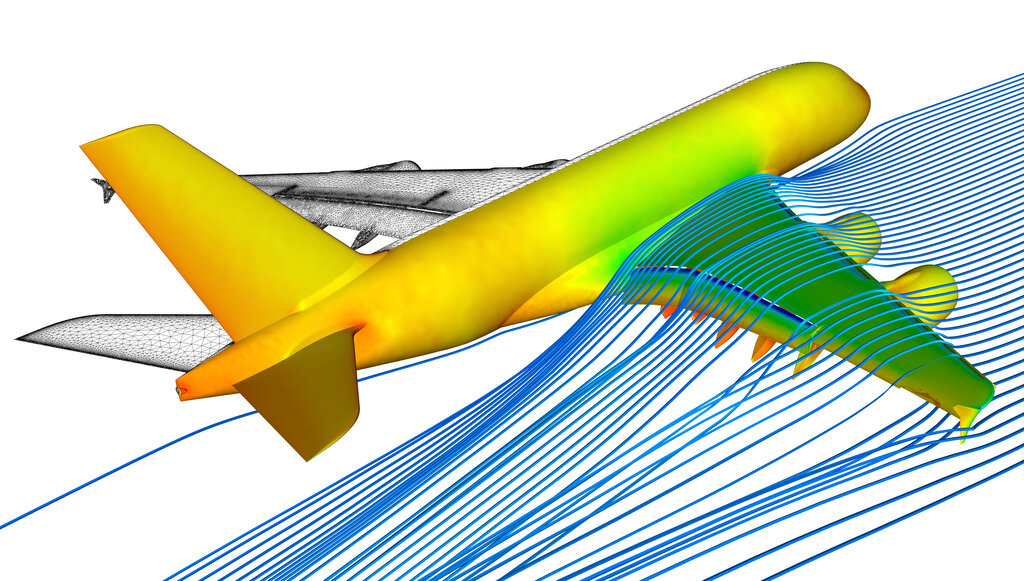
A good mesh is often a hybrid of different techniques. For example, engineers might use very fine, structured cells right next to the surface of an object—in an area called the boundary layer where flow changes rapidly—and larger, unstructured cells further away to save on computation time.
The Solvers
Once the mesh is created and the boundary conditions are set (e.g., specifying the fluid's inlet velocity and outlet pressure), the CFD solver gets to work. The solver is the software engine that iteratively solves the discretized Navier-Stokes equations for every cell in the mesh until the solution converges, meaning the results are stable and no longer changing significantly with each iteration.
There are many different CFD software packages available. Some are commercial, offering user-friendly interfaces and extensive support, while others are open-source and highly customizable. Two of the most well-known are:
- ANSYS Fluent: A widely used commercial CFD package known for its robust and comprehensive features.
- OpenFOAM: A powerful, open-source C++ toolbox for CFD, popular in both academia and industry for its flexibility.
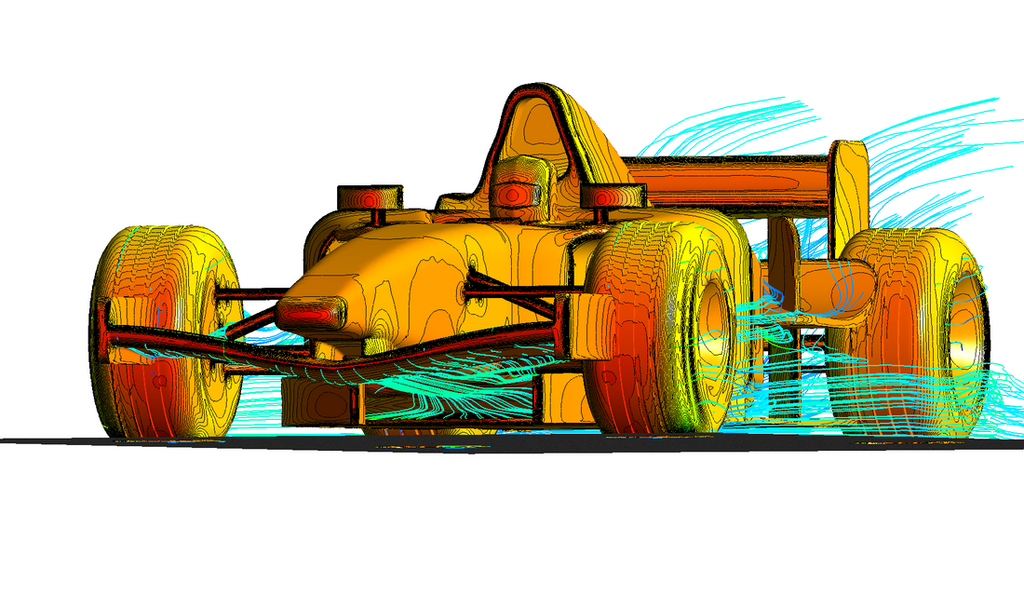
Regardless of the specific software, the fundamental process is the same: define the problem, generate a high-quality mesh, solve the governing equations, and then analyze the results. This process gives us incredible insight into the unseen world of fluid motion.
What is the primary purpose of Computational Fluid Dynamics (CFD)?
The Navier-Stokes equations, which form the mathematical foundation of CFD, are based on which set of fundamental physical principles?